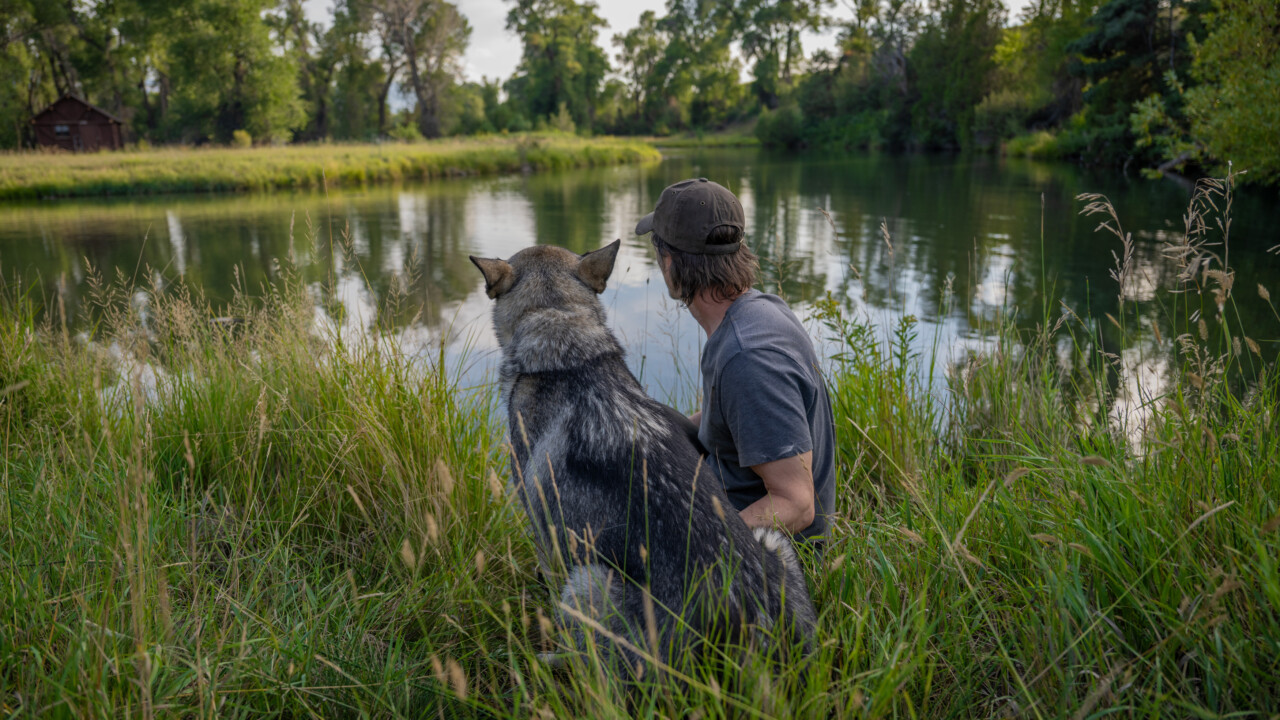
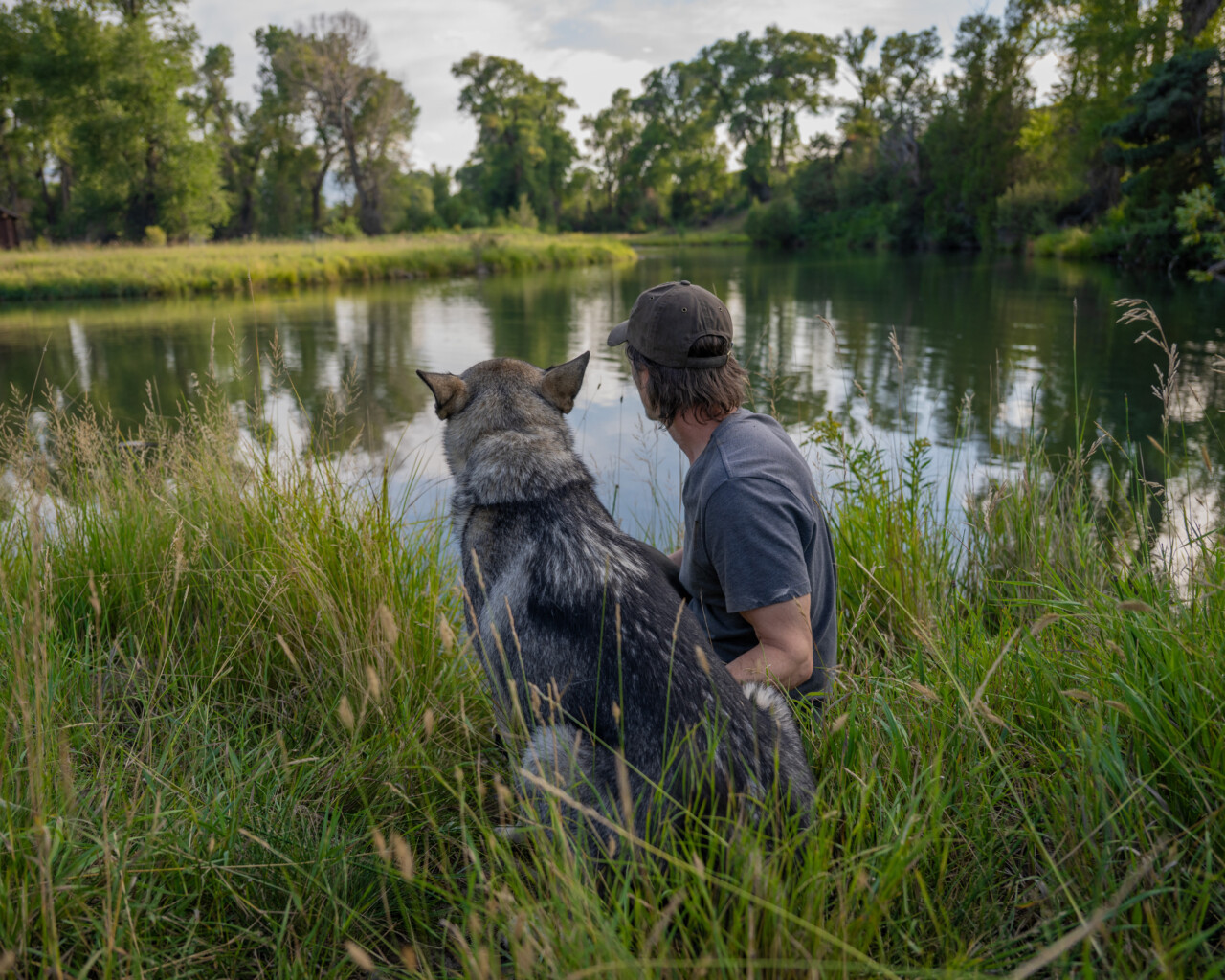
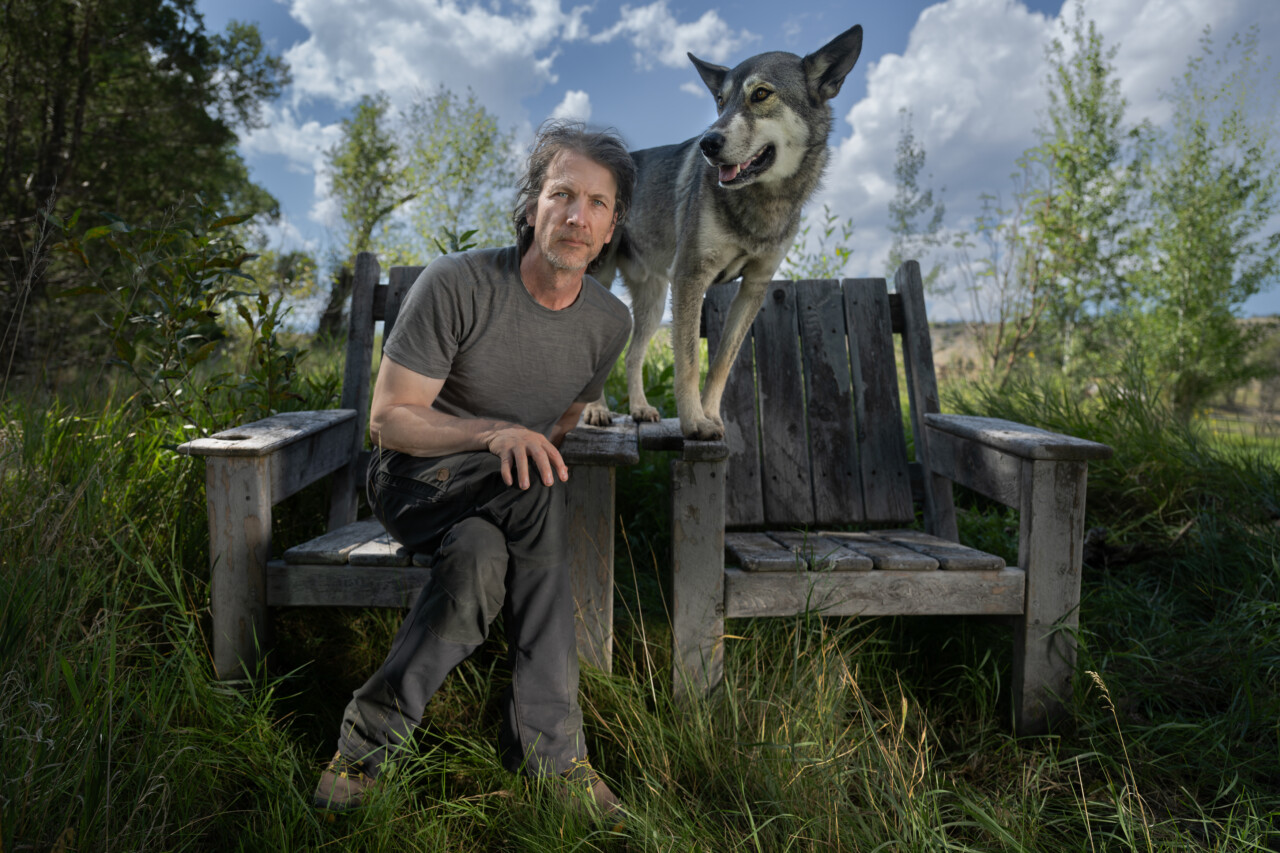
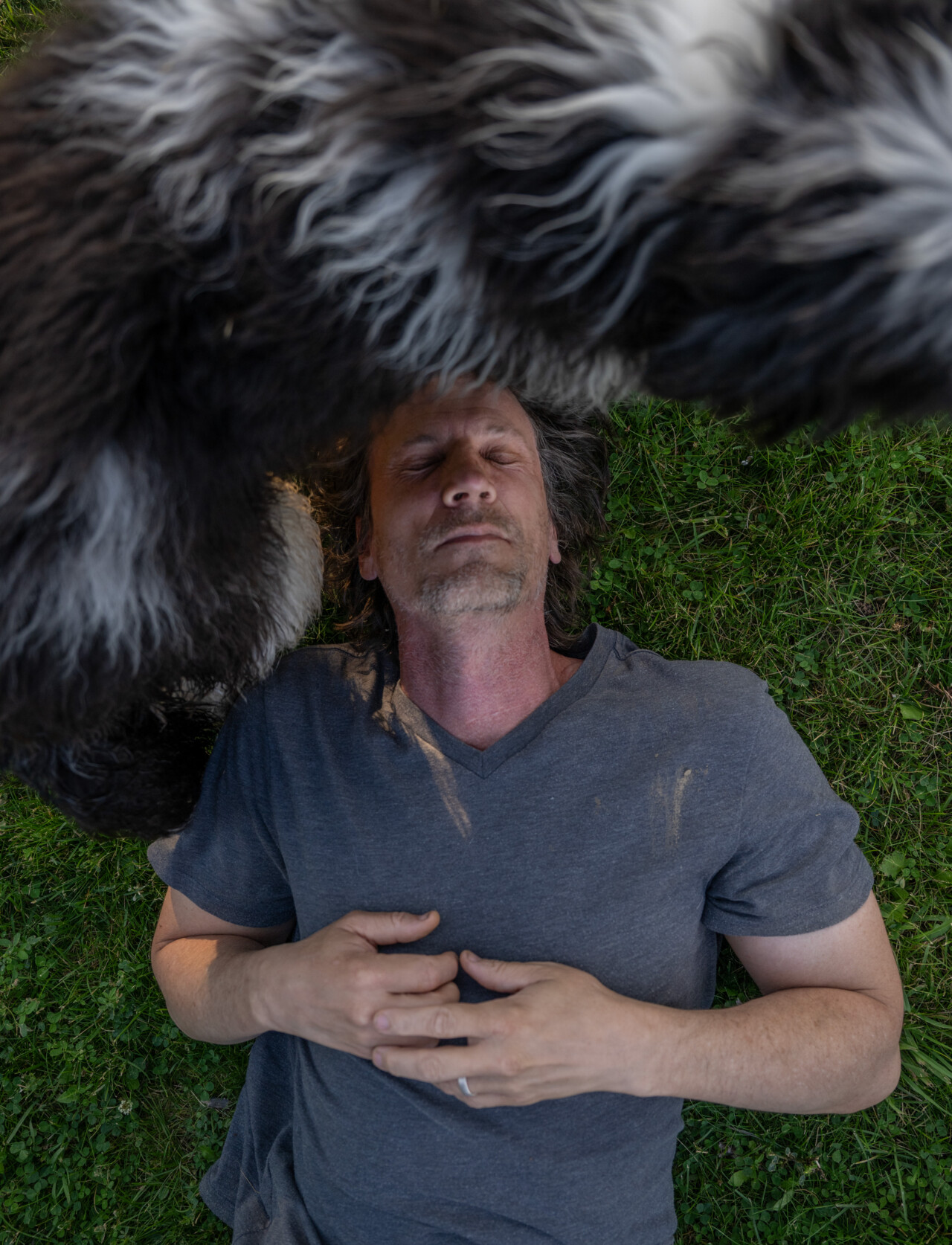
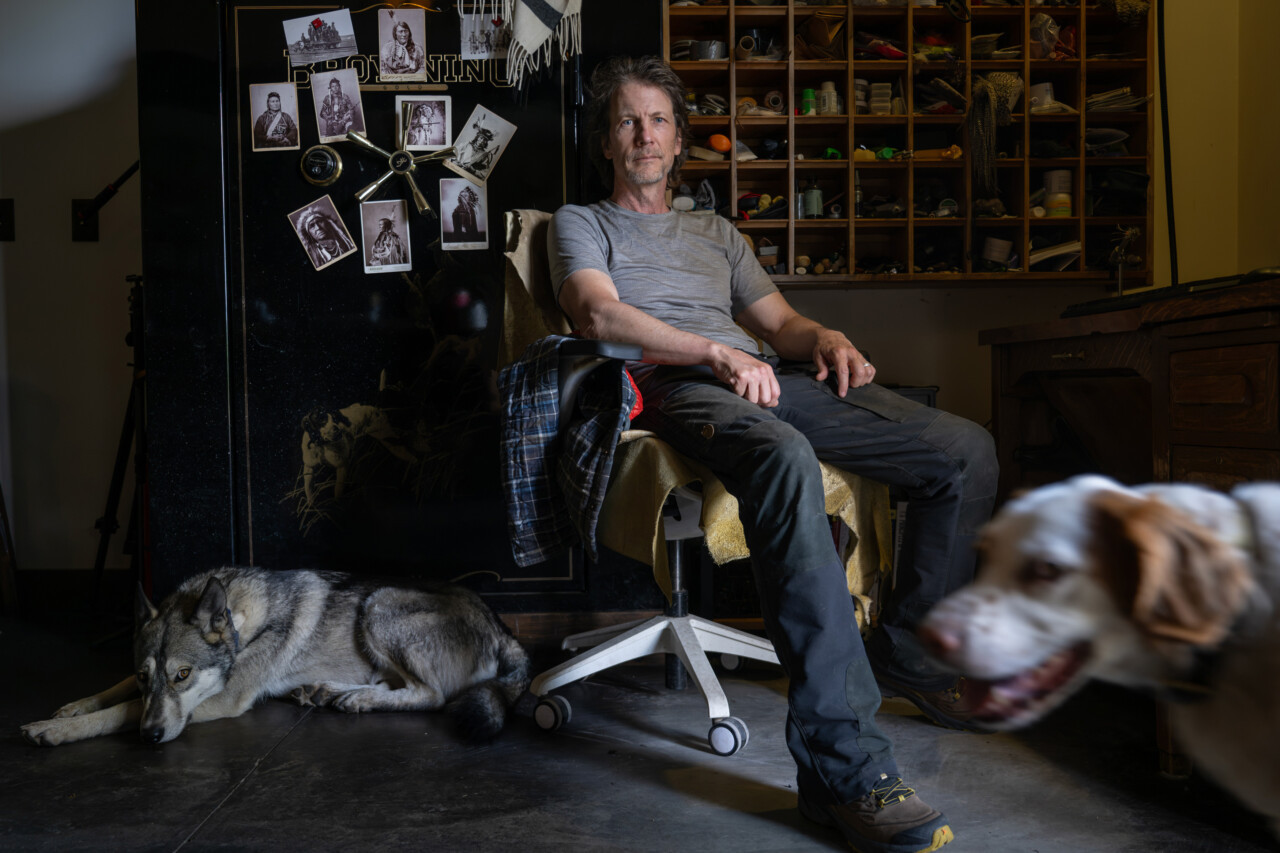
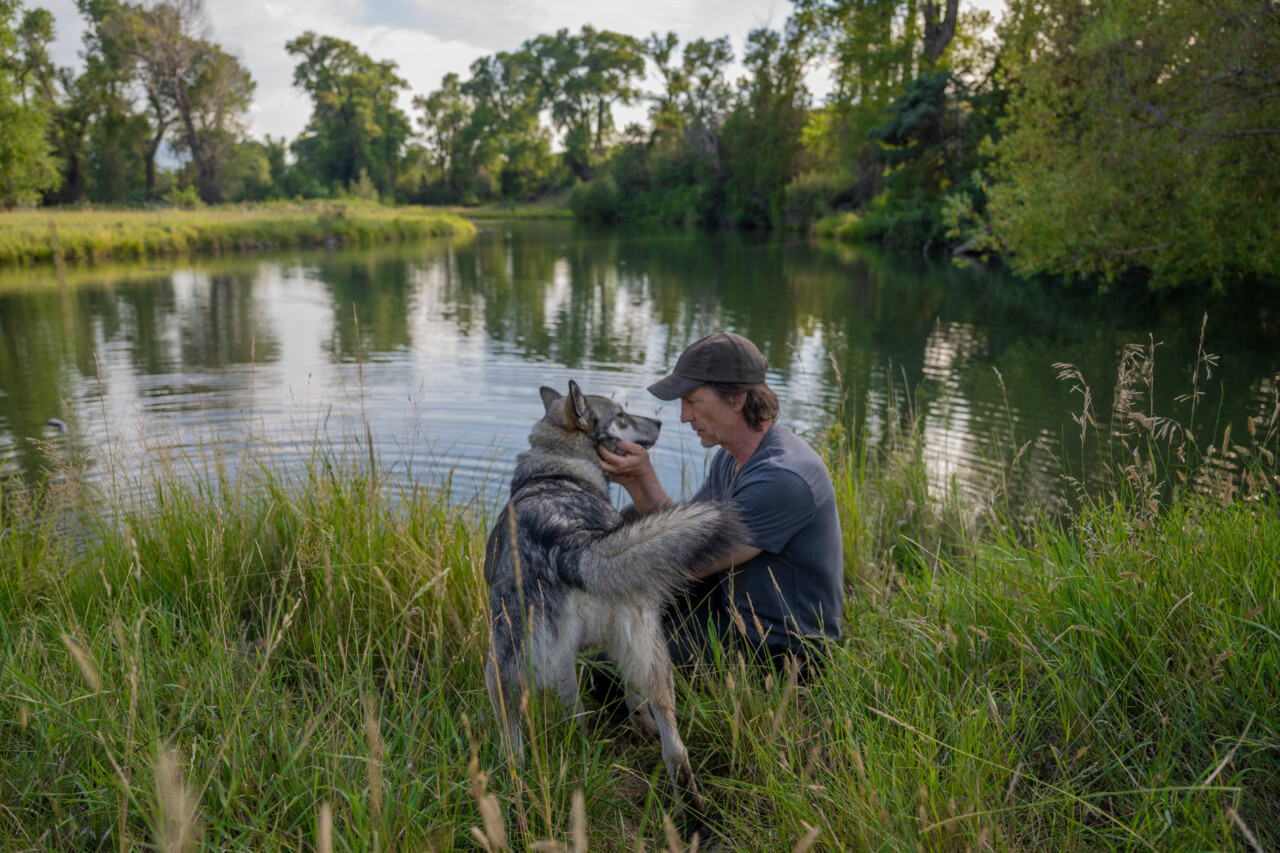

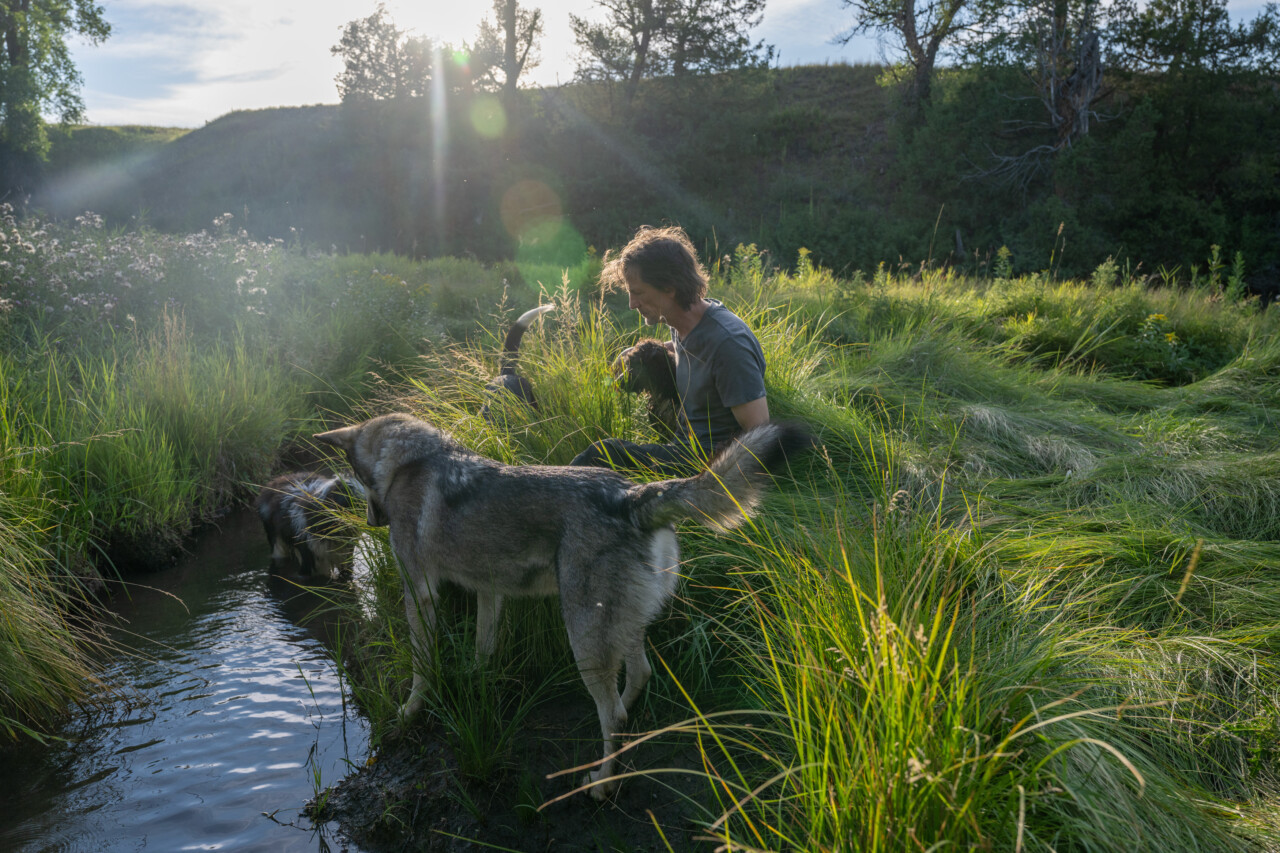
Dr. Jeff Reed, cofounder of The Cry Wolf Project, sits with his pet dog.
Words by Alexandra Marvar
Photographs by Ami Vitale
When wolves hear another pack’s chorus howl rise in the distance, they stop. They listen. And according to naturalist Rick McIntyre, who has logged more than 100,000 wolf sightings and filled more than 12,000 pages of field notes near his home in Montana, they calculate: “Do those guys have more members than we do? Or do we have more members than they do?”
In January 1995, a momentous—and hotly debated—experiment commenced. Fourteen wild wolves were captured in Alberta, Canada and brought by plane and truck to 1-acre acclimation pens stationed throughout Yellowstone National Park. After 10 weeks, they were released into the wild. Seventeen more arrived from British Columbia the following year. It was the world’s first deliberate attempt to return a top-level carnivore to an ecosystem of this size. Wolf howls were audible in Yellowstone again after seven decades.
McIntyre, then a Yellowstone National Park interpreter, hoped he might catch a glimpse that first season. He set himself a modest goal: If he could see just one wolf—even a tail, a hind leg, a lupine flicker through the trees—he’d be “the happiest guy in the world.” On his very first day of searching, he saw the entire six-member pack.
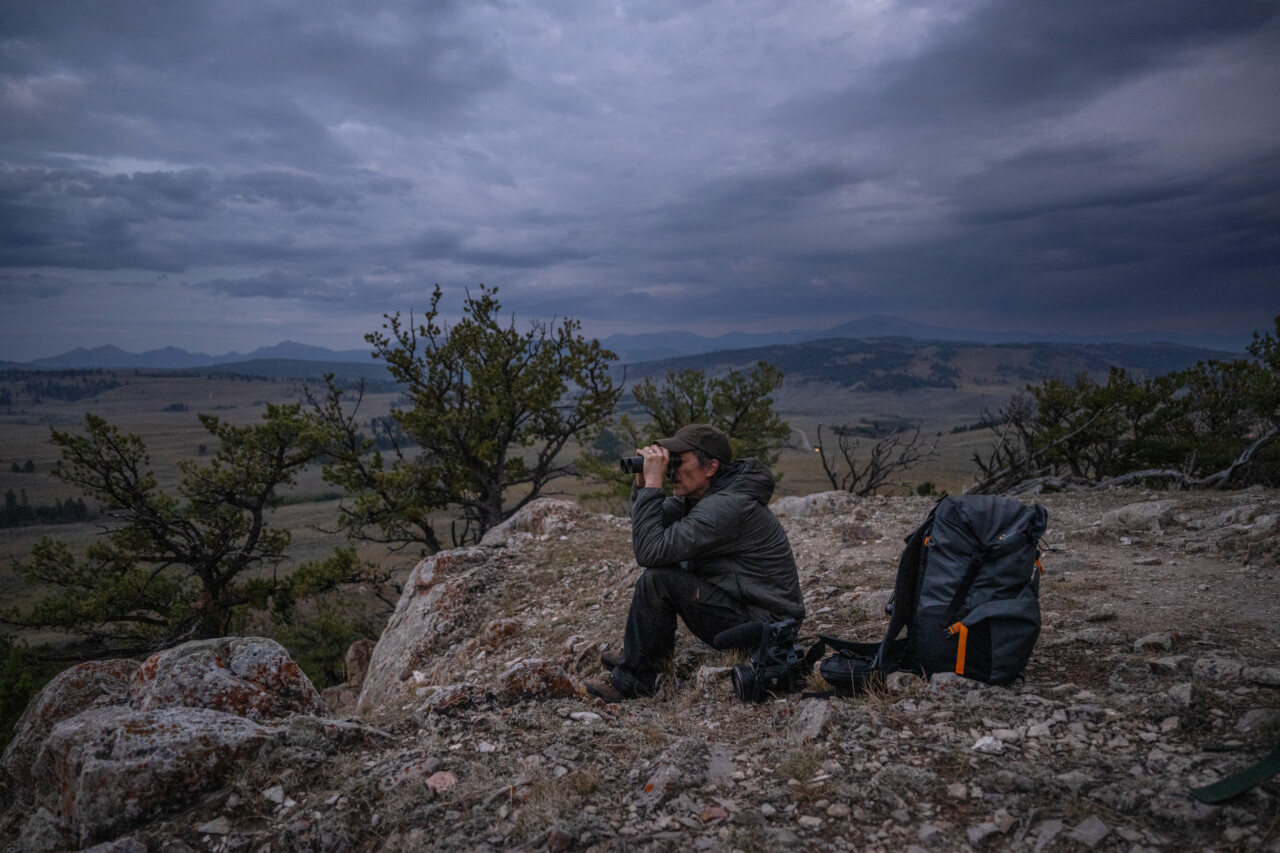
He has watched wolves nearly every morning for the 30 years since, hiking into Yellowstone and looking out 1.5 miles from a viewing point. Only a quintuple bypass heart surgery interrupted his daily streak; and even then, only briefly. Along the way, McIntyre amassed an extraordinary trove of knowledge about Yellowstone’s wolves, chronicling individual lives and becoming a kind of historian of certain packs. He’s one of a small group of dedicated wolf-watchers to approach the limits of what human observation alone can reveal.
Today, Yellowstone National Park is home to more than 80 wolves across seven packs with family bonds, social relationships, personalities, and hierarchies. Within Yellowstone, a wolf’s greatest threat is another wolf; beyond the park’s perimeter, its greatest threat is humans.
Wolves have always counted one another by sound. Since their return to the Greater Yellowstone region, counting wolves has become important to people, too.
Across most of Wyoming, wolves can be shot on sight without a license or designated hunting season. Idaho Fish and Game in 2023 approved a plan to reduce the state’s estimated wolf population from 1,300 to 500. In Montana, where McIntyre lives, killing 452 of the state’s nearly 1,100 wolves was approved in August 2025. But this summer, Montana Fish, Wildlife & Parks announced the population estimate on which it based this number had been wrong: The state, which models wolf populations based on surveying hunters and then applying estimated population sizes rather by counting, had overestimated. The actual figure, officials determined, could be closer to 700—or as low as 618. A take of 452 was intended to be less than half the population; instead, it could account for most of it.
To straighten out these numbers, wolf howl archivist Jeff Reed proposed, why not count wolves the way wolves count wolves: by listening? Recorders spaced 6 kilometers apart could pick up howls within a nearly 5-mile radius and potentially produce a more accurate—and less expensive—population estimate, according to Reed. He pitched the approach to Montana wildlife officials. “Population estimates in ecology are the holy grail,” he told Atmos. “All that research is happening right now in Yellowstone.”
For Reed, though, more accurate counting is only the beginning.
Reed spent a year staring at a 48-inch monitor, poring over visualizations of nature sounds. They were spectrograms—neon-on-black graphic depictions of pitch and amplitude—and he searched them one at a time, working through roughly 300,000 hour-long files for the visual signature of a wolf’s howl.
“It’s probably the most iconic sound in nature, at least in the Northern Hemisphere,” Reed said of the howl. “It basically means ‘Here I am. Where are you?’” But it’s just one of more than 20 vocalizations wolves learn over their lifetimes, he added, and every wolf’s voice may be unique, much like a human’s.
When Reed was young, he thought he might become a pastor or a missionary. He studied linguistics and earned a doctorate researching extinct languages, hoping to decode them and interpret previously untranslated passages of ancient religious texts. But, he found, jobs in this field were scarce. He eventually pivoted and brought that background into computational linguistics in Silicon Valley.
Reed he returned home to Montana’s Paradise Valley about a decade ago, settling in a house along the Yellowstone River about 25 miles from the park entrance. On a lark, he began recording and cataloguing bird sounds. Three years later, he turned to wolves.
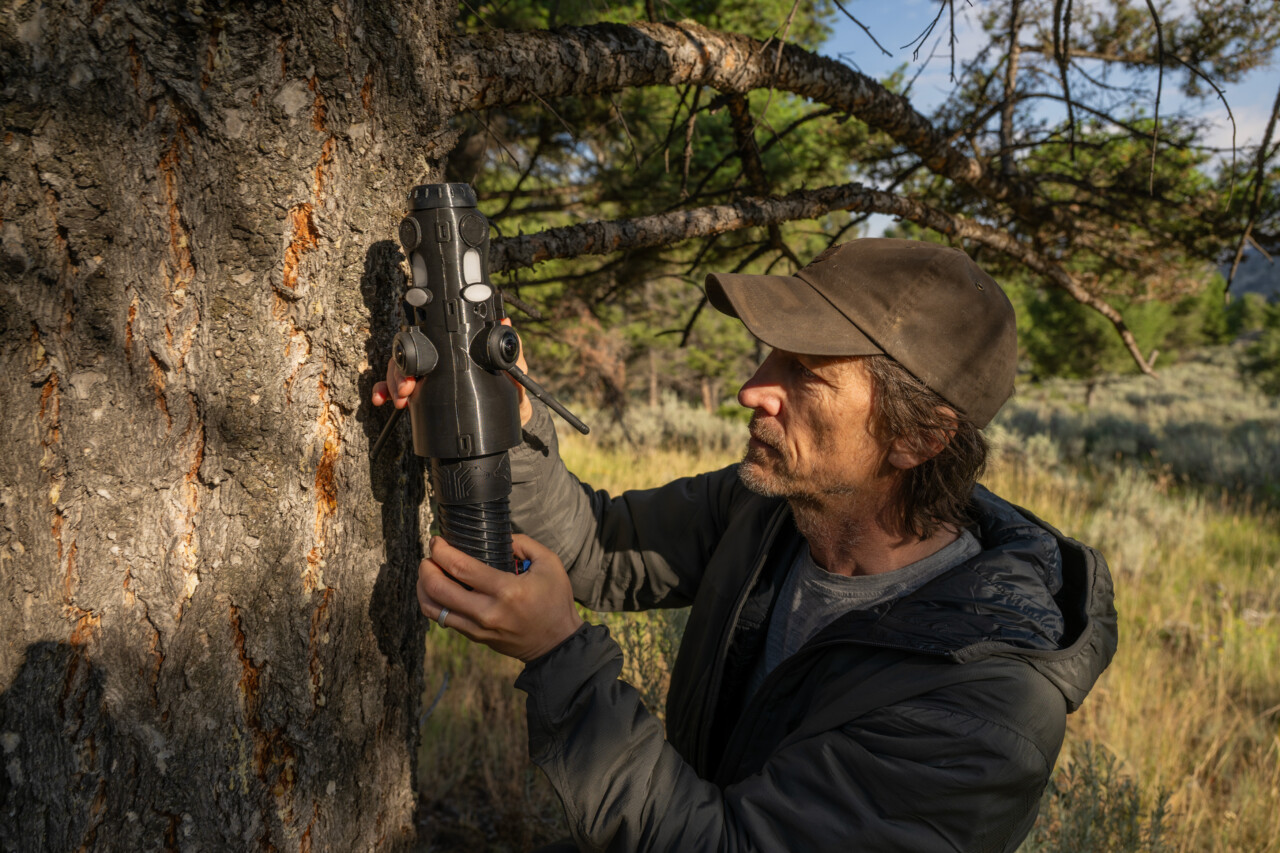
Yellowstone researchers have been recording wolves since their reintroduction, but Reed thought their systems could benefit from an upgrade. “I’m a technologist, so I was always like, ‘Oh, I can do it better.’ I started building my own,” Reed said. “What I wanted to do was create a device that replaces me: It sits in a tree and listens, looks, smells, and feels, and it does that on a solar panel, year-round.”
The result was the GrizCam, developed by Grizzly Systems, a company Reed cofounded. Several dozen GrizCams operating 24/7 were installed throughout the park with Reed’s help, in his capacity as a research affiliate with the park’s Yellowstone Center for Resources. The effort is part of the Yellowstone Wolf Project and has so far yielded terabytes of sounds and images. Stahler of the Yellowstone Wolf Project described the effort as “the most detailed acoustic study of wild wolves ever conducted.”
Reed’s own Cry Wolf Project extends wolf-listening beyond park boundaries and onto private land across Greater Yellowstone, an ecosystem roughly the size of Ireland. He also built free software used by citizen scientists in Italy, New Mexico, and the Netherlands to isolate wolf sounds from their recordings.
Cry Wolf has amassed about a century’s worth of audio—far too much for any person to review manually. Instead, Reed used the 300,000 files he labeled by hand to train an AI model to find wolf howls on its own.
The Grizzly Systems team doesn’t sell AI wolf classifier software commercially. Reed knows the same technology used to study wolves could also be used against them. “If I can locate where an animal is vocalizing from, I can go kill it,” he said.
And the devices don’t just record wolves. They record everything. The software processing their output is programmed to blur human faces or delete human conversations, Reed said.
“It’s probably the most iconic sound in nature, at least in the Northern Hemisphere. It basically means ‘Here I am. Where are you?’”
He argues the technology is no more invasive than carrying a cell phone. But the team also said the GrizCam can record human conversations from hundreds of yards away and identify the make and model of motor vehicles by their engine sounds. At a moment of intense backlash against surveillance technology companies, the idea of super-recorders running 24/7 on public land could be controversial.
One organization already interested in the data is Colossal Biosciences, the John Hammond-esque Texas start-up attempting to resurrect the woolly mammoth, which also claimed to have used ancient DNA to bring lab-bred dire wolves “back from a 12,000-year extinction.” Colossal’s nonprofit arm funded a rollout of GrizCams in Yellowstone and plans to help train AI to classify individual wolves.
“This is the cheapest, best way to learn more about these animals and tell their stories and try to get protections for them,” Reed said. “The only question is, will GrizCam be used to protect nature or harm it?”
The Grizzly Systems team designed the devices to require minimal maintenance from the researchers using them. The solar-powered recorders need no battery swaps or memory-card retrievals, sparing biologists day-long hikes through the snow, Reed said. “I’m trying to engineer to make their labor [costs] go down so they can do what they do really well, which is biology.”
The effort to understand wolves through sound goes back decades. In the 1950s and ‘60s, researchers lugged battery-powered, reel-to-reel tape recorders and parabolic microphones into wolf country, waiting for the animals to break into a chorus—or howling at them until they howled back.
But capturing their quieter, everyday sounds has always been harder. Field biologists generally prefer observers to remain at least 100 yards from a wolf pack. “Well, you can’t hear anything 100 yards away,” said documentary cinematographer Jim Dutcher. Sound recordist Jamie Dutcher added that seeing without hearing can’t give you the full picture—nor can the opposite.
In the 1990s, while making documentary films for ABC and the Discovery Channel, the husband-and-wife team devised a workaround. They spent six years living in a tented camp inside a vast fenced enclosure—the largest in the world—in Idaho’s Sawtooth Mountains. Here, the Dutchers explained, they raised and documented a captive wolf pack—a way to film wolves’ social behavior up close without putting nearly extinct-in-the-region wild wolves at risk.
While making their Emmy-winning documentary about the pack, Wolves at Our Door, Jamie Dutcher positioned a microphone outside their tent, its cord winding through the woods to a tape recorder inside. When the pack began a midnight chorus, she could press record from her cot.
Gradually, she learned to identify individual wolves by voice, the way one recognizes a friend by their hello on the phone. “They had distinctive voices,” she said. “You knew who was whining and who was howling … But I couldn’t tell you exactly what they were saying. I just didn’t have those tools.”
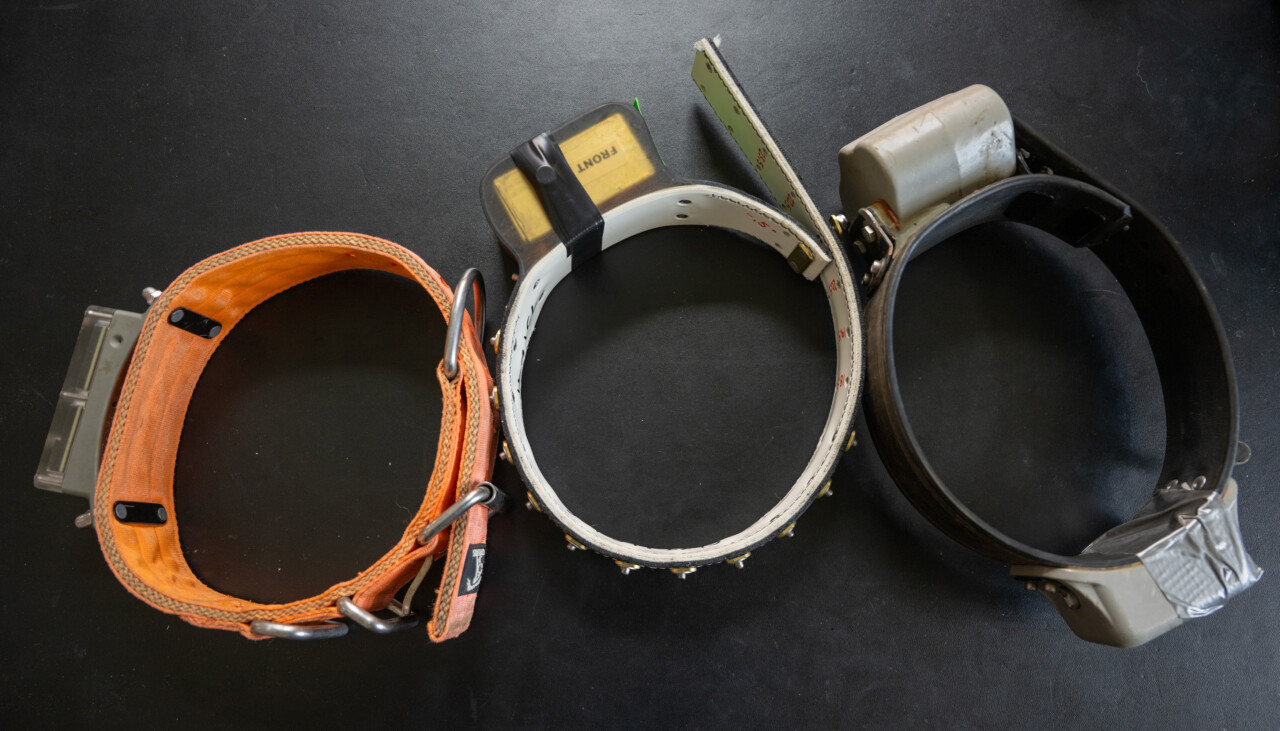
Today, the Dutchers run a national educational nonprofit out of their home city of Ketchum that helps people better understand wolves and helps fund wolf research, including Reed’s. Their hope is to see an end to collaring, an invasive practice that involves tranquilizing wolves with darts from helicopters and fitting them with radio-transmitter collars, then repeating the process when batteries need replacing. Researchers say wolves mostly ignore the collars once they are on.
Yellowstone wildlife biologist Dan Stahler already speculated that advanced bioacoustic monitoring might one day replace at least some of that work. The technology isn’t there yet, but Jamie Dutcher is eager for it. “We’ve always dreamed of this,” she said.
For now, bioacoustics can also make use of the collars themselves. Last year, researchers attached small recorders to collars designed to last about a month, tracking everywhere a wolf went. Reed heard howls, yips, whimpers, and what he and the Dutchers independently decided was the “Chewbacca” sound.
In context, Reed believes some of these vocalizations correspond to messages along the lines of: I love you. Stranger danger. Send back-up. “You learn a language by inserting yourself into culture and hearing it all the time,” he said.
Reed hopes the audio archive he is building—and the tools he’s developing to process it—will ultimately benefit researchers, ranchers using non-lethal wolf deterrents, and even wolves’ public reputation. Hearing a wolf chorus can be an entry point to seeing wolves in a new light, he argued, just as recordings of whale song in the 1970s helped galvanize the marine preservation movement.
The soundscapes captured by these autonomous recorders are now being assembled into what Reed described as the world’s largest library of wolf calls. “You start understanding something,” Reed said, “and that builds respect, and that builds conservation.”
Meanwhile, Rick McIntyre continues using his own tried-and-true methods. He wakes at 3:40 a.m., hikes up the mountain, and watches wolves through his scope from an unobtrusive distance. A few years ago, he logged his 100,000th wolf sighting.
When a family pulls over to ask what he’s looking at, he waves them over. “It’s really a transforming event in a person’s life to be in a national park and to watch a wolf pack,” he said. “They’re never going to forget it, and it’s pretty much guaranteed that they’re going to be on the side of wolves because of that.”
Join our membership community. Support our work, receive a complimentary subscription to Atmos Magazine, and more.
The People Learning to Understand Wolves