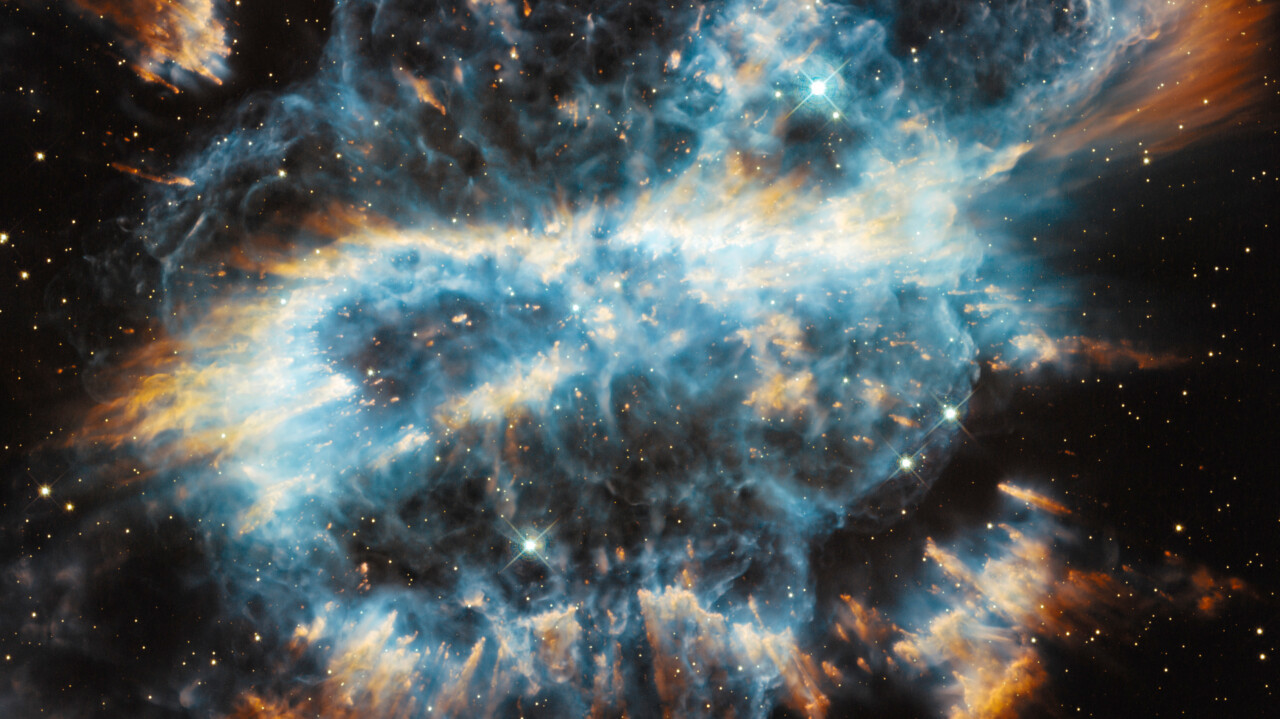
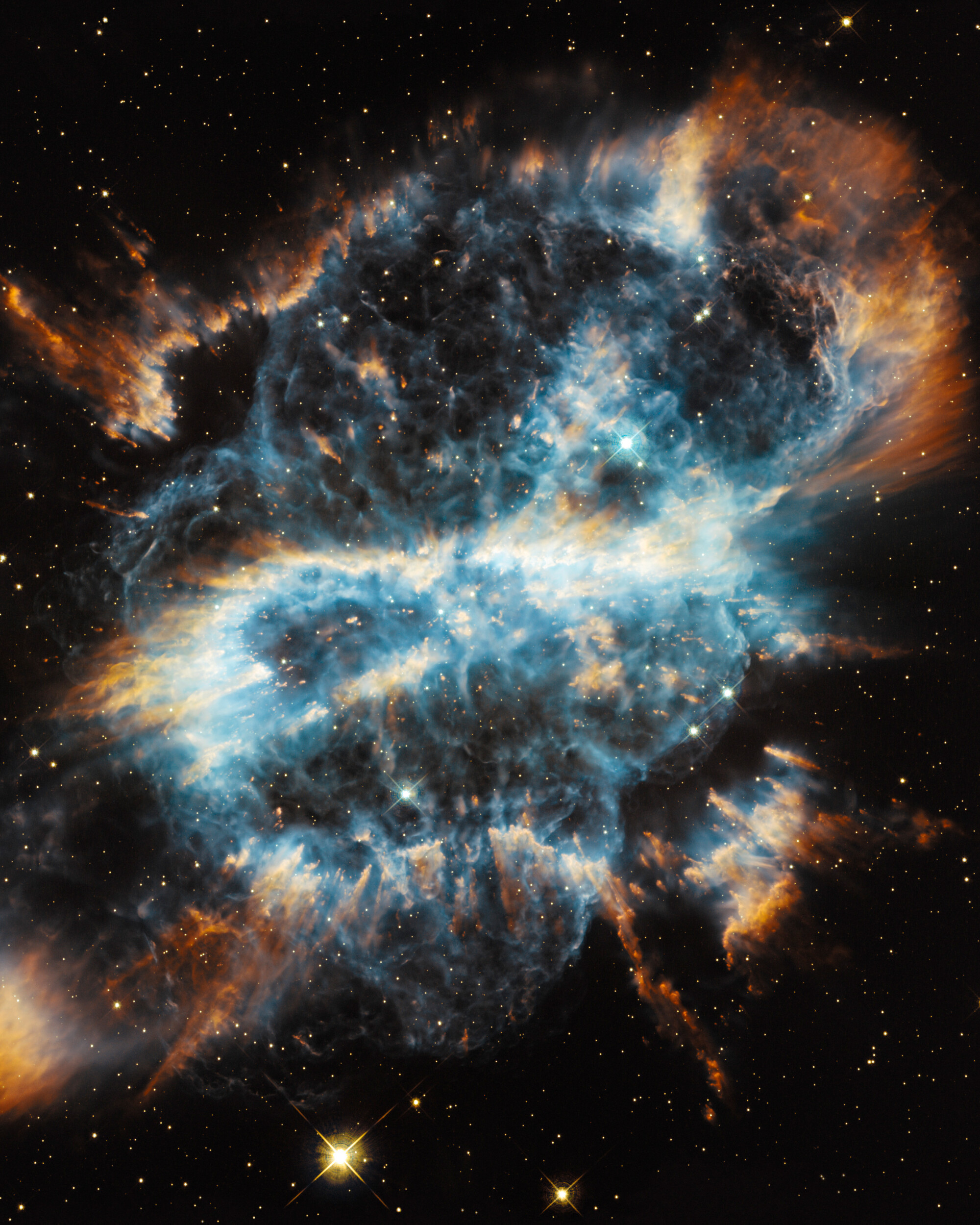
Photograph courtesy of NASA
To never miss an episode of The Nature Of, be sure to follow here.
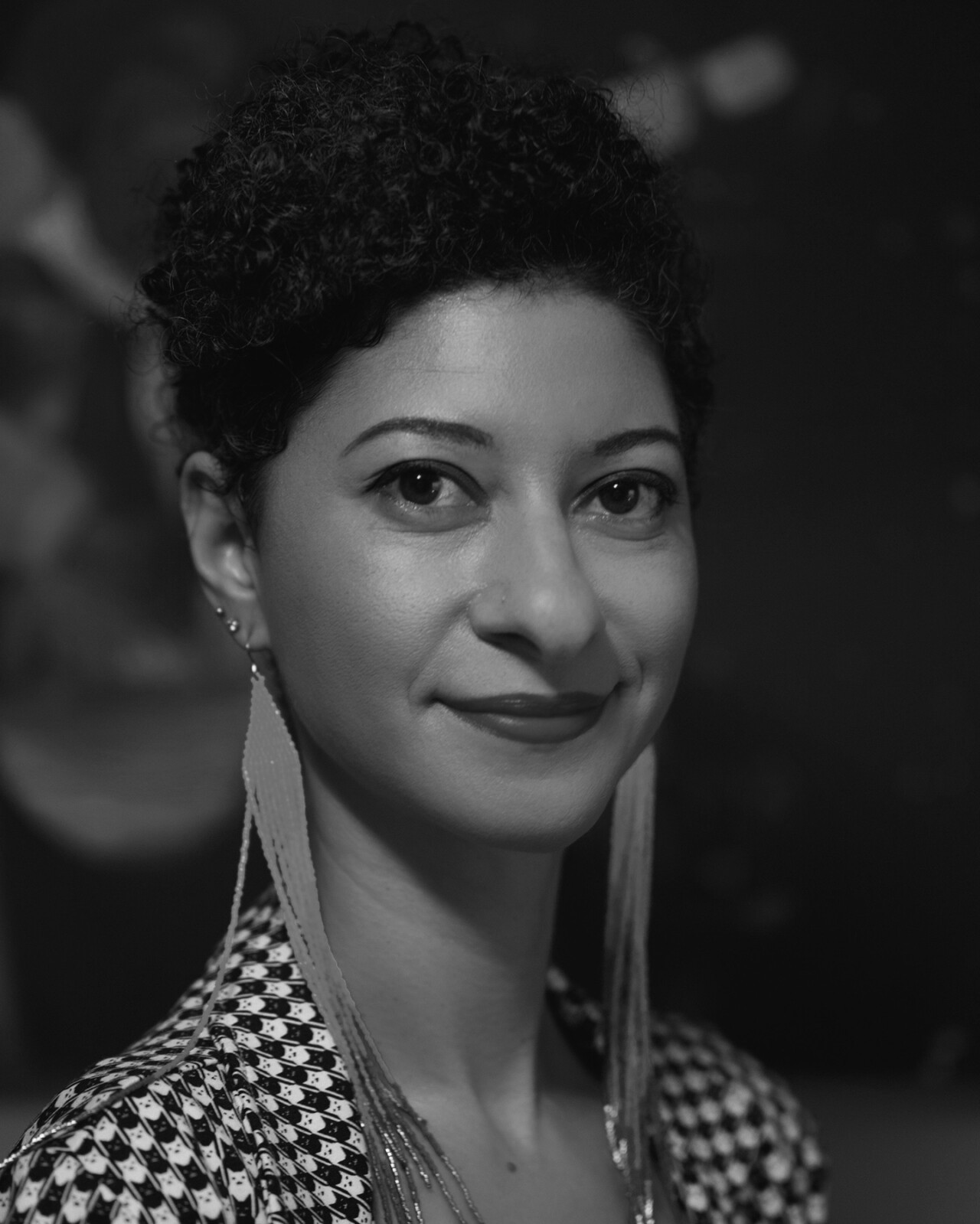
What if the universe is stranger and more full of possibility than we’ve been taught to imagine? This week, Willow sits down with cosmologist and The Edge of Space-Time author Chanda Prescod-Weinstein for a conversation about the cosmos, curiosity, and the power of expanding our perspective. They explore the physics of dark matter and other mysteries, what the universe can teach us about possibility, and why it’s always a good idea to have a beginner’s mind.
Chanda Prescod-Weinstein is an associate professor of physics and astronomy and core faculty in women’s and gender studies at the University of New Hampshire. She conducts award-winning theoretical physics research on dark matter, the early universe, and neutron stars, while also researching Black feminist science studies. Her first book, The Disordered Cosmos: A Journey into Dark Matter, Spacetime, and Dreams Deferred, won the 2021 Los Angeles Times Book Prize in Science and Technology, the 2022 Phi Beta Kappa Award in Science, and a 2022 PEN Oakland/Josephine Miles Literary Award. A columnist for New Scientist and Physics World, she is originally from East L.A. and now divides her time between the New Hampshire Seacoast and Cambridge, Massachusetts.
Chanda Prescod-Weinstein
As far along as we think that we’re getting, I think it’s always good to have beginner’s mind. There is no point in my life when that won’t be useful for me. As much as I think I know, I still don’t know most things.
NARRATION
I have been joking for a week now that I am prepping for an interview with a particle physicist, even though I do not understand particle physics. But it turns out that is the right way to go into a conversation with Chanda Prescod-Weinstein. They have a way of describing the cosmos and the fabric of space-time that feels like you’re accompanying Alice through the looking glass, revealing a universe that is senseless at times, strange, and full of wonder. She also points out that looking at the cosmos and widening our view can grant us a perspective—particularly at a time when everything feels so overwhelming.
Chanda
People need to know that the universe is bigger than the bad things that are happening to us. There are a lot of things that Donald Trump can do to us and is doing to us right now, but the one thing that he can’t take away from you is your awe in the universe. That’s yours.
NARRATION
I’m Willow Defebaugh, and this is The Nature Of, where we look to the nature of our world for wisdom and ideas that change the way we live, and this week, that extends to the cosmos at large. I’m sitting down with Chanda Prescod-Weinstein to talk about her new book, The Edge of Space-Time, and to ask my most pressing questions about the universe.
WILLOW DEFEBAUGH
Chanda, thank you so much for being here and joining us on The Nature Of. I have to say: You are the first cosmologist and the first particle physicist on the show.
Chanda
Thank you for having me. I feel honored to break this barrier for the show.
Willow
As someone who looks at the origin and evolution of space-time—no small thing by the way—and everything inside of it, can you just start by gently explaining how did our universe begin?
Chanda
I guess I will say the easy and cheap answer is we don’t know, but we can talk a lot about what happened in the immediate aftermath of the formation of the universe. Often people think like, oh, there was a big bang, and I think people imagine there was some explosion from at some point and then the universe came into existence, and actually, I genuinely think that we don’t know exactly what happens at that moment because whatever that was, it’s where our equations break down, and so we don’t have a good description of that. But we know that very soon, immediately after the universe came into existence or this iteration of it, that space-time started expanding rapidly. It happened really fast in less than a fraction of a second. It goes faster than anything’s allowed to go inside of space-time. Space-time is going faster than that.
And soon after that, we start to have particles forming. The universe is filled with this dense plasma of hot particle stew. And so if you think about it, something trying to move around in a stew—for example, just to take that metaphor, stew is thick. It’s constantly running into potatoes, and chunks of lamb, and pieces of carrot or whatever. And so in this case, a photon, like a particle of light, it gets emitted, but it can’t go very far without running into something. And so this is like the very early stages. And then, at about 380,000 years after whatever came before, for the first time, hydrogen atoms start to form, and the universe starts to cool off, and light can travel freely through the universe for the first time without just constantly running into something.
You might be thinking, this is very detailed. How could you possibly know that?
And so the incredible thing is that this light is still available to us, and we can see it, and we’ve sent multiple telescopes up to space to measure it. We have telescopes down in Antarctica that are studying it. And then you have these hydrogen atoms that are gravitationally attracted to each other. So they start to form clumps of gas, and those clumps of gas get bigger and bigger, and they start to gravitate more and more, and in some cases, they condense enough into clumps that will go on to become stars. And those stars eventually die, they leave behind gas. Another generation comes along, and another generation comes along, and those generations have some of the heavier elements, carbon, oxygen, other things you need to form a planet like Earth, and so you get stars like our sun, and that’s how you get us.
Willow
We have a little bit of a framework that we’ve now established for how the universe got here. What is one of your favorite facts about the universe that still blows your mind to this day?
Chanda
Wow. OK. So this is a tough one for me because, obviously, as a theoretical cosmologist, I have a bunch of things that I think are very awesome. I am a really big fan of the fact that neutrinos are non-trinary. A neutrino is a type of subatomic particle. They randomly oscillate from one type to another as they’re traveling through space-time. As part of the fusion process that creates all the energy that we get from the sun, neutrinos get emitted and neutrinos interact with almost nothing. So they just like fly out of the sun, they go out into the universe, some of them come to the Earth, and the type that’s created in the sun is specifically the electron neutrino. Of course, scientists were like, “So we’re going to go out, we’re going to look, we’re going to see a bunch of electron neutrinos coming from the sun,” and they noticed that they weren’t getting as many electron neutrinos as the theory might predict.
And so this was known as the solar neutrino problem, and eventually it was realized that the reason that they weren’t all electron neutrinos is because they were changing type on their way out, and so not all of them were arriving to us as electron neutrinos. And I think that’s such a wonderful reminder that the things that we take for granted, like identity stability or category stability, don’t necessarily exist in the same way at the subatomic level. So that was kind of a cool, like, oh, the universe isn’t what we thought it was. And there’s just like a lot of that in the physics, the universe isn’t what we thought it was.
Willow
And the neutrinos are transitioning as they leave the sun and come toward Earth. So cool. I want to talk about your book a little bit: The Edge of Space-Time. You have shared that part of the goal is to really help people wander through physics. How do you like to begin that journey for people who are uninitiated?
Chanda
With this book, eventually where I landed was on the Akan proverb, an idea of Sankofa, and this is kind of captured in this proverb: “Sɛ wo werɛ firi na wosan kɔfa a yɛnkyiri.” And this means it is not incorrect to go back and get what you may have forgotten. And it is represented visually as a bird that has its head turned backwards. So it’s kind of moving forward while looking back. I will say I wrote The Edge of Space-Time with a sense of urgency because I was looking around and realizing that the funding support for particle physics and cosmology and the stability that I had come of age with as a graduate student was evaporating and public support wasn’t necessarily there for sustaining it.
And so there’s an element of the book that was like, I need to convince my audience that this is something that matters to them politically, materially, spiritually, culturally. And so the argument I make to my audience is, we should go back and get our history—and knowing our history includes knowing our cosmic history. There was also an important tie-in there for me as a Black person, of reaching into my Black cultural reference points that are part of the way that I think about the doing of science and why my science matters.
Willow
Beautiful. I love the visual of the bird flying forward but also looking backward, and I think that speaks to the dimension of your work. I think you even have a line in the book where you’re saying, like, in order to understand our future, we also have to understand our past, and I mean, this is true in so many arenas right now. But talk to me about The Edge of Space-Time. What is that referring to? Does our universe have an actual edge?
Chanda
I think of The Edge of Space-Time as my vulnerable book. I think a lot of people think The Disordered Cosmos, my first book, was my vulnerable book because I talk about things that are messed up in science and race and gender and how those shape people’s participation in science. But actually, those are easy criticisms to offer. And for me, The Edge of Space-Time was very much like, let me just open my Black queer Jewish particle cosmologist brain and tell you what it’s like to walk around inside.
And so the actual title, The Edge of Space-Time, is a phrase from a textbook about cosmology that was written by Steven Hawking and George F.R. Ellis, and they’re basically saying that solving problems in cosmology is really a series of boundary problems. So if you think about, like, if you’re in a room right now, there’s a floor, there’s a ceiling, you have four walls probably, and you can think of those as boundaries of the room and any equation that we might want to solve that describes something that’s happening in the room will have to take into account those boundaries, the presence of the floor, the presence of the ceiling. So their claim is that every problem in cosmology basically comes back to a boundary condition problem and is really about what is the edge of space-time. So this is where this phrase comes from.
And I just read that and I was like, “That’s so poetic. How has nobody used it yet?” So I was like, “I’m using it.” And the other piece is as a Black feminist thinker, and I think that this is in part where my identity comes in addition to my intellectual interests. I was already thinking a lot about Bell Hooks’ concept of margins to center and bringing people who are usually asked to exist at the margins or forced to exist at the margins to the center of our storytelling and our narration. We have to tell the story of science through metaphors. I already use the lamb stew as a metaphor. I’ve used the room and its physical boundaries as a metaphor for space-time and this idea of non-trinary transition, which is clearly borrowing and inspired from conversations and discourses about non-binary gendered identities.
So part of it is putting queerness at the center of the story because that is how I see the universe, and those are the metaphors that feel natural to me, and that’s taking queerness from the margin and putting it at the center. There’s also—In my chapter on black holes, I say that they’re the best-laid edges in the universe, and that’s like something that if you’re someone who’s thought about black hair, you probably know what edges are. If you’re someone who wears wigs, you probably know something about laying down edges. I’m saying to the audience that is familiar with this nomenclature, this is science writing that puts you at the center of the story, and it’s a different cultural centering that becomes kind of part of what’s generative in the book.
Willow
Can you share a little bit more about how queerness has shaped how you do science?
Chanda
I think one of the gifts that the world gets repeatedly from the continuous birth and outness and transitioning of those of us who are queer and/or trans and maybe difficult to categorize and on the boundary of identity in these different ways that there is a kind of freedom that comes with our existence, because we already understand that sometimes when people tell you something, that a boundary exists, that the boundary isn’t real and that there’s something beyond it. And so I think that it has been easier for me to sit with what is strange about the universe because I’m not as married to the idea that received wisdom, received norms are definitive in the end of the conversation. I just think that that for me has been an intellectual opening.
And also when I think about my reading queer theory like José Esteban Muñoz, he talked a lot about queerness as futurity and queerness as always being whatever is pushing the boundary in that moment, and I realized that that’s a lot like science. And so I think my understanding of what we do in science is very, like my job is to exist at the edge of what is known and unknown and push that boundary forward.
Willow
I think something that resonates so much with me is part of what I love about exploring queer ecology and writing about and just existing out in nature, is I’m always just delighted by the fact that everything is so strange. And we live in this world where we try to put everything into boundaries, and I think me as a trans woman, no one could possibly be strange on a planet where everything is constantly shifting and evolving and growing into itself. And I think that always just re-centers me, and I love that you sort of take us—you widen the lens out even further, going from queer ecology to queer cosmology.
Chanda
One of the reasons I was so excited to come on this show in particular is because I think, for historical and political reasons, that physics has often been bifurcated away from our sensibilities about the natural world and naturalness, and physics is coursing through the veins of nature. It’s literally like, our job is to ask the questions about the most fundamental building blocks of nature. I’m looking at the night sky, and I’m using physical laws to interpret what’s going on, and that’s what we’re doing, and the night sky is a huge part of our ecosystem. We know from the way that animals interact with moonlight and use it to orient themselves, and also their rhythms are set by when the sun is setting and rising, and all of these things.
So I think, for me, it was very exciting to have that acknowledged and welcomed into a space that is very ecosystem- and natural-environment-focused because I do think that we need to start understanding that our universe is actually part of our natural environment. And also, as we start to move further and deeper into the solar system, that we’re expanding our sense of what outside means for us.
Willow
I’ve heard you describe luminous matter, visible matter, like everything that we are made of. We are like the cosmic oddities, we’re the weird stuff because everything else, dark matter, dark energy, that makes up the majority of our universe, but we also still don’t really understand what it is. What is our best guess about dark matter and dark energy, and also what’s the difference?
Chanda
So the reason it’s called dark matter is historical. It’s actually, as far as we can tell, transparent matter. So light goes right through it. Other particles don’t interact with it except through gravitation. And so how that dark matter is clumping together is playing a really big role in how these other types of matter are clumping together. Particularly when we start to think about, well, how are stars getting organized into large enough groupings that we might call them a galaxy? That dark matter plays a really big role in that. Dark matter is very mysterious in that we know that it’s out there, we have lots of really good evidence for it, but we’ve also never handled it in the lab. We don’t know what kind of particle it is, whether it’s one particle or 15 particles.
Then, on top of that, you have dark matter, you have visible matter, and then we have something called dark energy, which you were asking about, and dark energy is completely different from dark matter. They have similar names because white male scientists have liked to use the word dark as a container for things they don’t understand, and—
Willow
Shocking.
Chanda
Shocking. In terms of the impact on the universe they have, they’re completely different. So dark matter acts just like visible matter gravitationally, but as far as we can tell, dark energy seems to have a negative pressure. So it causes the expansion of space-time to increase in speed. So space-time is expanding, dark energy is causing that expansion to accelerate. So it’s continuously increasing in speed. So that’s like the total opposite of dark matter. In terms of, dark matter gravitationally pulls together, and dark energy basically does the opposite.
Willow
I want to revisit something that you shared earlier about the relationship between physics and metaphor. You point out how physics is almost impossible to explain without metaphor, even these phrases that have kind of become somewhat common, like the fabric of space-time, or we talked about the electromagnetic field. This is metaphoric language. So how in your eyes do poetry and physics really go hand in hand? Because these are two fields that we are almost conditioned to think of as being deeply, deeply separate, but that you kind of bring together so beautifully in this book.
Chanda
I think for years people would be like, “Oh, the arts are getting defunded. That’s so unfortunate. It’s too bad that they don’t do something useful. If they did something useful, then that wouldn’t be happening to them.” And scientists kind of had this arrogance of like, “Well, that could never happen to us.”
Willow
I feel like I’m getting all of the insider academia tea right now.
Chanda
Yes. I mean, there’s definitely just this element of I don’t think that the science has stood with the humanities at key points, and I drafted this book before the election in 2024. So I think I always have to make this point because people will be like, “Yeah, it’s been really bad over the last year,” and I’m like, “The NASA astrophysics budget was in trouble under Biden, and I was already worrying about all of these things. We were already facing risk and running into trouble.” And so there is this element of, what if instead of walking around and being like, “Well, at least I’m useful unlike the poets,” you admitted to yourself, actually, maybe you’re like a poet and that’s OK because we need poetry, because poetry is part of our humanity, and it’s an expression of our humanity. And humans are curious and like to come up with mathematical descriptions for how things work, and an equation is a metaphor. It is a collection of symbols that symbolize phenomena.
And yes, there are very specific rules. It is also the case that poetry follows rules. You look at iambic pentameter and one of the reasons iambic pentameter, which Shakespeare often wrote in, is hard to understand is because it has a very clear rule that you have to have a feeling for. Similarly, with physics, it’s something that you have to learn. So I think that there was that piece of just saying, politically speaking, we are like poets and there is value particularly in this moment of us learning to be in solidarity with the poets and to understand ourselves as being on the same side. And then I think there’s also just this part that people look up and they see poetry. And why wouldn’t we embrace that element of how humans experience the physical world, the natural world?
Willow
Beautifully said. And I mean, looking up into the stars and seeing poetry feels like it is like the most ancient, most human thing in the world. I mean, our word for the universe, our word for everything that is has verse written right into it. A single verse. In moments when the world feels overwhelming, why does looking at the cosmos and widening our scale, why is that helpful for just the average everyday person who’s listening to this show?
Chanda
I think the first thing is, as my mom, Margaret Prescod, said, and this was the epigraph for my first book, people need to know that the universe is bigger than the bad things that are happening to us. There are a lot of things that Donald Trump can do to us and is doing to us right now, but the one thing that he can’t take away from you is your awe in the universe. That’s yours. You don’t have to let him or anyone like him or fascists or authoritarians mediate your relationship, and that sense of awe can be a reminder of what you want the next generation to have and five generations from now to have, and that can be a real guiding light in moments of despair, which is I may not live in a time where there is no fascism, but maybe I can be motivated to put some pieces in place so that one day there is a generation that does live without fascism so that they can experience that awe in a more full and day-to-day way than maybe has felt accessible to us.
Willow
I mean, what you’re sharing makes me think of what you spoke to earlier about on the quantum level, it’s like everything is possible, right? This might possibly be here. This might possibly go there. Possibility is in so many ways all we have. I was on a panel recently, and I was asked about hope, and I was like, I don’t know if I’m necessarily concerned at this point in my life of, do I have hope or do I not have hope? Because what I know is I have possibility. Our universe is made up of possibility. We live in what is in many ways a very impossible and improbable universe, and I’m like, holding onto that is—that’s enough. That’s what I need to do every day, is holding onto the fact, the idea as you’re sharing that a different world is possible than the one that is being modeled for us right now because everything’s possible.
Chanda
I mean, just to come back to the universe is too fucking fabulous for capitalism. The universe has billions of stars in it, billions of galaxies, all these planets and rocks and dust and there are supernovae going off and there are kilonovae making gold. And you’re telling me that this pinche economic system is the best that the universe has to offer? Come on, it doesn’t make any sense. And so I think just thinking about that, holding onto that, there’s no way that this is the best that the universe has to offer, and so we should aim for more of the good stuff that the universe has to offer.
Willow
Make it make sense. Make our senseless universe make sense.
Chanda
Yes.
Willow
It’s the other name for this episode. OK, final question. What’s something that the universe has been teaching you lately?
Chanda
As far along as we think that we’re getting, I think it’s always good to have beginner’s mind. It never hurts to have beginner’s mind about things. And I’ve benefited a lot from going back to the Thích Nhất Hạnh in my brain and returning to my breath. So I think I’ve been learning that there is no point in my life when I won’t need that, and when that won’t be useful for me to remember that as much as I think I know, I still don’t know most things.
Willow
Beautifully said. Having a beginner’s mind and letting ourselves be humbled by this massive, beautiful, in some ways, nonsensical universe. And I know I have been humbled a number of times in this conversation as I have attempted to understand quantum physics and everything else, but you’ve done such a wonderful job explaining it. So thank you so much, Chanda, for being here and for writing this book. I hope everyone goes and checks it out.
Chanda
Thank you so much for having me.
Narration
Something I have been humbled by lately, aside from particle physics, is how much I don’t know. I feel like I am in a chapter of my life where, rather than clamoring to get the answers, I am trying to become more comfortable living the questions, as Rainer Maria Rilke once put it. So as you walk away from this week’s episode, in addition to hopefully inspiring you to look up at the night sky with a little bit more awe and reverence, I also encourage you to think about what that might mean for you to live the questions, to sit with everything that feels senseless and know that it is a part of this vast, beautiful, largely unknown universe made mostly of dark matter and all that we cannot see.
The Nature Of is an Atmos podcast produced by Jesse Baker and Eric Nuzum of Magnificent Noise. Our production staff includes Emmanuel Hapsis and Sabrina Farhi. Our sound designer is Kristin Mueller. Our executive producers are me, Willow Defebaugh, Theresa Perez, Jake Sargent, and Eric Nuzum. Atmos is a nonprofit that seeks to re-enchant people with our shared humanity and the earth through creative storytelling. To support our work or this podcast, see our show notes or visit atmos.earth/biome. That’s A-T-M-O-S.earth/B-I-O-M-E. I’m your host, Willow Defebaugh, and this is The Nature Of.
Join our membership community. Support our work, receive a complimentary subscription to Atmos Magazine, and more.
Exploring the Edges of the Universe With Chanda Prescod-Weinstein