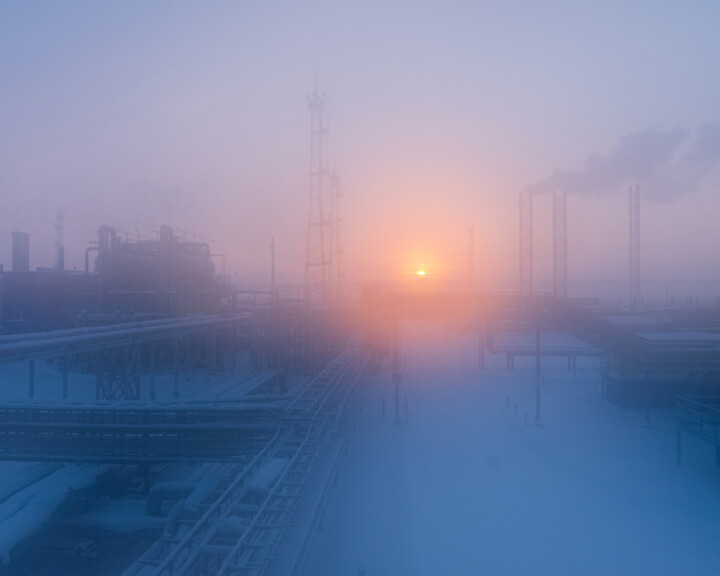

Photograph by Alex Stead / Stills
words by miranda green
A decade before Exxon’s scientists warned the company’s executives about the likely fallout of burning fossil fuels, White House scientists were already advising then-president Lyndon B. Johnson on a theoretical technology that might curb the impacts of global warming: geoengineering.
The concept refers to the modification of the Earth’s climate systems on a large scale to combat global warming. Johnson’s Science Advisory Committee used a 1965 report to raise the potential for geoengineering the atmosphere by spraying reflective particles over the oceans or modifying cirrus clouds.
Geoengineering’s subset of solar radiation modification, which involves reflecting a small fraction of sunlight into space, was inspired by the cooling effects of volcanoes. When volcanoes erupt, they emit sulfur particles into the atmosphere that act as a natural sun reflector and can drop temperatures in surrounding areas.
But while researchers have long studied geoengineering and SRM concepts, they’ve largely stayed out of the mainstream lexicon—likely because the concept of messing with the world’s atmosphere, or placing external satellites or mirrors to reflect the sun, was considered the stuff of science fiction. Conspiracy theorists connected the concept with climate control; others worried that the move could have unintended, catastrophic consequences for the earth; and environmentalists warned that relying on geoengineering as a “climate solution” could remove any pressure to reduce emissions.
But today, as we face an increasingly likely future of scorching summers, melting glaciers, and worsening storm systems, researchers and climate experts have begun taking geoengineering—and more specifically its SRM subset—more seriously. Many now see a real, growing need for eventual solar-modifying climate solutions.
“Interest is accelerating: from governments, from private companies, from research institutions globally,” Michael Thompson, managing director of the Alliance for Just Deliberation on Solar Geoengineering, tells me. “The question isn’t whether SRM research proceeds; it’s who shapes it, who governs it, and whose concerns inform the decisions it feeds into.”
So far, no national government body has taken up the cause of SRM.
Switzerland unsuccessfully campaigned for the United Nations to officially regulate geoengineering and study its risks and opportunities. While the UN’s Intergovernmental Panel on Climate Change has accepted carbon capture as a necessary part of addressing the climate crisis, it does not consider geoengineering as part of the mix. The IPCC wrote of geoengineering in 2020: “SRM would not counter all effects of climate change, and all proposed geoengineering methods also carry risks and side effects. Additional consequences cannot yet be anticipated as the level of scientific understanding about both SRM and CDR is low.”
A working paper released this month by the UN Environment Programme determined SRM should be considered a last resort, and that “the current state of scientific knowledge does not support SRM as a viable response to climate change as it does not address the root cause of the current anthropogenic climate change.”
The report got mixed reactions from experts. That’s because an increasing number of environmental groups and researchers see the merits of further SRM research. The American Geophysical Union—an affiliate of the National Academy of Sciences—and a separate group of more than 100 scientists each published statements urging additional studies of climate interventions such as SRM. Deployment of solar-modification technologies could include aerosol injection, marine cloud brightening, or cirrus cloud thinning.
The United Kingdom’s Advanced Research and Invention Agency began launching outdoor experiments on solar geoengineering last year. Russia has conducted tropospheric aerosol trials, and Australians are trying out marine-cloud brightening to stop the bleaching of coral reefs.
Several American universities, including Harvard, have research departments studying geoengineering. Private companies are also betting on the need.
Investment companies have reportedly put more than $100 million into developing versions of the Earth-warming technology. Stardust Solutions is one of the leading firms. Earlier this month, the company disclosed details about the particle technology it hopes to use to cool down the Earth. Stardust publicly published its research, led by former members of Israel’s nuclear energy program, showing how the chemical properties of its materials could react with the atmosphere if deployed. The firm has applied for a patent and is awaiting scientific review. These are still the early days, but studies and reception show there’s a very real chance the technology can be deployed.
That’s why Thompson, of the Alliance for Just Deliberation on Solar Geoengineering, is focused on getting shareholders together to discuss the possibilities. His organization joined forces this year with three other groups to launch the Solar Geoengineering Research Governance Platform, an initiative aimed at making solar geoengineering research more transparent, publicly legible, and accountable so the technology isn’t deployed haphazardly or unilaterally—and doesn’t benefit certain countries or regions at the expense of others.
“Our position is we shouldn’t even be talking about deployment at this point, and it actually hurts the conversation, hurts the research, hurts the potential for legitimate decision-making down the road,” said Thompson. “What we focus on and want to focus on is the research that we think is going to happen, and we think is important. How is that shaped and informed and governed? Particularly by Global South countries that are on climate frontlines, and may not have to date the technical involvement or technical capacity, but certainly need to have, you know, some input and some understanding?”
The American government’s geoengineering research and development have been limited.
The Biden administration released a plan in 2023 requiring more research into the pros and cons of bioengineering to “address knowledge gaps and build understanding to aid decisionmaking and policymaking.” The Trump administration has not taken any official stance on the technology, but many people in the MAHA camp have linked geoengineering to chemtrails.
Last year, several states passed local laws prohibiting the use of the technology. But there’s reportedly been pressure from one former Trump energy adviser for the administration to embrace SRM, which can be useful tools for a country determined to keep drilling for and burning fossil fuels. But to embrace the technology, the Trump administration would have to acknowledge the reality of climate change, which, as of this writing, it still denies.
Today, the U.S. spends much of its geoengineering focus on monitoring potential SRM activity across the country.
Researchers recognize that much of human life is based on the principles of nature, and they acknowledge that a climate solution could take its cues from the natural world, too. The 2022 eruption of the Hunga Tonga-Hunga Ha’apai volcano, which caused the biggest underwater explosion recorded with modern instruments, has provided much fodder for researchers seeking to understand the climate impacts of aerosols and plumes released into the atmosphere.
“The day will come when, confronted with the violent effects of climate change, we will seriously consider resorting to geoengineering,” Bernard Legras, research professor at France’s Laboratory of Dynamic Meteorology, told CNRS News. “Hunga Tonga provides us with the opportunity to determine what we can do and, above all, what we must absolutely avoid doing. Theoretically, adding sulfate aerosols to the atmosphere could cool the climate, but that’s not at all the same thing as removing greenhouse gases. The best way to offset their impact is to reduce emissions.”
Want me to look into The Understory of something? Send me an email!
Join our membership community. Support our work, receive a complimentary subscription to Atmos Magazine, and more.
With Geoengineering, a Fringe Climate Solution Moves Into the Mainstream