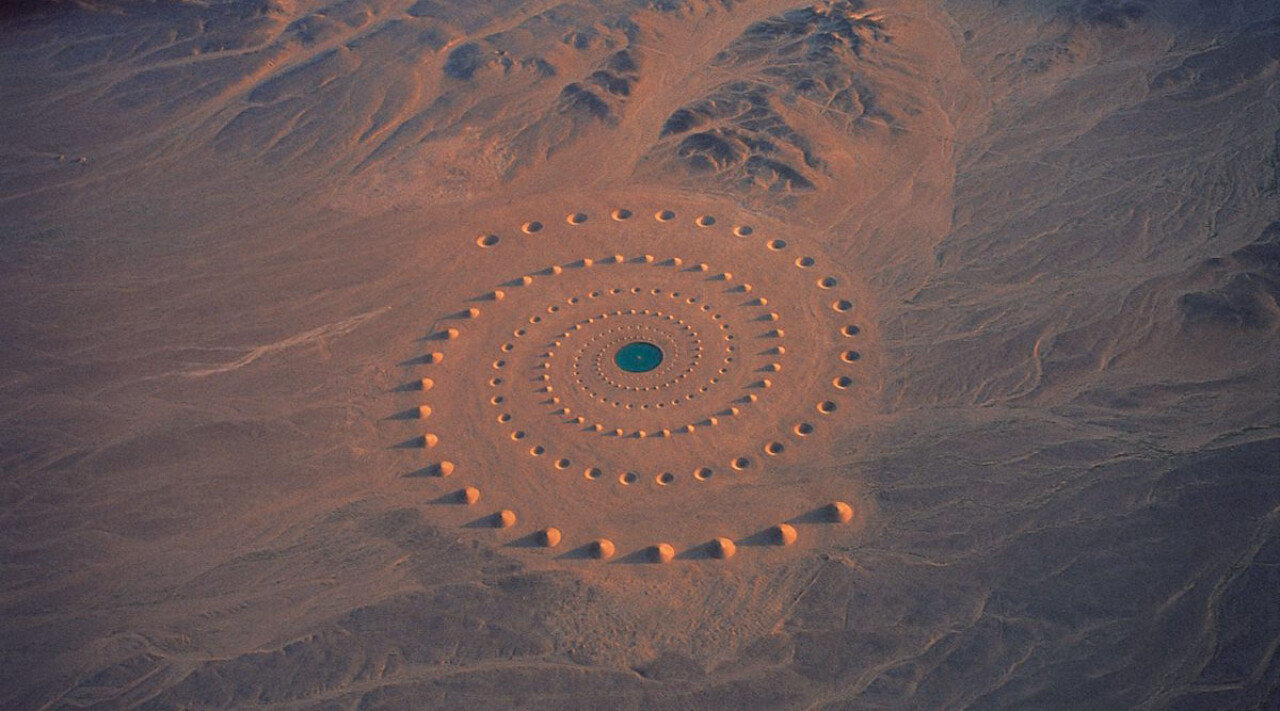
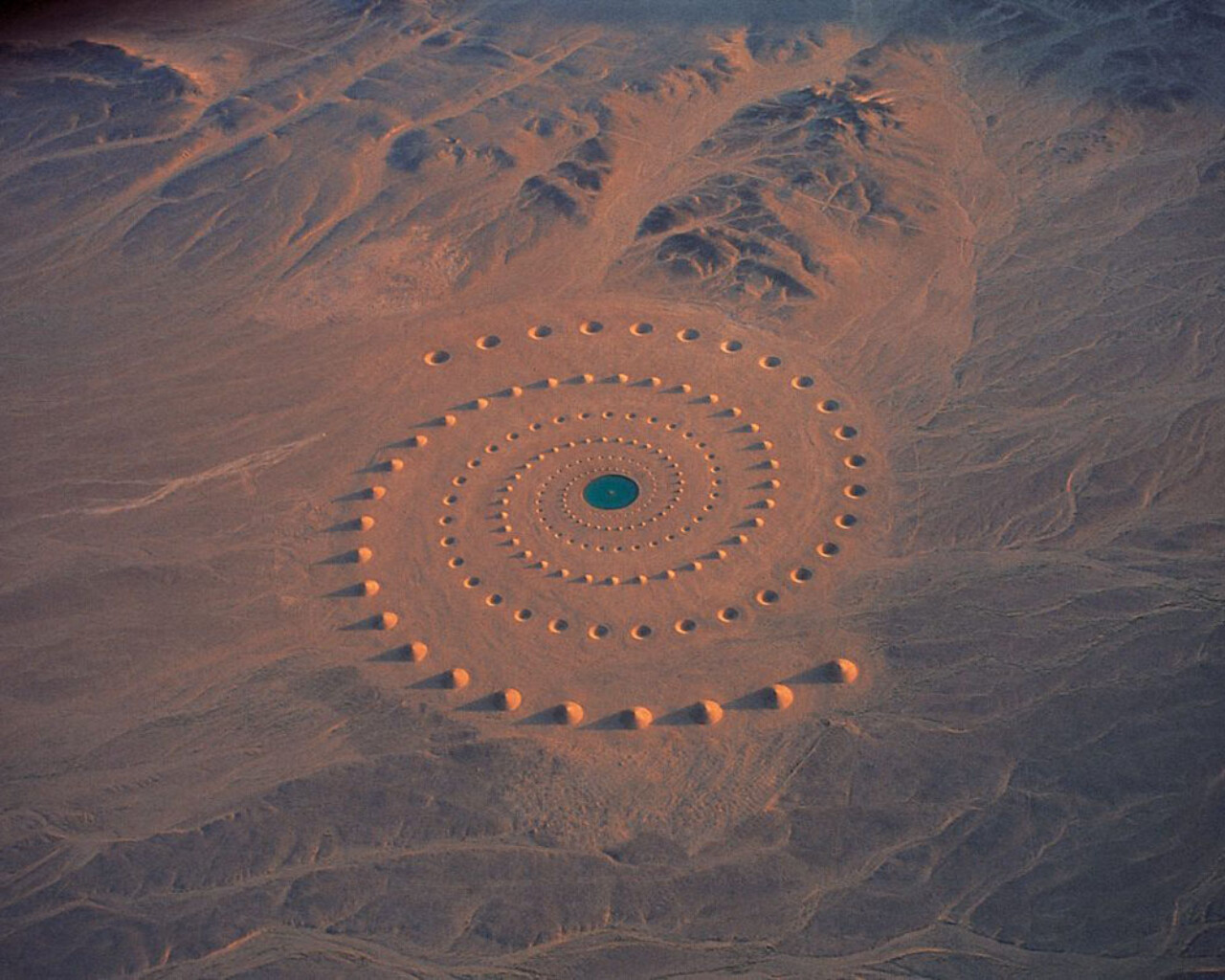
Photograph from Desert Breath, Egypt 1997 by D.A.ST Arteam, Danae Stratou, Alexandra Stratou, Stella Konstantinidis
words by willow defebaugh
“To see a world in a grain of sand
And a heaven in a wildflower,
Hold infinity in the palm of your hand
And eternity in an hour.”
—William Blake
In Cosmos, Carl Sagan’s beloved 1980 treatise on our unknowable universe, the astronomer popularized the notion that “The total number of stars in the universe is larger than all the grains of sand on all the beaches of the planet Earth.” As was Sagan’s signature, this poetic musing was a way to communicate the vastness of stellar existence. But this is difficult to measure. Scientists now estimate there to be as many, if not more, grains of sand on Earth than stars in heaven.
Have you ever run your fingers through sand on a beach and wondered what it is you’re sifting? Tiny parts of mineral, rock, shell, and coral—sand is defined more by size than substance, a unit of measurement larger than silt, yet smaller than gravel. Most sand is made of quartz, a mineral especially resistant to weathering and erosion. Formed by the slow fragmentation of landscapes across eternity, sand is the miniature evidence of the immensity of time.
For scientists who study the shifting states of matter, sand is somewhat of a marvel. An individual grain is undeniably solid. But when sand accumulates, it acts more like a liquid: particles capable of flowing around one another, taking the shape of their container. Even more mystifying is the way grains collide in the air when you kick a sandpile, their dispersal resembling more of a gas. Sand rejects categorization in favor of context.
Sand organizes itself on the edge between stability and uncertainty. Physicists study sandpiles to measure what’s known as self-organized criticality, the tendency of a complex system to naturally reach a tipping point. Consider the way sand falls in an hourglass: Grain by grain, a pile forms in the lower half, even as many tiny avalanches constantly occur. But as the steepness increases, so does the likelihood of a single grain triggering a large-scale collapse.
In certain deserts, these avalanches make sound. As grains cascade down the slopes of a dune, the sand sings. Researchers believe this is the result of dry sand moving over denser, wet sand below. The dune becomes an instrument, trapping and amplifying vibrations from tumbling grains that synchronize and resonate across the sand. These sounds can mimic the strings of a cello, the pipes of an organ, or even the far-off boom of desert thunder.
Our world is built from sand; without it, much of modern life would fall apart. It is among the most extracted substances on Earth, essential to concrete and roads. And through a transition rare in nature, sand heated to extraordinary temperatures—such as a lightning strike —turns to glass. What was once opaque becomes clear. Your smartphone is made from such glass as well as silicon refined from quartz, grains of time transformed into a device capable of devouring it.
A single grain of sand might be older than multicellular life itself, carrying histories of ancient continents and landscapes long lost. More than just our cities, it shapes ecosystems; sand blowing from the booming dunes of the Sahara nourishes the Amazon. For hundreds of years, we have been trapping this substance to sieve time. And in time, after all our castles and empires have crumbled—perhaps from the stumbling serenades of tiny, singing grains—sand will remain.
Join our membership community. Support our work, receive a complimentary subscription to Atmos Magazine, and more.
The World in an Hourglass: The Singing Physics of Sand