



Words by Izzie Ramirez
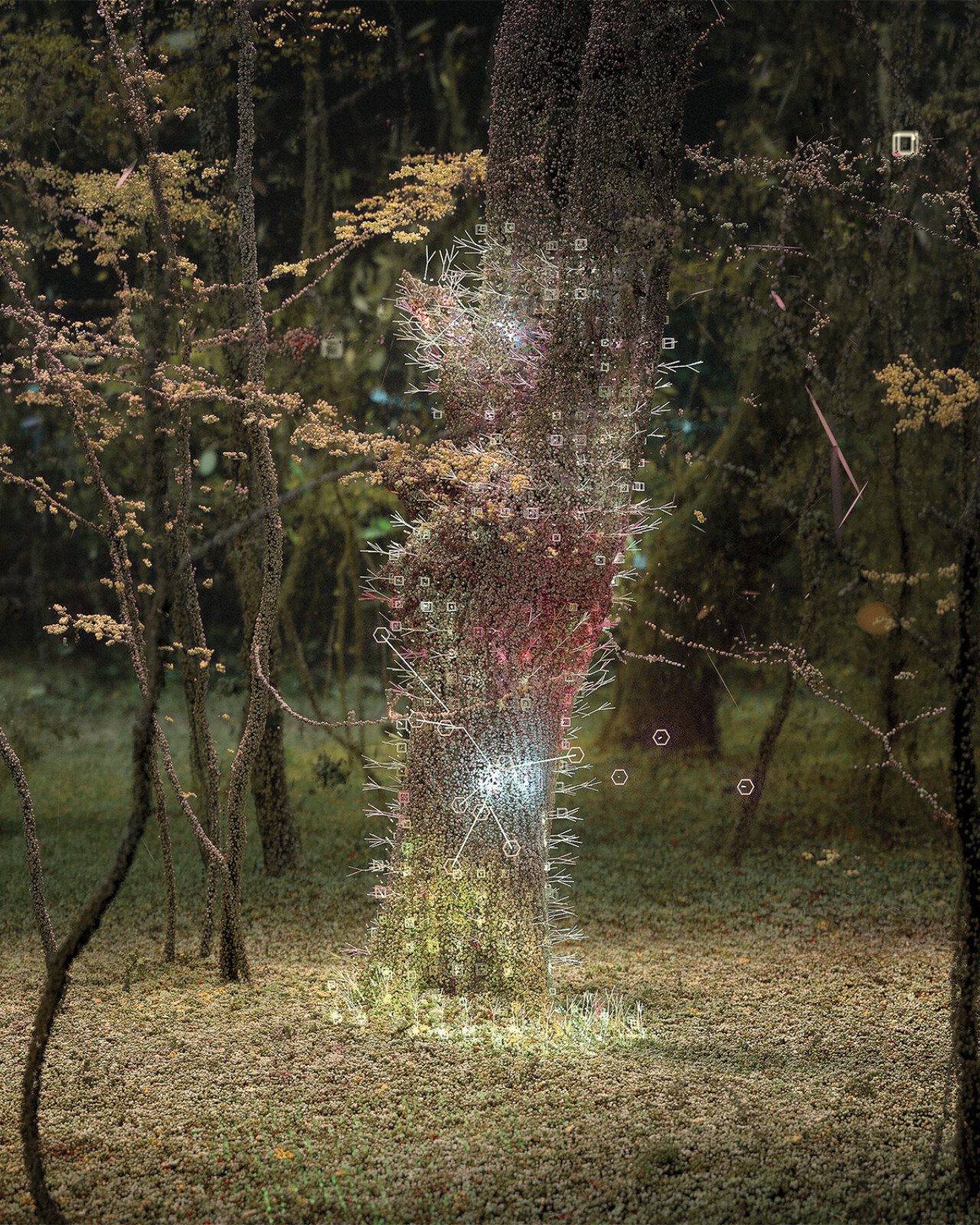
artwork by Dan Hoopert
Harpreet Sareen is on a mission to turn the average houseplant into a sensor that can make city life safer, smarter, and more alive.
Sareen grew up in Punjab, the epicenter of India’s “Green Revolution,” where lush wheat fields and agricultural abundance shaped his early life. But as he started building a career designing inert infrastructure such as cell phone towers, he found himself in an identity crisis. The technological landscape he was helping create felt entirely divorced from the natural ecosystems of his childhood.
“We love to be around nature, and it’s nicer to see plants than to see things that are meaningless to us,” Sareen, who now focuses on growable electronics, told Atmos. “Technology needs to feel warm.”
Guided by that ethos, Sareen eventually left his job in electronics engineering and spent time working at museums, where he began to imagine technology as something more than a tool for utilitarian problem-solving. In 2018, he built his first “plant robot,” an early prototype now known as Elowan. Instead of relying on algorithms to make decisions, Elowan is made up of a plant directly connected to a robotic system, translating the plant’s internal electrical responses into movement that propels the robot toward light. That experiment laid the groundwork for MIT Media Lab’s Cyborg Botany initiative, which he cofounded later that same year alongside media technology professor Pattie Maes.
Cyborg botany harnesses plants’ natural ability to respond to their environment and translates those subtle biological signals into legible forms. Since founding MIT Media Lab’s Cyborg Botany initiative, Sareen and Maes have developed a series of prototypes that integrate circuitry into plant systems, effectively turning plants into living sensors.
That possibility points toward a different kind of urban technology. “Smart” cities around the world, such as Zurich, San Francisco, and Singapore, already use digital infrastructure to collect data and automate urban management. But those systems are typically built around opaque, silicon-based technologies that do little to account for ecological health and often create environmental problems of their own, including millions of metric tons of e-waste. Though cyborg botany is still in its nascent stage, it could transform the future of the smart city by challenging the impulse to separate the unruly natural world from the efficient urban one.
Sareen hopes plant-based sensors could make cities healthier and safer—and more beautiful, too. He envisions, for instance, plants capable of detecting lead in a city’s water supply or signaling changes in soil toxicity or air quality. “To create a picture where humans would flourish, we have to let nonhumans and other forms of life flourish as well,” said Sareen. “And that is what started this philosophical journey for me in imagining what cyborg botany could be: a place where nature and technology collide.”
At its most basic, a sensor translates an environmental phenomenon into readable data. Traditional electronic sensors are typically designed to detect one specific input with great sensitivity, and all sensors are shaped by a human understanding of how the world works. We convert conditions into measurements, like temperature, pH, humidity, and air quality, and use those numbers to interpret our surroundings.
Plants have their own logic, one humans don’t always fully understand, with responses that are not always governed by legible numbers. A Venus flytrap, for instance, usually snaps shut only after two of its hairs are touched within about 20 seconds of each other, or when one hair is touched twice. A prayer plant, whose leaves fold inward at night, follows an internal clock. Leave it under a harsh fluorescent light for a few days, and it will begin to change under the strain.
Plants are exquisitely responsive, but most of us haven’t learned how to read the signals. That is precisely what Sareen and Maes are trying to do. “The reason I love plants is because they are self-growing, self-repairing, self-powering,” Sareen said. “They have these capacities that are hard for us to achieve in artificial electronics. To me, they are as good as a science-fiction creature.”
Sareen and Maes use liquid electronics to make a plant’s internal signaling systems easier to read. They inject silver or platinum electrodes into the plant’s vascular system, where the material polymerizes inside the xylem and forms a continuous conductive wire within the stem. In reactive plants such as the Mimosa pudica, this allows researchers to detect chemical imbalances caused by touch or environmental stress. It is a much more sophisticated version of the familiar grade-school experiment in which a stalk of celery is placed in dyed water. The colored water illuminates the plant’s internal transport system while rising through its xylem. By the end, the celery is no longer pale green, but veined with color.
The potential applications for cyborg botany are vast. Plants can, in a sense, register pollution, light, and water. And because they have been shaped by millions of years of evolutionary adaptation, they may also be able to reveal environmental changes that researchers are only beginning to understand and that conventional sensors still struggle to detect.
It is an exciting prospect, but also a complicated one. The real-time demands of digital systems sit uneasily with the slower timescale of plants, putting cyborg botany at odds with the usual logic of the smart city. “These technologies are fundamentally different,” Sareen said. “They operate on a natural time scale, meaning if the plant is not generating a signal, this technology is not going to give you an output. This is at a tension point with how we have come to understand technology.”
For now, that tension helps keep the work largely confined to the lab, where variables can be isolated and controlled. Outside, in the real world, too many forces act on a plant at once. “Extrapolating those findings to decisions in the built environment needs to take into account not just the biological factors, but also the engineering factors, the social dimensions, the environmental justice dimension,” said Elizabeth Hénaff, a computational biologist and assistant professor at New York University, who uses microbes to detect and help remediate pollution in the Gowanus Canal in New York City’s Brooklyn borough.
The danger, Hénaff said, is that even ecological technologies can perpetuate extractive thinking, valuing environments only for the services they provide us. If cyborg botany is to rebalance the relationship between living systems and built ones, that logic has to be challenged from the start.
Nowhere is that tension clearer than in the smart city.
“Where we see sensors today, it’s really tied to operational efficiency of the city,” said Anthony Vanky, an urbanist and assistant professor at the Columbia University Graduate School of Architecture, Planning and Preservation, “be it getting things to move faster or more smoothly or cheaply.”
Cyborg botany inverts that logic, shifting the focus from efficiency to responsiveness, care, and coexistence. Because plants need healthy environments to thrive, their responses could help cities identify and act on environmental harms at a more local scale. A smart city powered by cyborg botany, for instance, might use plant data on air pollution to identify which traffic corridors need decongesting, or detect hotspots of soil contamination before they become a broader public health risk.
“What are the opportunities to rethink this kind of intelligence at different scales?” Vanky asked. “We as individuals do not live in the city as a whole. We live in a series of rooms and other spaces. What if the plant could help interpret the environmental conditions around me, from my room to my home to my building to my city?”
Vanky envisions living sensors interacting directly with a resident’s immediate environment. A plant might help manage climate controls by communicating with a building’s heating and cooling system, or serve as a subtle wellness indicator, nudging someone to rest or hydrate. More broadly, integrating responsive greenery into buildings could create space for a slower kind of computation, one that moves people away from industrial time and toward a more reciprocal ecosystem among living beings. There is also a growing body of evidence linking greater access to greenery with lower stress and better mental health.
But any new technology carries the possibility of misuse. Vanky noted that conventional sensors already enable forms of masked surveillance, reproducing existing hierarchies of class, race, and gender. Sensors are already being used to track bathroom breaks of employees at Amazon fulfillment centers; facial-recognition systems increase the risk of misidentification and disproportionate scrutiny by performing worse on people with darker skin; and license-plate-reader networks have been used in abortion-related investigations. Plant-based systems, too, could be weaponized for policing. “The risk is that, because this is a potentially more opaque system, it’s not as easily legible or accountable by people,” Vanky said.
The premise of the smart city also assumes a particular point of view: that urban design should remain fundamentally human-centered. Hénaff questioned the very definition of “smart,” noting that it is almost always measured by how well an environment or organism can provide operational efficiency for humans. That, she said, raises a broader ethical question about harnessing biological labor without a clear moral framework. Despite the rhetoric often used by smart-city proponents, “collaboration assumes a consensual relationship,” she said. “And I am not sure whether that is possible.”
Sareen, for his part, emphasized the importance of setting guardrails for any technology embedded in urban infrastructure, and “making human choices that do not make the technology go in the wrong direction,” he said.
Building ethical, sustainable alternatives to extractive corporate technologies where living biology and built infrastructure might flourish together will require rethinking what technology is for. “To have a solarpunk future where plants are absorbing energy and powering other devices feels like the right kind of future,” Sareen said. “That’s the future that I imagine we can help build with these experiments.”
Join our membership community. Support our work, receive a complimentary subscription to Atmos Magazine, and more.
Cyborg Plants Are Coming to a City Near You