words By kate fishman
Animation by Kyo Jwa
I have never dived in the open ocean, so when I first hear the whale’s call, I assume it’s a technical glitch. Perhaps this is what happens when a microphone is submerged beneath the surface: the sound of bubbles colliding with the machinery.
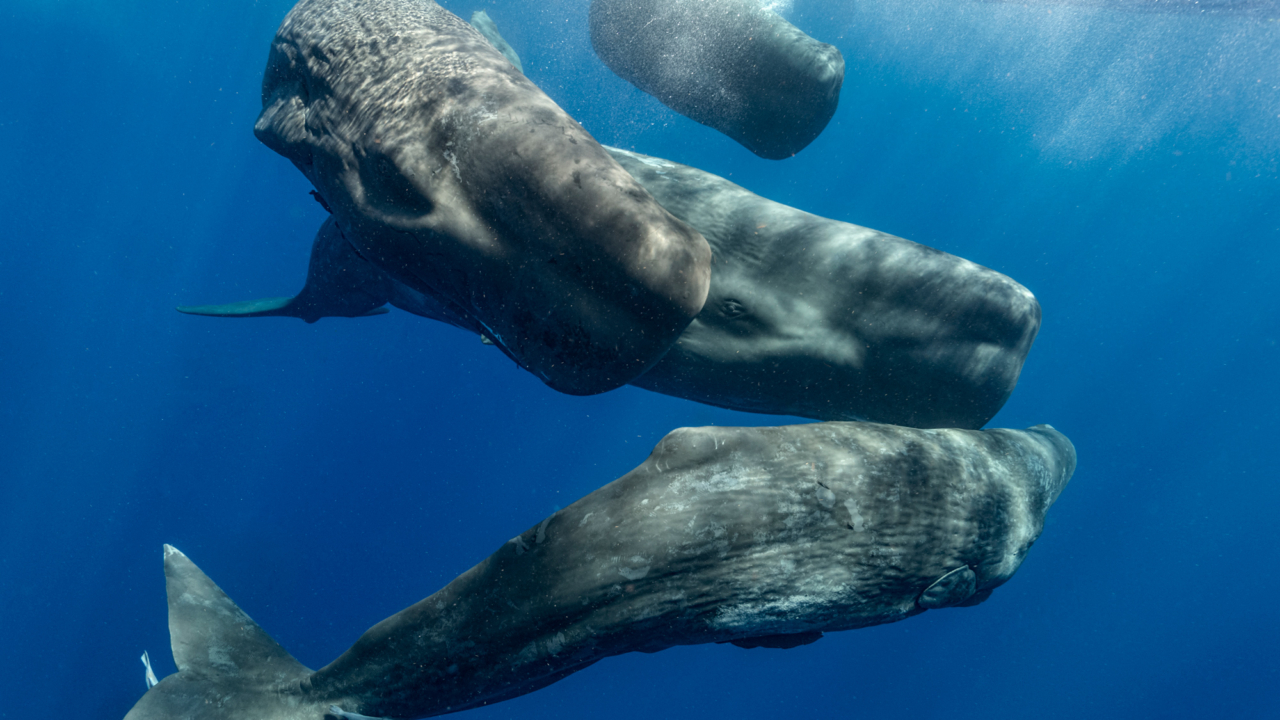
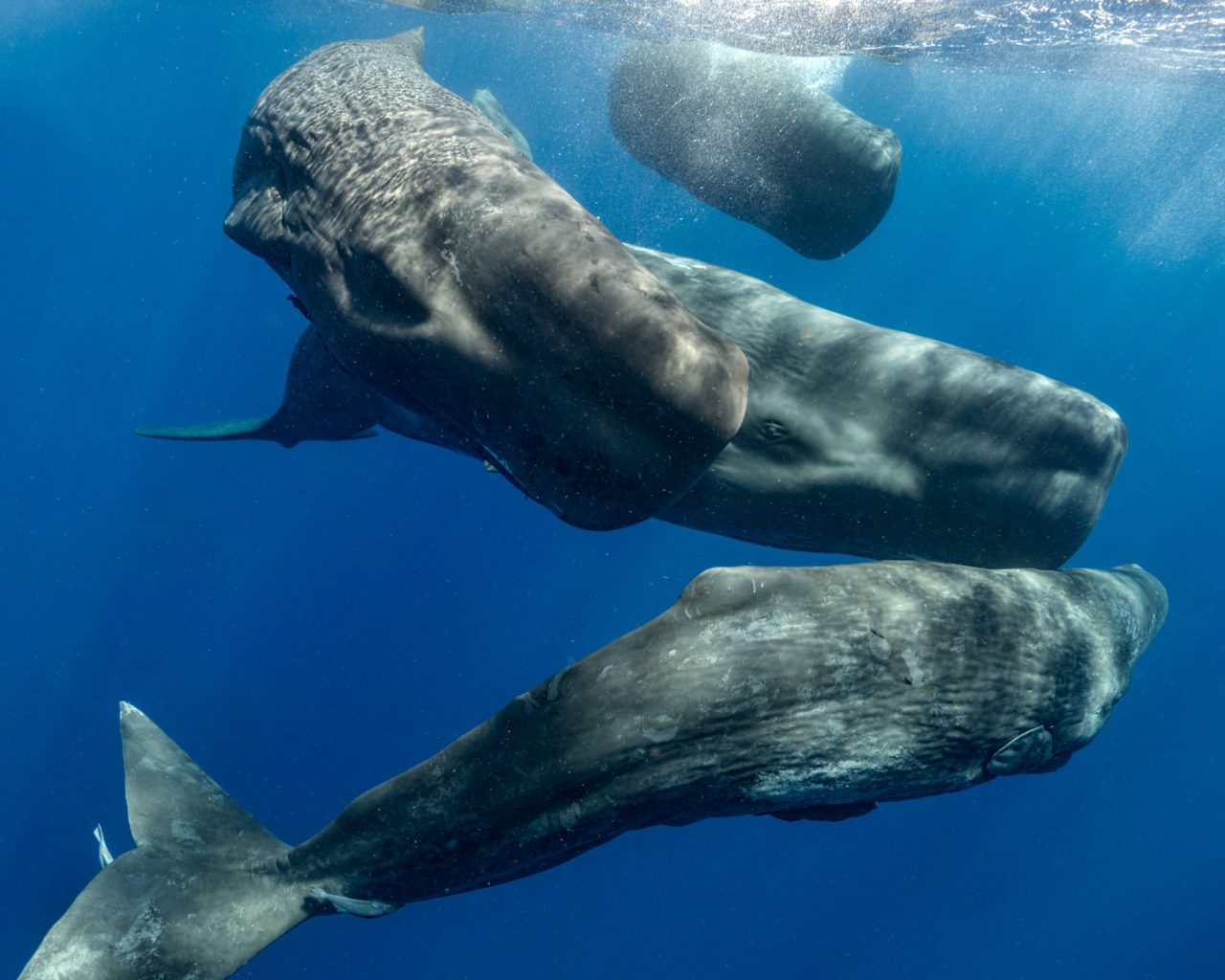
But this is a click, the sound a sperm whale makes in the presence of another. It’s hard to describe. Not wet like a person’s voice or sonorous like a humpback’s song, clicks arrive in tight, percussive beats known as codas. At first, they seem almost robotic. But the longer I listen—as the theoretical computer scientist Orr Paradise adjusts the dials on an AI model he built to translate any sound into sperm whale vocalizations—the more the clicks start to sound like one end of a conversation.
The system Paradise is tweaking is called WhAM, short for Whale Acoustics Model. Its interface is simple, inviting, and resembles a light-up dance floor. He shows me how the model works in a hotel lobby, during a break from presenting WhAM at the machine-learning conference NeurIPS. He’s wearing a bright pink fleece that nearly matches the colors on his screen. He asks me to give the model something to translate.
At first, it picks up ambient audio by mistake, but Paradise doesn’t think “Last Christmas” will translate well into sperm whale. Instead, he suggests I snap my fingers into his laptop’s microphone. In an instant, WhAM converts the snapping into a sperm whale coda and predicts the sequence of clicks that might follow in the wild.
Paradise created WhAM with Project CETI, a nonprofit working toward something audacious: to one day translate the language of and communicate with sperm whales. For now, the clicks WhAM produces carry no meaning. If we had successfully translated “Last Christmas,” a listening whale would not have grasped the song’s holiday heartbreak. With any luck, that won’t always be the case; the team behind WhAM is intent on making the AI model conversational in the coming years.
At this juncture, though, the absence of meaning is intentional. WhAM operates across what Paradise and his team call a “semantic gap,” focusing only on acoustic structure, because it was built on the architecture of another AI system designed to generate music. When Paradise first encountered that model—known as VampNet—a few years ago, he saw possibility in its ability to riff on any sound, recombining fragments into plausible variations. If a machine could create music like this, he reasoned, perhaps it could begin to learn a language humans can’t yet understand.
Video courtesy of Project CETI
The idea that sperm whale sounds might constitute a language—systemic communication with its own structure and conventions—is still relatively new. Research dating back to the 1960s documented whale clicks largely in terms of quantity and timing, treating them a little like Morse code. In other words, more signal than speech.
But Project CETI is challenging that view. In recent years, the group has published studies arguing that sperm whale communication is far more complex by drawing analogs to our own speech. In a 2024 paper in Nature Communications, researchers described what they call a sperm whale’s “phonetic alphabet,” borrowing terms from music theory to classify recurring click patterns. The study proposed that whales combine these units into phrases and vary them depending on social context. Last year, a paper in Open Mind identified systemic shifts in click lengths, resonances, and frequencies—features that the authors cautiously, albeit controversially, likened to vowel sounds.
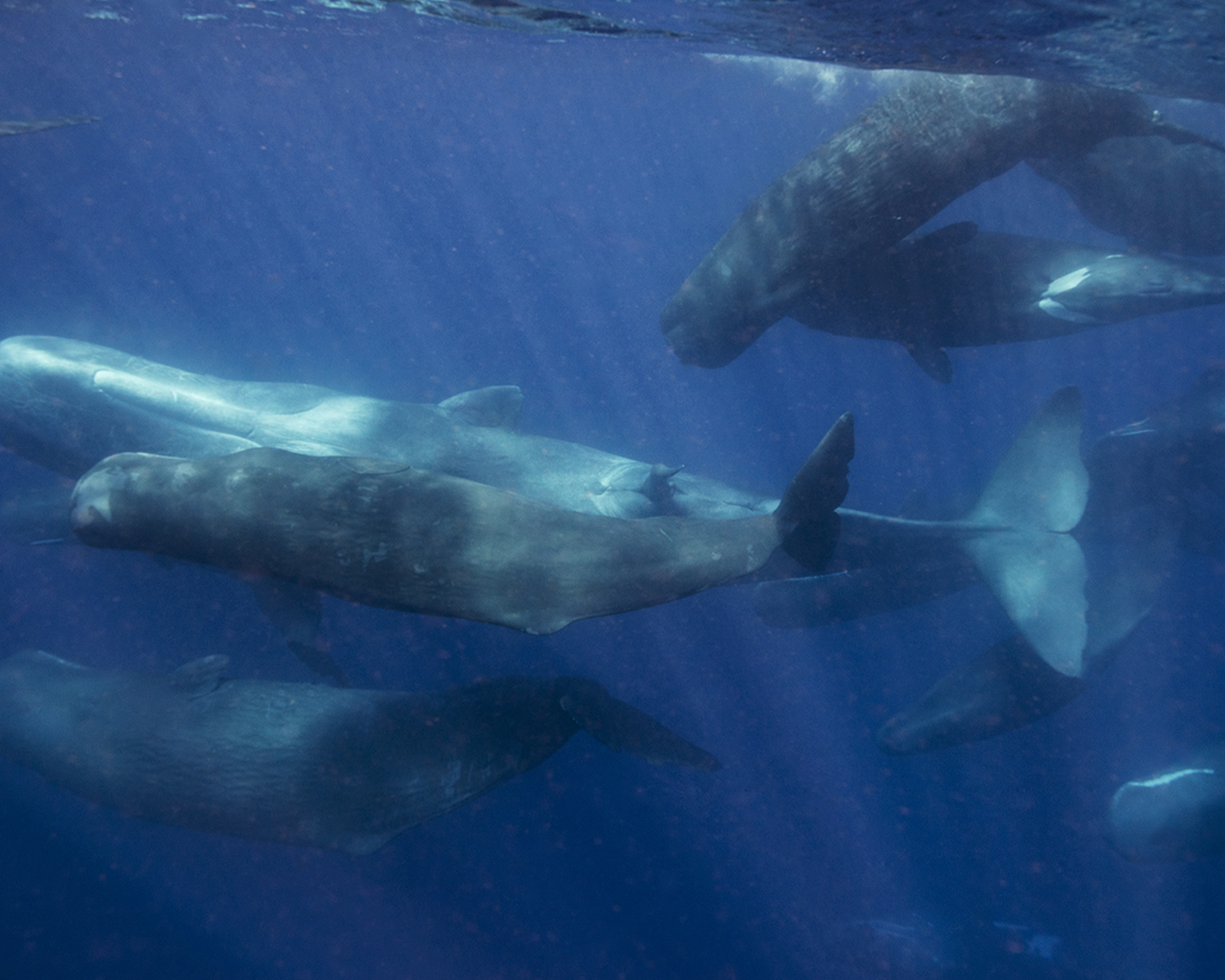
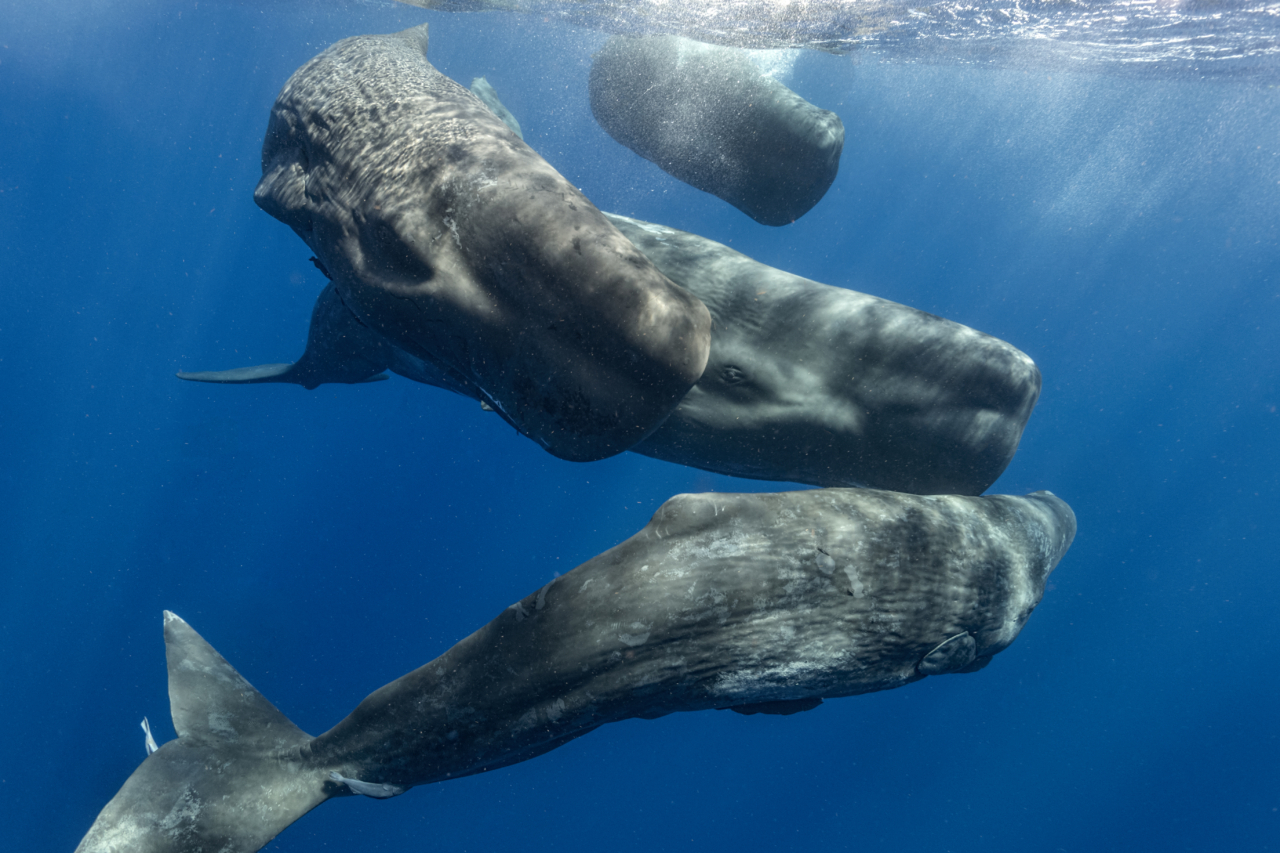
A family unit of whales echolocates with surface sounds.
To teach WhAM how to speak sperm whale, Paradise and an international team of graduate and undergraduate students, including Paradise’s advisor and Turing Award winner Shafi Goldwasser, spent months training it on an ark’s worth of animal audio from open databases. They fed the system birdsong, dolphin chirps, and even the occasional human mimicking a big cat’s call. From there, they narrowed the data to sperm whales alone, drawing on recordings from the Dominica Sperm Whale Project and Project CETI’s marine biologists. WhAM, then, finetuned its own understanding through a kind of acoustic Mad Libs, predicting missing sequences in codas until it began to sound convincingly whale-like. “The model learns never to generate cow moos,” Paradise said, “never to generate a snare [drum].”
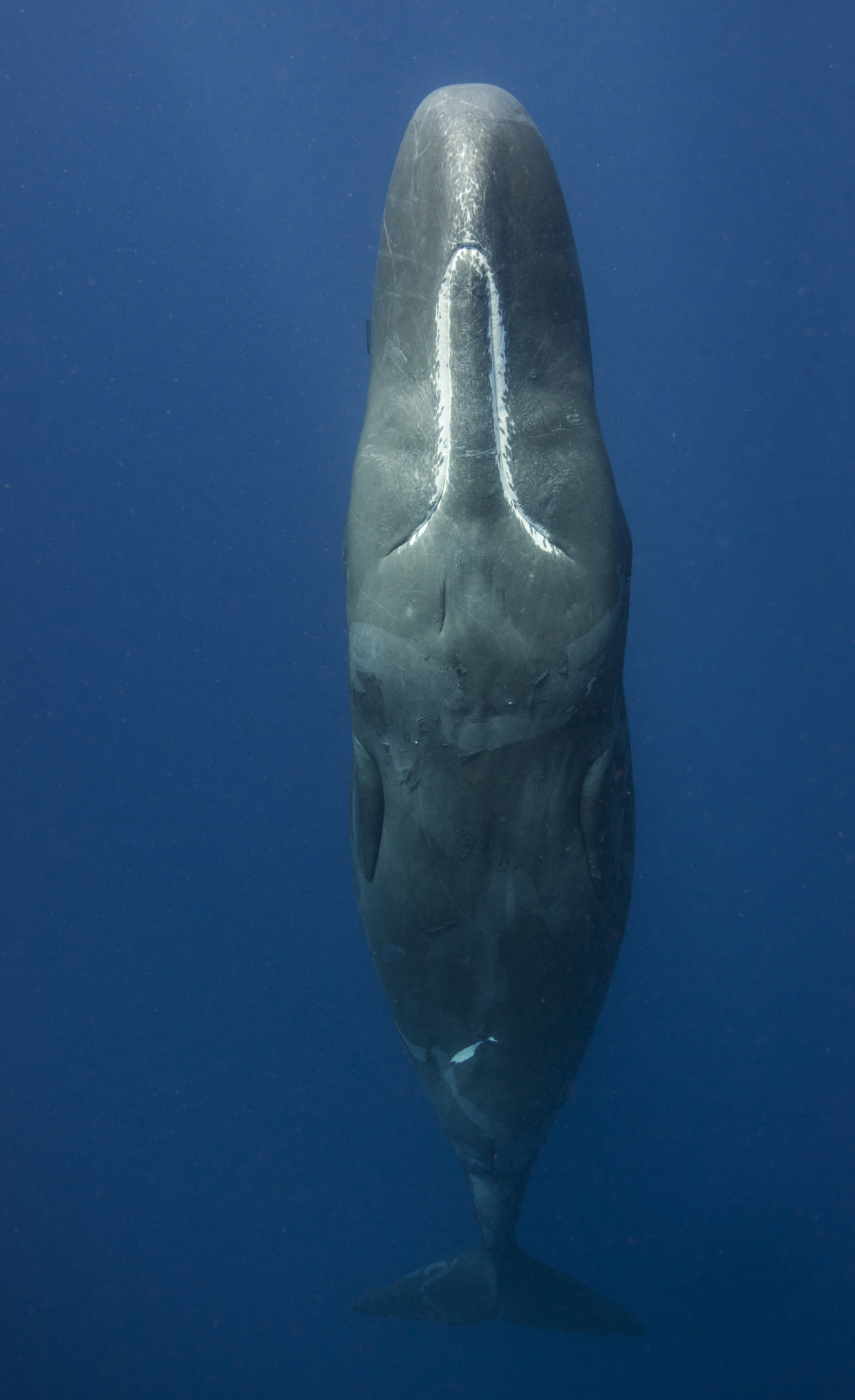
Today, WhAM may detect acoustic features of sperm whale clicks “we never even thought to think about,” Paradise said. Unlike human listeners, the model searches for patterns without prior knowledge of how people talk and what we talk about. For this reason, machine learning may be well suited to uncover unique features of communication in animals that spend much of their lives 3,000 to 10,000 feet underwater, possess the largest brains on Earth, and produce the loudest known biological sound.
Machine learning is well suited to uncover unique features of communication in animals that spend much of their lives 3,000 to 10,000 feet underwater.
A 2023 theoretical paper co-authored by Paradise posits that the greatest challenge for translation lies in the aspects of whale life that do not overlap with human experience. Paradoxically, that gap may play to machine learning’s strengths. The more complex sperm whale communication is, the more likely a model is to learn its patterns even across the “massive domain gap,” the team theorized.
“The real frontier is the parts of their world and our world that are different,” Project CETI founder and CEO David Gruber told Atmos.
Human expertise remains central to the process. Paradise evaluated WhAM’s progress partly through perceptual tests with marine biologists and acousticians. They were asked to distinguish between real sperm whale clicks and those generated by the model. Their feedback helped identify where the model was convincing and where it wasn’t. They pointed to giveaways like odd click volumes, coda rhythms that sounded closer to echolocation than social calls, and background noise that didn’t ring true.
Paradise also compared real whale codas with WhAM’s translations of other sounds, including synthetic beeps and walrus barks. Each time, the system reshaped the audio to more closely match the acoustic profile of sperm whale codas. For four species, WhAM’s codas were indistinguishable from the real thing.
“What do we want the interface between us and whales, or us and the natural world, to look like?”
Gruber thinks of WhAM like an early internet browser—at once crude and a big paradigm shift.
But while Project CETI has drawn attention for its long-term ambition to one day talk with sperm whales, its founder is now focused on a more immediate goal: learning how to listen. “What do we want the interface between us and whales, or us and the natural world, to look like?” he said.
CETI’s scientists hope to use WhAM to test hypotheses about whale communication through playback experiments, a long-standing but ethically fraught method in animal-behavior research. Traditional playback, which broadcasts sounds directly to whales, has sometimes caused distress. Whales have fallen silent, swum away, and even charged research boats. If WhAM becomes sophisticated enough, scientists could run many of those tests on the model first, probing how whale communication works without intruding on living animals at all.
For Gruber, that possibility offers a rare opportunity for artificial intelligence to expand human understanding beyond optimization and toward other forms of intelligence. “We can’t put this technology back in the bag and pretend it was never here,” he said. The question, for him, is whether technology can actually bring us closer to the natural world. As someone who still longs for days spent observing a single head of coral, Gruber admitted: “I honestly still keep a question mark at the end there.”
Video courtesy of Project CETI
His path to founding CETI reflects that earnest curiosity. Trained as a marine biologist studying sharks, sea turtles, and jellyfish, Gruber became increasingly interested in whales—and frustrated by scientific silos. “I couldn’t find any whale biologists that would take my phone call,” he said. Roger Payne, the biologist whose album Songs of the Humpback Whale helped ignite the storied conservation movement, proved to be an exception. Payne spent three hours on their first call trading “creative, outside-of-the-box ideas,” and became both a friend and mentor.
Payne’s generous ethos has shaped Project CETI’s ecosystem of collaborators from its inception, and even after his passing in 2023. The group brings together linguists, marine biologists, theoretical analysts, computer scientists, robotics experts, and ethicists, insisting that no single field can make this leap in understanding alone. As Paradise’s mentor, Shafi Goldwasser, told him before he joined the project: “Nobody has the right skill set for this task.”
In an age of ecological rupture, the fact that Paradise’s AI model can begin to untangle another creature’s communication challenges a long-held assumption that animal intelligence should resemble ours to count as intelligence at all. “Even if we don’t understand what [sperm whales are] saying, or even if it turns out that what they’re saying is not really humanly relatable, in the end they still deserve empathy,” he said. “WhAM being already something that you can interact with, I think has immense value.”
Join our membership community. Support our work, receive a complimentary subscription to Atmos Magazine, and more.
We Are One Step Closer to Understanding Whales. What Now?