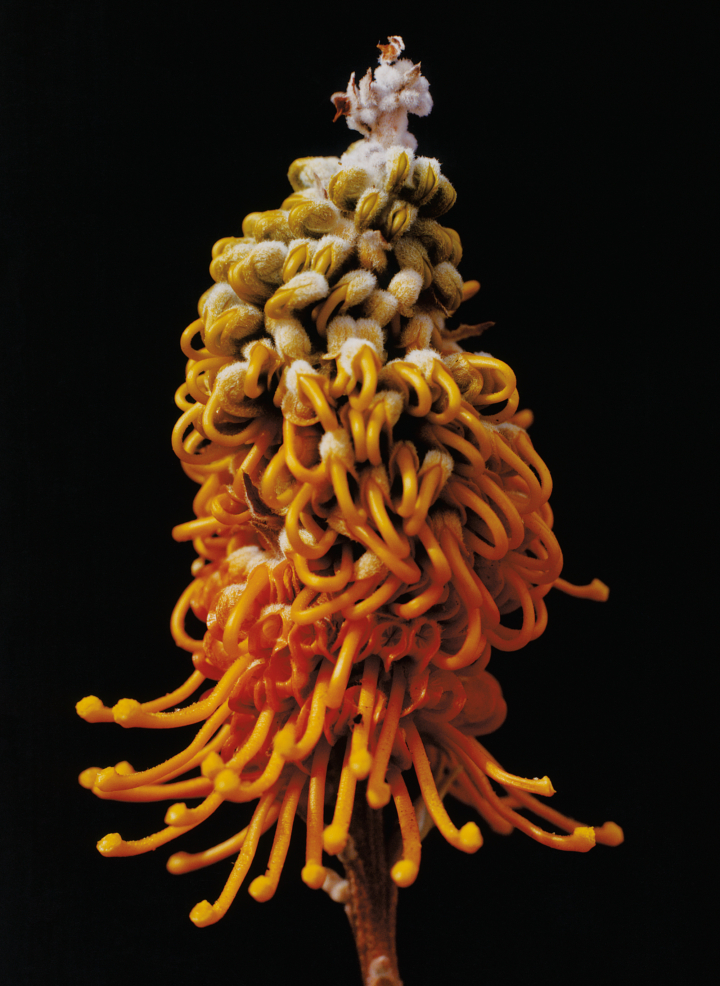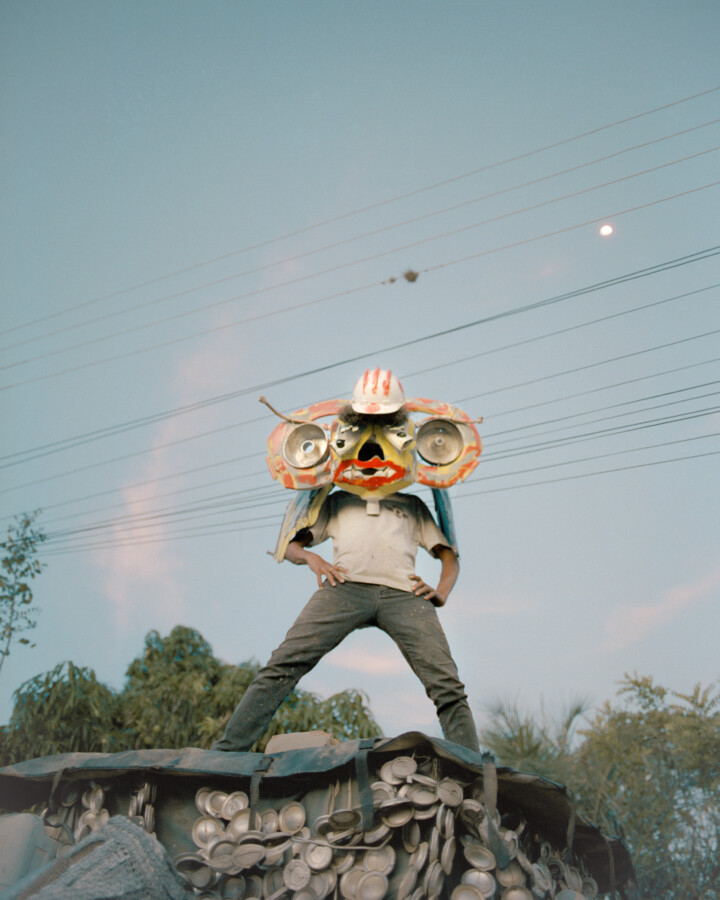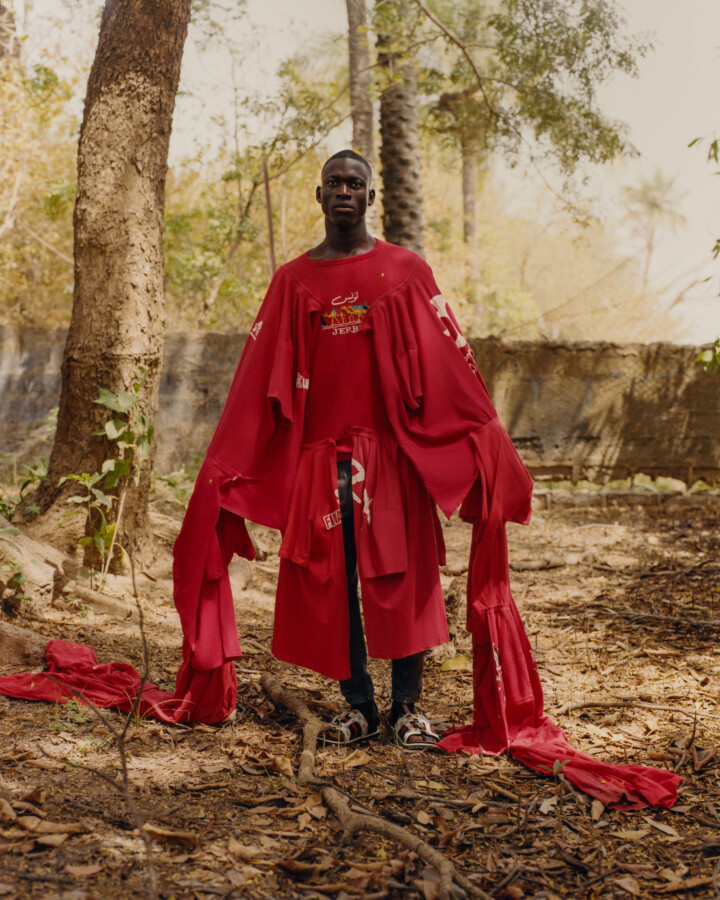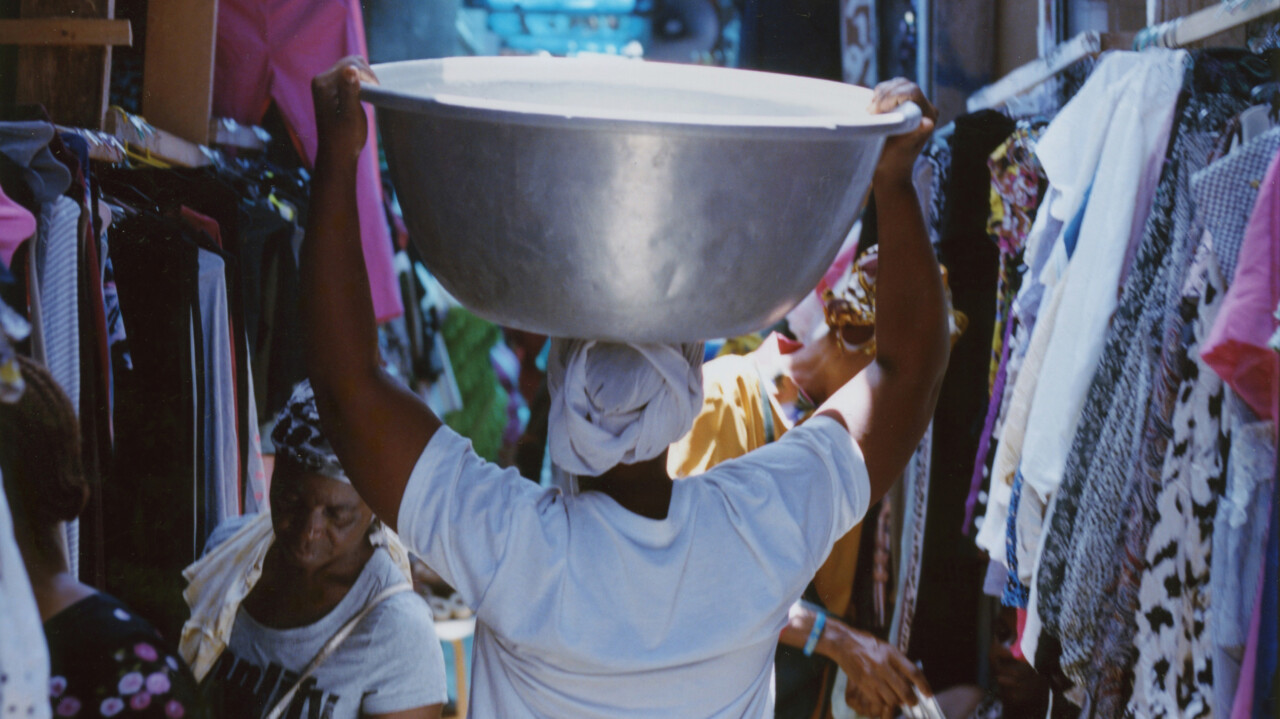

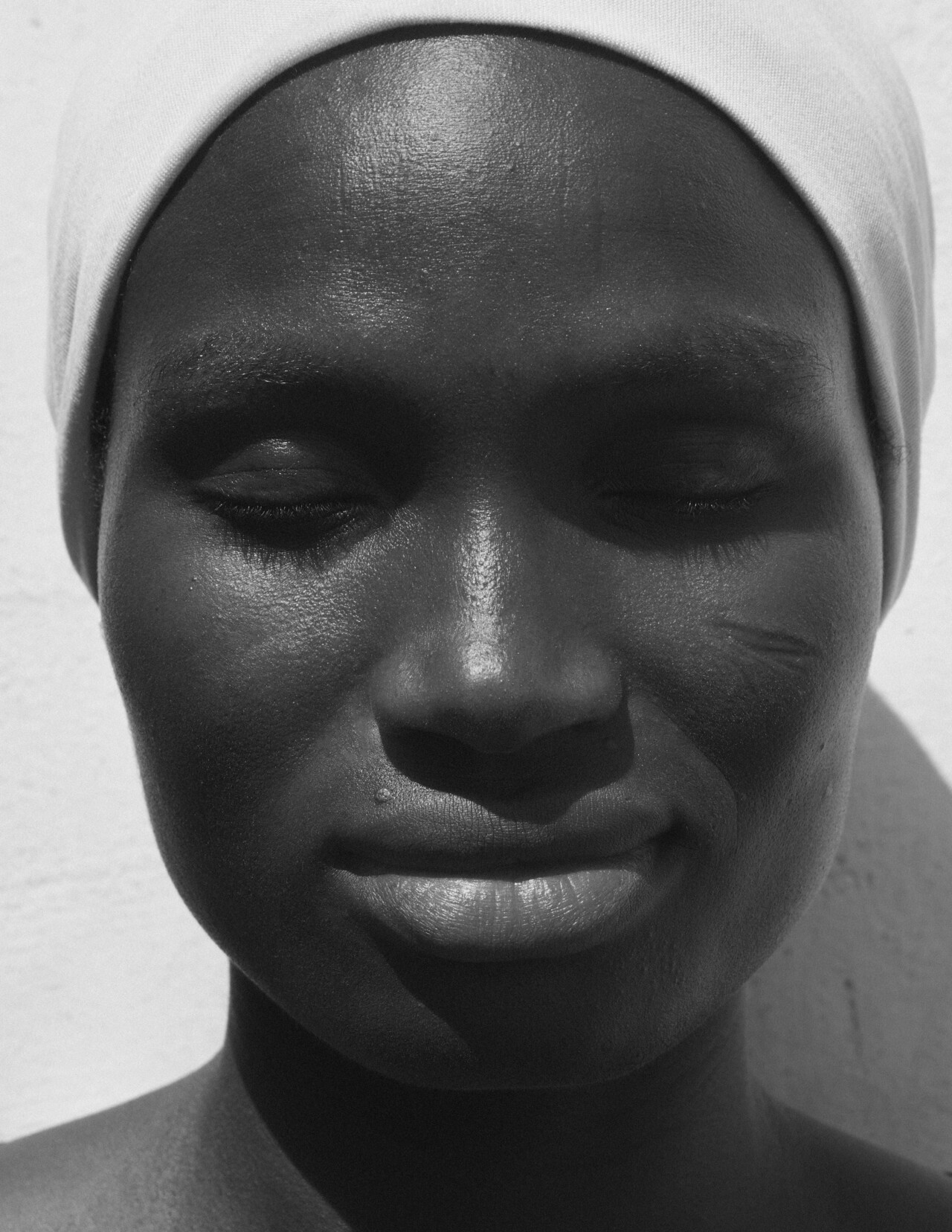

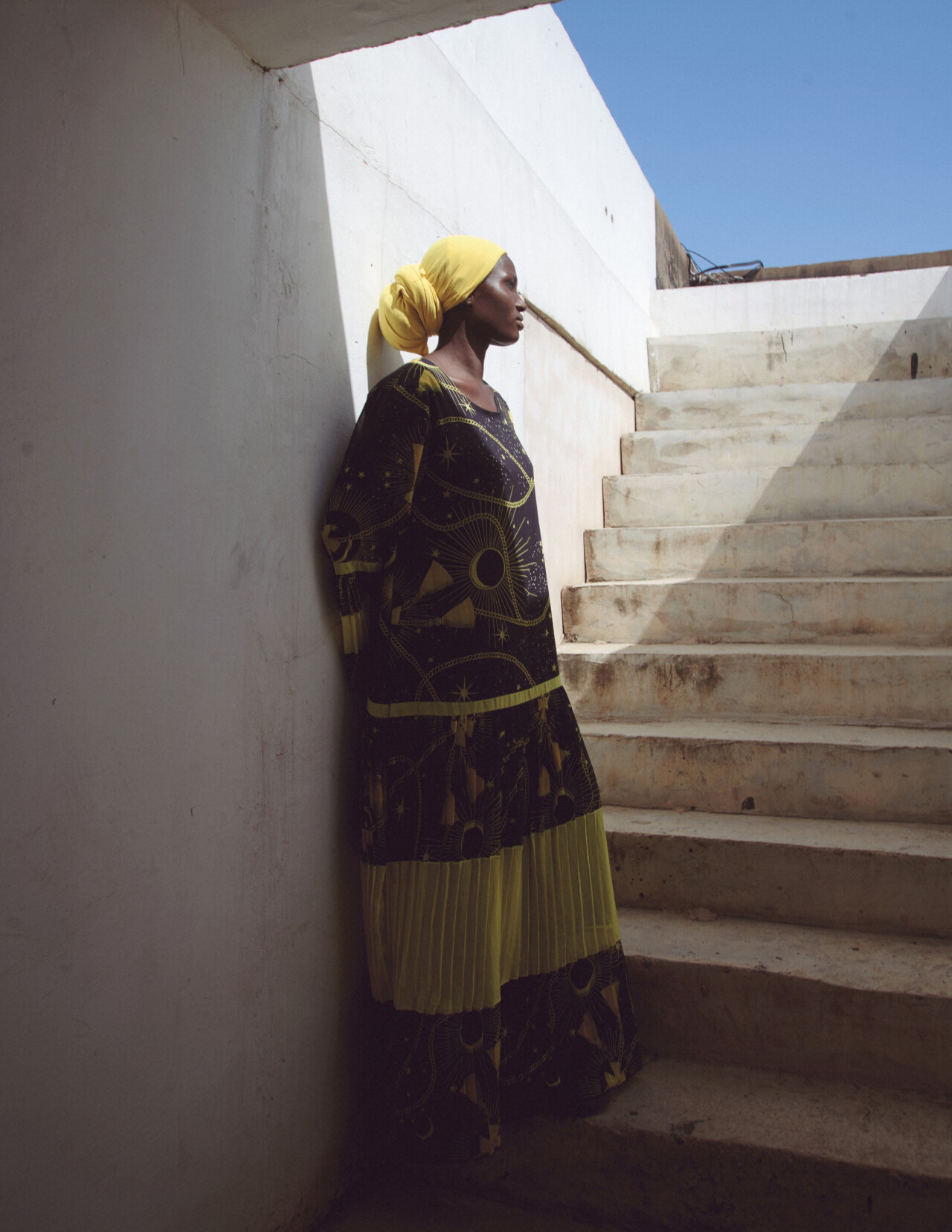
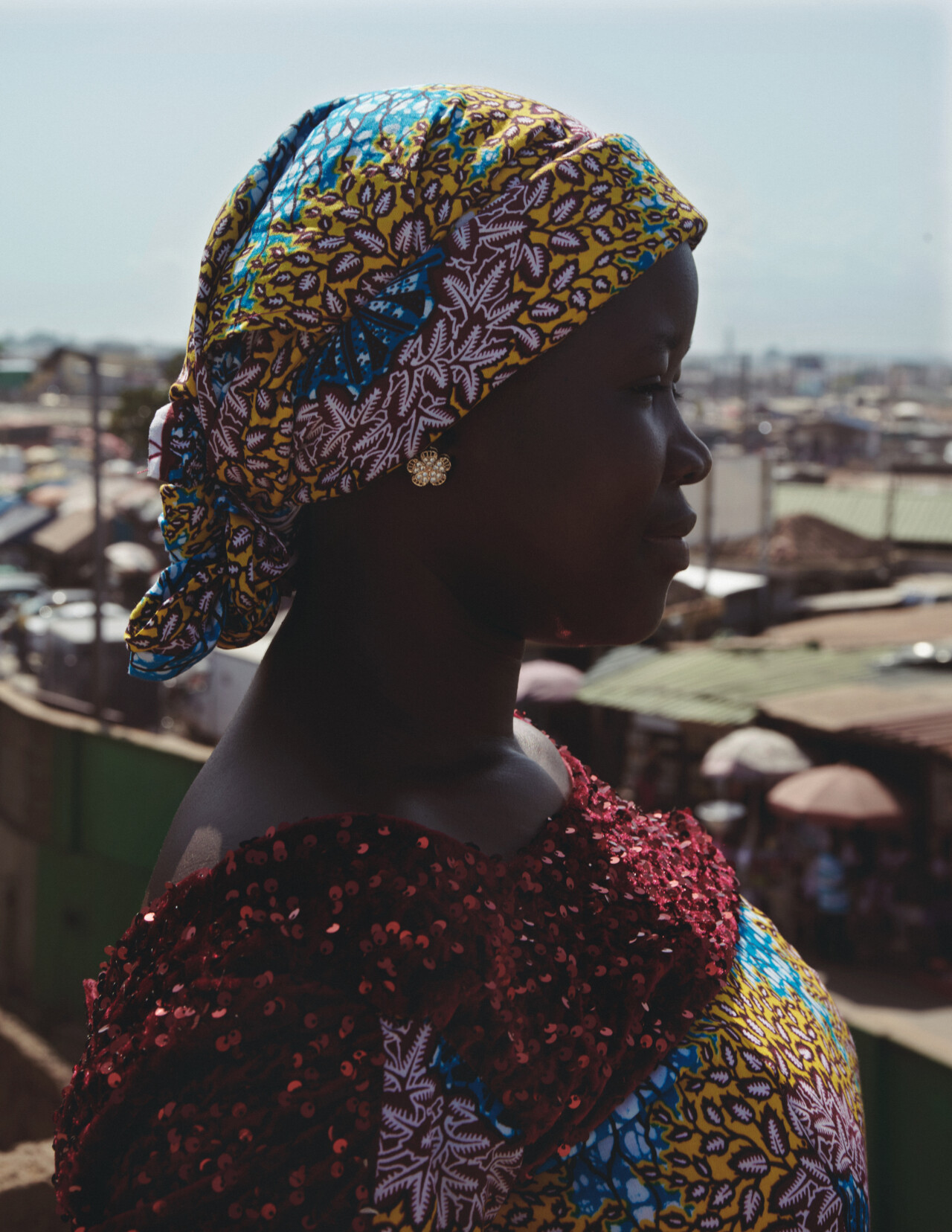
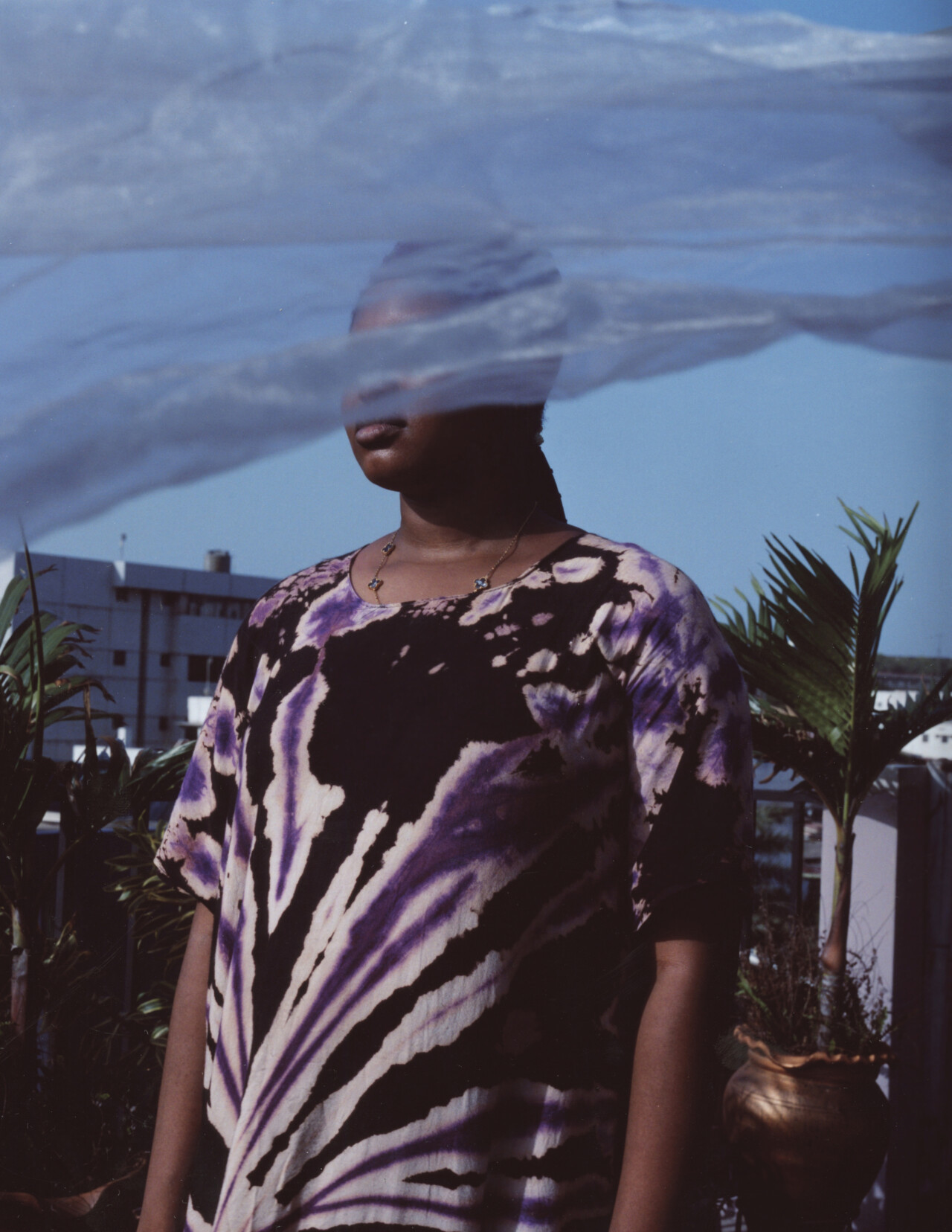
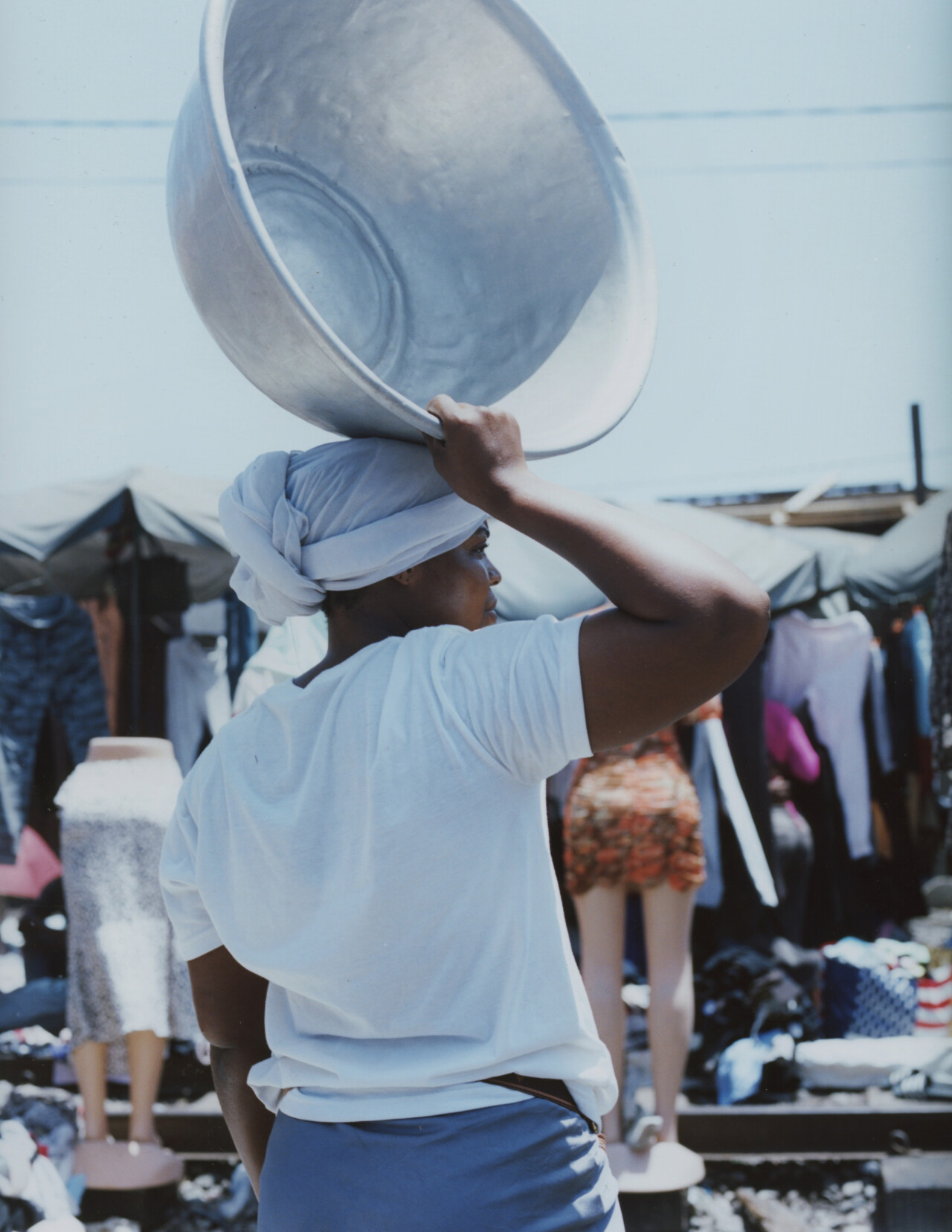
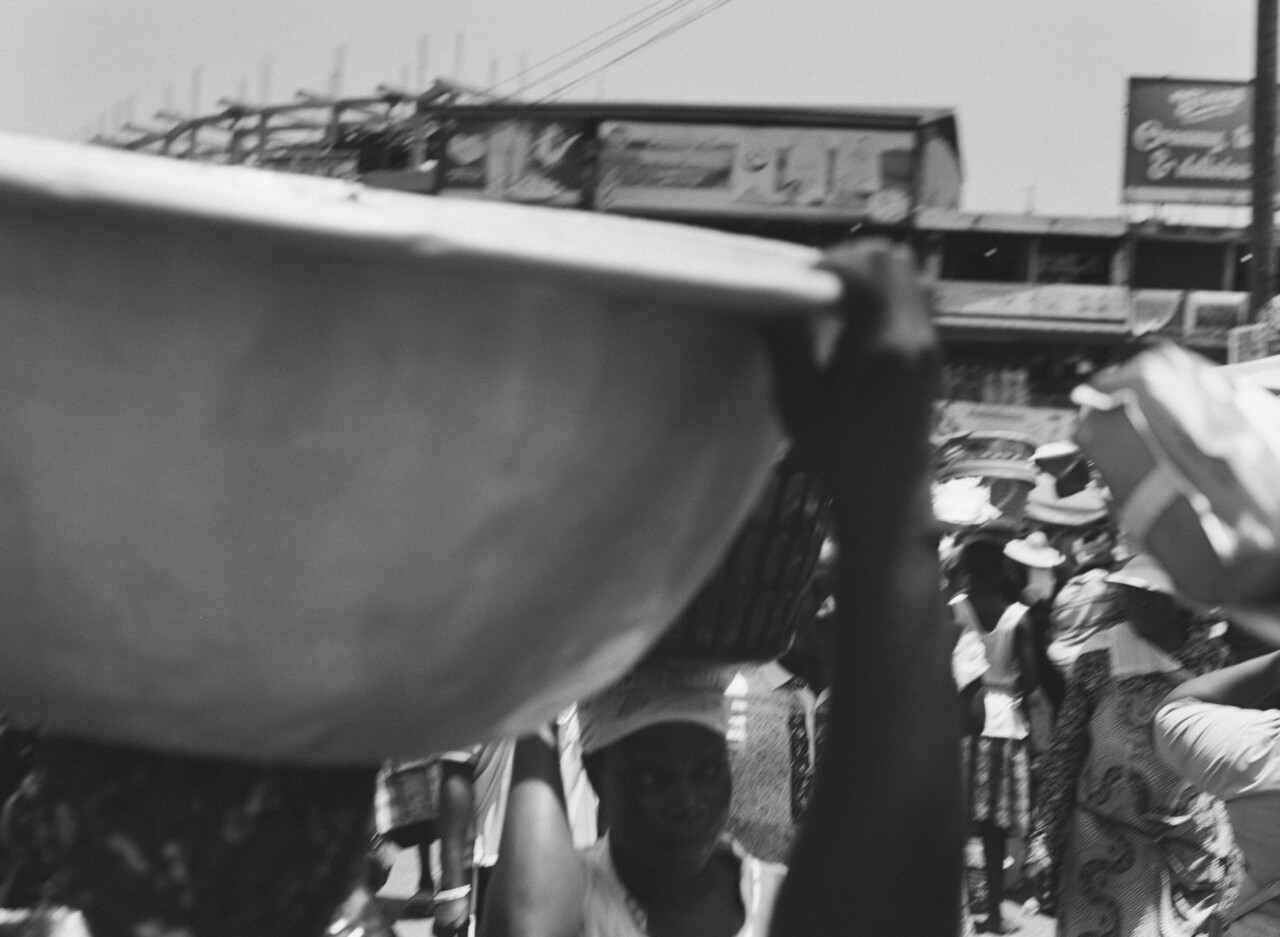
Amina follows her daily route through the busy Kantamanto Market. Surrounded by secondhand clothes, sellers, and buyers, it takes some time to navigate the maze. Note: The pots photographed were intentionally left empty to avoid any visible weight.
words by whitney bauck
Photographs by Eric Asamoah
Najiha Yahaya has a wide smile, a creative impulse so strong that she taught herself to crochet without the help of a smartphone or YouTube, and the kind of courage that allows her to stand before powerful men and defy them to their faces. But if you had met her when she first arrived in Accra alone at 15 and began working as a head porter, or kayayo, carrying heavy bales of secondhand clothing on her head, you might not have seen any of that.
Born and raised in Kpilo, a small farming community in northern Ghana, Yahaya moved to the bustling capital of Accra to earn just enough money for books and a school uniform before returning home. In the rural community where she grew up, she had seen people carry water or bundles of firewood on their heads, but she had never done it herself because her dad insisted she was too young to haul heavy loads. In Accra, though, a teenage girl from a farming background with an incomplete education had limited economic options. So Yahaya quickly began head porting to make ends meet.
She found herself in Kantamanto, one of the largest secondhand clothing markets in the world. There, garments discarded by customers in Europe, China and North America arrive packed into large bales that usually weigh about 120 pounds. Small-scale retailers selling that clothing to Ghanaian customers pay kayayei like Yahaya less than $1 to carry the bales on their heads through the market’s narrow aisles to their stalls.
The first time Yahaya loaded one of those crushingly heavy bales onto her head, she cried. Rather than ask her what was wrong, the retailer who’d hired her told her coldly that if she wasn’t up to carrying the load, she should go back to the North.
Despite the ways that customers talked down to her, and the pain that began to blossom in her chest each time she loaded up with a bale that weighed more than she did, Yahaya gritted her teeth and kept working. She used the few cedis she earned each day to pay for a place to sleep in a small room shared with more than a dozen other women, and saved whatever else she could.
After about three months, she finally had enough money to return to Kpilo. But once she was home, it wasn’t long before her father decided he no longer wanted her to go to school, and arranged for her to be married off—to a man closer to his age than hers. Yahaya soon found herself stuck with a husband who beat her and his other wives. She decided to leave for Accra and the market again, this time with a baby in tow.
Yahaya is just one of about a thousand women who end up working as kayayei in Kantamanto each year. Though the job is often the first that women from the northern regions of the country can find upon landing in the capital, Yahaya sees it less as an opportunity than as a trap—the kind of job you get stuck in despite the poor pay, the lack of upward mobility, and the ever-present risk of serious harm.
“It’s something I don’t think anybody will wish to be doing,” Yahaya told Atmos, describing it as an option women take up when the only other alternatives they can see are stealing or sex work. “Head porting is a slavery.”
The comparison between slavery and head porting can feel jarring, especially considering the long, grim shadow that chattel slavery still casts on both sides of the Atlantic. Just a few hours’ drive from where Yahaya sits is Cape Coast Castle, known as the “gate of no return,” the last place enslaved Africans saw before beginning their forced journey to the Americas. Once across that vast ocean, W. E. B. Du Bois wrote in Black Reconstruction, “they descended into hell.”
And yet the comparison to slavery is one that you hear over and over when you spend time talking to kayayei, former kayayei, and the people who advocate for them. Some girls are literally trafficked, lured to Accra by an agent who promises good jobs and then keeps all the money the girls earn, effectively entrapping them without resources hundreds of miles from their families.
Other times, the comparison has more to do with how kayayei are treated or their living conditions. “People really abuse them in the market because they are a minority,” said Mambaru Mustapha, who works on a scholarship for kayayei created by the nonprofit The Or Foundation, an environmental justice organization that works extensively with kayayei. “People literally call them animals.”
“It’s something I don’t think anybody will wish to be doing. Head porting is a slavery.”
Huzeima Hafiz, who fled her home in the north to escape a forced marriage, got a job selling tea and provisions in Accra—only to end up with a boss who repeatedly tried to sexually assault her. She left that job and became a kayayo. Since she made as little as a couple of dollars a day head-carrying in the market, she resorted to lodging in Old Fadama, a slum on the edge of a trash dump where many other kayayei live. There, she stayed in a small, unfurnished room with a dozen other women, sleeping side by side on the floor. To use a shower or toilet, they had to walk down the street and pay to enter a public bathroom.
Getting to their shared room from the market required walking past roving packs of goats, chickens, and pigs, and alongside fires where residents burned e-waste, releasing toxic smoke as plastic melted away to reveal copper and other metals that could be resold. If Hafiz blew her nose at the end of the day, the tissue came away black. The floor of her shared room was neither paved nor tiled, so when it rained, water seeped up from the ground—some of which in Old Fadama is functionally dirt-covered landfill—causing skin issues that persisted as long as she lived there.
“I wasn’t feeling okay because of the noise and the air pollution,” she said. “[Living near] the dump is not good for our health.”
The living conditions aren’t the only thing eroding the health of kayayei, though. There’s also the work of head-carrying itself. Carrying things on one’s head has been the norm in Ghana for millennia, but the routine expectation that kayayei should be able to haul dangerously heavy loads multiple times a day in the secondhand clothing market is something else entirely.
Kayayei regularly report pain in their chests, necks, backs, feet, and knees, but most can’t afford to see a doctor. If they do manage to see a professional, discrimination is common. Mustapha recalled accompanying a kayayo to the hospital and hearing a health worker ask, “‘Why are we wasting money on these girls?’”
Beyond noticing pain, most kayayei aren’t aware of what head-carrying is doing to their bodies. So in 2021, The Or Foundation set out to try quantifying those health impacts. The organization brought 100 kayayei between the ages of 12 and 40 to see Dr. Naa Asheley Ashietey, a chiropractor who X-rayed all the participants and provided a basic health screening.
What Ashietey saw deeply alarmed her. The burden these girls and women had borne was etched into their bones. She saw teenagers and young women whose spines had degenerated so severely that they looked like they belonged to someone decades older. Some had developed bone spurs. Others had discs so worn down that their spinal bones were literally rubbing against one another, pinching nerves and causing intense pain. Others still had lost the natural curve in their neck and spine, or conversely, developed scoliosis. Many sustained foot injuries, too, from tripping while carrying heavy loads.
Some had compression fractures, “which come up usually due to physical trauma of the spine, like if you were to be in a car accident,” Ashietey said. “And then I would ask them, ‘Have you fallen? Have you had an accident?’” But they would tell her no, leading her to conclude that “the compression fracture is directly coming from the pressure of carrying those heavy loads on their head.”
In a few particularly severe cases, Ashietey was so alarmed that she said, “Hey, if you don’t stop [head carrying] right this second, this is not going to end well.” But according to Hajara Musa Chambas, The Or Foundation’s Kayayei Outreach & Education Manager, there are always women who are too desperate to feel they can stop. Chambas recalled one woman who returned to the market despite being warned not to, only to lose the ability to move her neck—and eventually her whole body—within weeks of seeing Ashietey.
Mustapha thinks often of a woman named Aisha Adam, who was the sole provider for her three kids. Adam was carrying a bale of secondhand clothing on her head and her baby on her back when she tripped on the railway just outside Kantamanto. The bale fell on top of Adam, breaking her neck and killing her. Her baby survived, but is now growing up without a mom. And Adam isn’t the only kayayo who has been killed on the job, Mustapha said.
Losing even one life this way is a horrific tragedy. But it’s made all the more senseless when you consider what this dangerous labor is in service of: a fashion system built on excess, in which companies and governments in the Global North export their waste to the Global South and pass it off as charity. This extractive dynamic echoes throughout fashion’s history. In the 18th and 19th centuries, African labor was exploited at the beginning of the supply chain on cotton farms in the Americas; in the 21st, African labor is being exploited at the end of the supply chain to handle textile waste. The names have changed, but a business model built on human rights abuses remains.
Today’s massive fashion companies, from luxury labels to fast-fashion giants, have produced many of the world’s richest men, their business models built on overproducing clothing through supply chains that exploit both landscapes and people. When that clothing is discarded by their customers—maybe because it’s fallen apart, maybe because trends move so fast that it looks “dated” just a few months or years after purchase—it is donated to secondhand stores, passed along to exporters, and shipped to places like Ghana.
“If a developed country cannot take care of that waste, what do you think a developing country can do about that waste?”
Some of that clothing is resold by retailers and skilled upcyclers in Kantamanto, but even the most creative minds cannot salvage all of it. The Or Foundation estimates that between 29-40% of what enters Kantamanto on the head of a kayayo leaves the market as waste, where it will go on to clog riverways, pile up in the dump near Old Fadama where many kayayei live, and wash up on the beach.
“If a developed country cannot take care of that waste, what do you think a developing country can do about that waste?” Chambas asked.
This, perhaps, is where the troubling comparison to slavery that Yahaya and so many others make starts to feel most apt. Though the system harming kayayei is barbed by the disregard and discrimination of their fellow Ghanaians at home, it’s ultimately fed by a giant monster of capitalism designed to enrich wealthy people, mostly in the Global North, without whom the system wouldn’t exist in the first place. Whether it’s garment workers in Bangladesh dying in unsafe factories, forests in Brazil dying to clear space for leather-producing farms, or kayayei dying under the burden of textile waste, the modern fashion industry has built its record-breaking profits on treating some lives as disposable.
Kayayei carry the literal weight of the fashion industry’s greed and excess on their heads. Some pay for it with their lives.
Those living closest to the violence of the system are also often the clearest about what would need to change.
One of the simplest solutions that Mustapha, Chambas, and others working on behalf of kayayei at The Or Foundation have identified is giving women access to their own health information. While the organization’s chiropractic research was sobering, it also had some immediate positive outcomes: About 40 of the 100 women who participated stopped head carrying and returned home to the north after seeing their X-rays and having them explained, according to Chambas.
“That alone was very empowering for me,” Chambas said, “because once they understand the level of risk that they are putting their lives in … there’s going to be so much change.”
Another major effort of the organization is the creation of a feature-length film, Zjili, set to be released later this year, which tells the fictional story of a kayayo named Zoya as she moves to Accra from a village in the north. Inspired by a composite of true stories from a host of kayayei and co-directed by Chambas and Christine Boateng, Zjili marks the first time kayayei’s stories have been brought to the big screen. The Or Foundation plans to use the film to educate a wide range of audiences about the realities facing kayayei, from Accrans who hire kayayei in the market for a few cedis, to those in northern Ghana who send their daughters into this line of work without fully understanding what awaits them, to the Global North whose fashion waste undergirds the entire system.
At beta screenings in February in Northern Ghana, viewers appeared shocked to learn just how harsh life can be for their sisters, daughters, and nieces who become kayayei. At a recent kayayei-only community screening in Accra, the crowd cried, gasped, and whispered feverishly. When the film ended, a kayayo named Mohammed Arahamatu, who has been head carrying in the market for 10 years, stood up and spoke about how deeply it resonated with her own life, especially as someone who had just injured her leg while carrying a bale.
“This film is not just a movie,” Hafiz said later. “It’s a true story of us … It touches everyone’s story.”
The Or Foundation has established a scholarship and apprenticeship program for women and girls seeking a path out of head-carrying. Those with high enough grades can receive support to attend any university in Ghana, with the foundation covering the cost of books, tuition, room and board, and medical fees. The program is called the Aisha Adam Mabilgu Scholarship, in honor of the mother who lost her life head-carrying in the market.
Others will go the apprenticeship track, where they can learn a trade such as leather working, sewing, carpentry, plumbing, electrical repairs, or digital and media management, alongside entrepreneurship skills—everything from how to write an email to how to design a flyer for social media—to help them eventually build businesses of their own. At the same time, the women receive mentoring, group counseling, and emotional support. Developing their sense of self is crucial, Chambas said, especially for women who have spent years being treated so poorly that many scarcely know how to express themselves or advocate for their own needs.

“Whether it’s garment workers in Bangladesh dying in unsafe factories, forests in Brazil dying to clear space for leather-producing farms, or kayayei dying under the burden of textile waste, the modern fashion industry has built its record-breaking profits on treating some lives as disposable.”
Both Hafiz and Yahaya went through the program. Hafiz now works for The Or Foundation, assisting with the apprenticeship program and helping other women on their own journeys out of head porting. Yahaya has started her own business: a fashion brand called Dinnani, which turns T-shirt waste from Kantamanto into yarn that Yahaya crochets into colorful bags, laptop cases, and other goods. Yahaya testified last year at a United Nations Environmental Program multi-stakeholder dialogue, speaking confidently about her experiences as a kayayo in the face of people who would discredit her to avoid accountability. Her sure-footed, assertive demeanor was a far cry from the averted eyes and frightened silence that so many kayayei are intimidated into by the people treating them poorly in the market.
Still, not every kayayo will be able to leave the market immediately. One of the final scenes in Zjili features an unscripted conversation in which a group of kayayei realizes they need to form a union to stop retailers from pitting the workers against one another and driving down the price for their services. After the beta screening, a few women got up to ask: Why not do this in real life? A union wouldn’t eliminate the dangers of head carrying—from Dr. Ashietey and The Or Foundation’s perspective, the work is inherently dangerous—but it could at least help kayayei advocate for better pay.
For now, Kantamanto still depends on kayayei. Without them, the market—one of the best examples in the world of a functioning circular economy, where resale and upcycling reign supreme—could not operate. The alleys between stalls are so narrow that, at the moment, there is no way to move clothing bales in and out without human beings carrying them.
But the people behind The Or Foundation have an ambitious idea for how that might change, too: a complete rebuild of the market, with wider alleyways that would allow for carts instead of head-carrying. Their proposed plans would also improve ventilation and fire-truck access—an urgent need in a market that has burned down to devastating effect multiple times, most recently in 2025.
It’s an audacious dream, and one that would come with a price tag of 70 million dollars. But that sum looks more reasonable when set against the billions of dollars in annual revenue earned by the fashion companies whose overproduction fuels the problem. A world in which these companies would fund the rebuilding of Kantamanto—while also committing to reduce overproduction, manage their own waste, and fairly compensate the workers in places like Kantamanto who do so much of that work for them—is a world in which the job of carrying dangerously heavy bales of secondhand clothing might cease to exist.
For Yahaya, Hafiz, Mustapha, Chambas, and their colleagues, that’s a world worth fighting for. The lives of kayayei, they know, are worth it.
Join our membership community. Support our work, receive a complimentary subscription to Atmos Magazine, and more.
Meet the Women Carrying the Weight of Fast Fashion