Words by Chris Baraniuk
artwork by Natalie Liu
Stepping through a sturdy metal hatch, technician Jelle Pennekamp entered the lowest level of an offshore wind turbine. He was now inside a huge, hollow tower supporting three 318-foot blades at Hollandse Kust Zuid, a 139-turbine wind farm a little more than 15 miles off the Dutch coast. Around him, the low hum of machinery echoed up and down the steel structure as seawater sloshed below. That’s when he realized: Something was alive down there.
Rising gracefully toward the surface was the unmistakably rotund form of a curious seal that had gained access to the structure from a water-replenishment hole at its base. Pennekamp hastily opened the camera app on his phone and started recording. The creature came into view, made a neat U-turn, then slipped back down in a series of undulating maneuvers.
Pennekamp, who contracts with a Norwegian maintenance company called Føn Energy Services, has inspected countless offshore wind turbines, probing around inside them or abseiling down their exteriors. He had heard rumors from colleagues that seals sometimes swim into turbines to hunt fish and other prey taking up shelter there. But he had never seen it himself until early March. “When stuff like that happens, it feels almost like a meant-to-be feeling,” he said. “You’re connected to the ocean.”
The concept of energy infrastructure may not immediately conjure images of wildlife habitats, but certain examples of such infrastructure have lately been recognised as unexpected havens for biodiversity. Scientists now routinely document marine creatures visiting or living within offshore wind farms, ranging from microscopic organisms such as oyster larvae to much larger animals, including seals, sharks, and porpoises. This colonization has happened largely by accident. Researchers and the wind industry have spied an opportunity. These massive energy projects, which inevitably come with some negative ecological impacts—including risks for seabirds that fly into them, as one example—could also provide marine animals with a foothold in seas damaged by centuries of human activity.
Pennekamp was delighted to see the seal inside a wind turbine, though not entirely surprised. Having observed fish doing the same thing, it seemed to him that the seal had simply found an easy hunting ground. A 2014 study found that satellite-tagged seals entering offshore wind farms appeared to move deliberately from turbine to turbine, spending time around the bases of the structures. Pennekamp has also spotted porpoises swimming near turbines.
Vattenfall—the company that owns Hollandse Kust Zuid—says it takes measures to support biodiversity above and below sea level. A spokesperson told Atmos the turbines occasionally get shut down during migration periods to allow birds a safer passage, and the structures were deliberately designed by the company with larger-than-usual water replenishment holes to allow fish and other marine life to enter and exit.
The ocean ecosystem ultimately depends upon the smallest organisms, at the bottom of the food web, explained Boze Hancock, senior marine restoration scientist at The Nature Conservancy. At the base of that web, microscopic creatures support progressively larger life forms all the way up to dolphins and whales. Some fish feed on oyster larvae, for example, and seals in turn feed on those fish. This is known as a trophic pyramid. However, oyster beds in the Atlantic and North Sea—once vital components of the marine habitat in those areas—have suffered massive damage from trawler fishing and dredging. “These are the coral reefs of the north,” said Hancock. “My focus is getting the bottom of that trophic pyramid established again.”
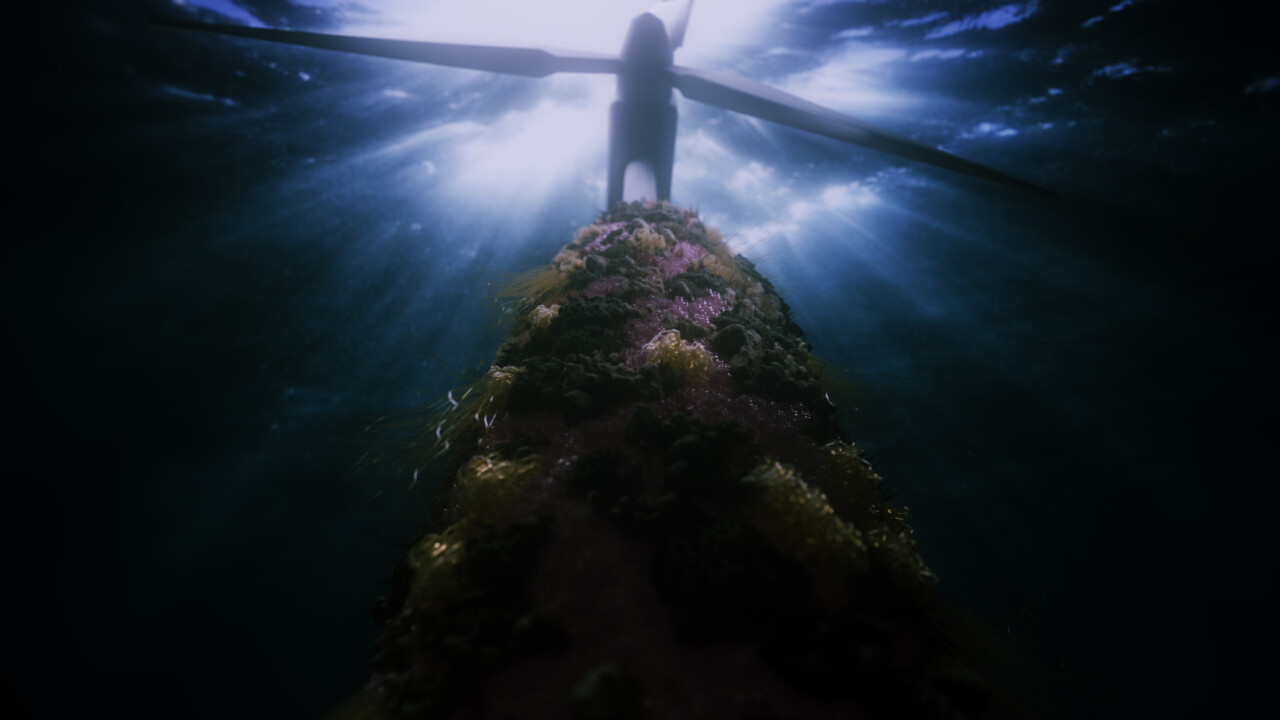
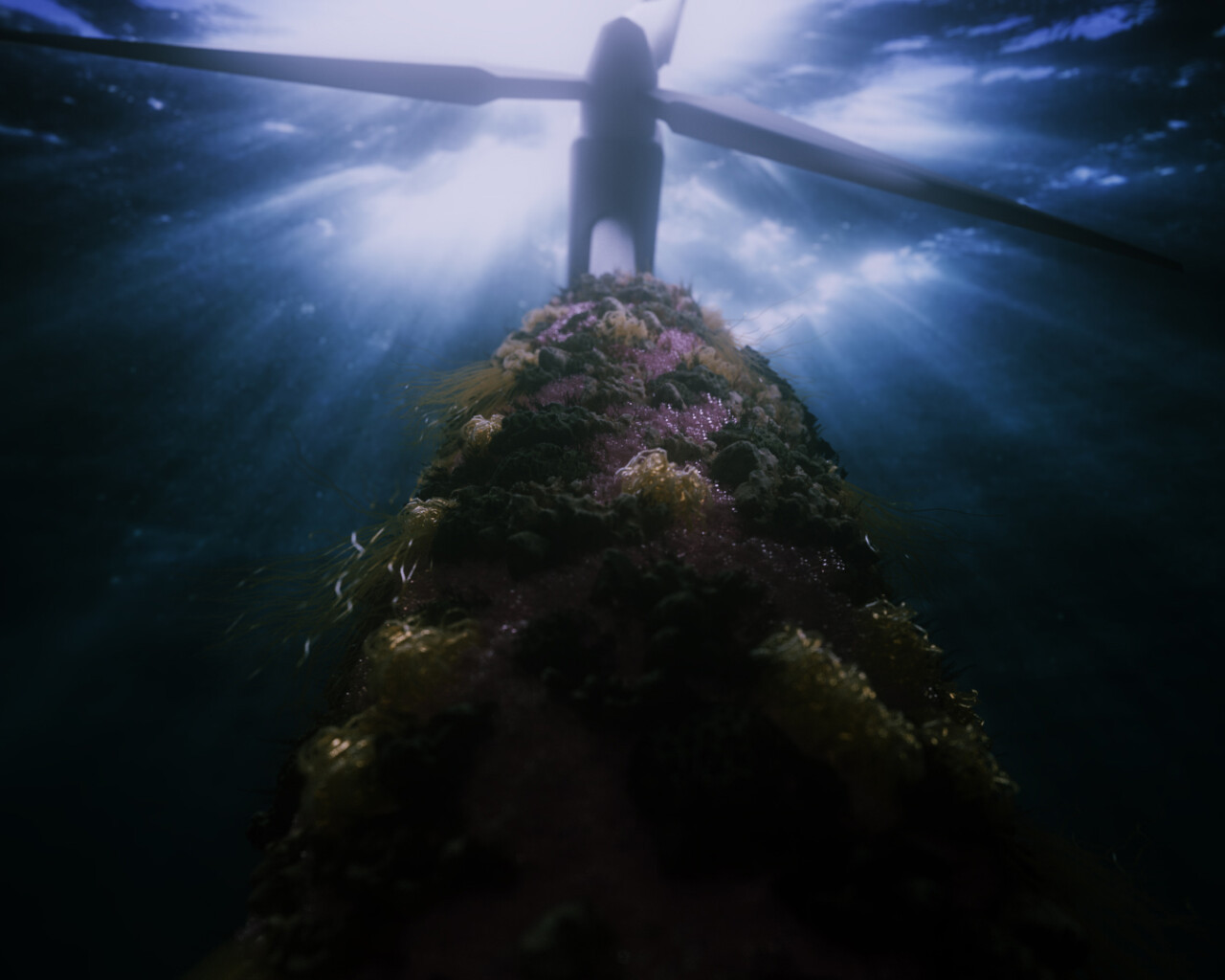
There is hope for those reefs, he added, because wind farms may be giving oysters and other bottom-dwelling creatures a chance to recover. Most offshore wind turbines are anchored below the water’s surface to seabed foundations. To prevent strong currents from eroding the surrounding seabed, those foundations are usually covered with piles of rocks or rubble known as scour protection. The lumpy mounds, full of crevices and crannies, can serve as nurseries for young oysters, lobsters, and sea stars.
“When stuff like that happens, it feels almost like a meant-to-be feeling. You’re connected to the ocean.”
Hancock is working on ways to help oysters make a home of these rock piles. In April, he placed a container of oyster larvae into an ice-cooled pack, loaded it into the back of a car, and drove for 11 hours from Brest, France, to Ghent in Belgium. The larvae did not make up an especially large cargo. “I can fit 5 million in the palm of my hand,” said Hancock. He eventually delivered them to a converted shipping container filled with rock-stuffed plastic crates sitting in seawater. He and his colleagues now plan to distribute the larvae onto the rocks, in the hope that they will latch on and begin growing. If successful, the oysters should soon be visible to the naked eye.
The oyster-covered stones would eventually be dropped into the sea. This process is rough on the animals—in experiments, about half die on average as the rocks tumble down a pipe into the water—but the survivors have a chance of reaching adulthood. Hancock and his colleagues hope to deploy the rocks to subsea structures, including the bases of wind turbines, beginning in 2027. What gives the plan such promise, he said, is the sheer scale and ambition of the offshore wind industry.
“I can’t conceive of trying to restore habitats like that in a system the size of the North Sea or the Irish Sea without a big industrial partner to help, and that’s offshore wind,” he explained. “They’re working at a scale that makes it possible.”
One wind company, Ørsted, has also experimented with planting coral larvae onto metal frames that were then deposited underwater in wind farms off Taiwan. To obtain larvae for the project, marine biologists waited until after a full moon in spring, when coral egg bundles emerge along shorelines. The coral releases billions of these egg bundles, so many that it turns the sea pink. The biologists gathered up just a tiny fraction of them.
Pre-seeding scour-protection rocks or underwater frames with larvae is one way to make wind turbines more attractive to wildlife. Another approach being developed in the United Kingdom uses specially designed concrete cubes at the base of turbines. Samuel Hickling, chief scientific officer at ARC Marine, has helped design the cubes, which have large holes running through their centers and a “knobbly-bobbly” outer texture. “We’re aiming to prevent the scour, but we’re also aiming to optimize it to create spaces for organisms to go inside,” he said.
Last year, 75,000 of the artificial reef cubes were deployed at a wind farm off the south coast of England. Hickling and his colleagues plan to survey the site in the coming months to see whether marine life has taken to the cubes in significant numbers. Early video footage taken roughly one week after the cubes were installed showed crabs and sea stars already clambering over them, he said.
The holes running through the concrete cubes should give wildlife better access to the deeper parts of the scour-protection pile than solid rocks might. And while the cubes must be made of concrete, a material with a high carbon footprint, Hickling said ARC Marine has developed ways to reduce that impact by incorporating recycled materials. Unlike natural rock scour protection, which is often transported over long distances from quarries to wind farms, the manufactured cubes can be produced relatively close to where they are deployed. Overall, Hickling said, their emissions should not be much worse than the quarried rock.
It “totally makes sense” that wildlife would colonize offshore wind farms, and that seals might find fish in and around turbines, said Tinka Murk, a marine ecologist at Wageningen University in the Netherlands. A study published in July 2025 found evidence of shark and skate species frequenting offshore wind farms in the North Sea. Researchers detected their DNA in water samples taken from several wind farms, including the wind farm where Pennekamp saw the seal.
To be clear, Murk cautioned that fishing should, in her opinion, be avoided entirely in such locations if wildlife is to thrive across the full area of a wind farm. “If you have a totally unbalanced ecosystem and you place a pot with flowers, let’s say, in a desert, it doesn’t work as an ecosystem,” she said. “The connectivity is important.” Murk also argued that when wind turbines are eventually decommissioned, their foundations and scour protection should be left in place for wildlife rather than removed, as some regulations require.
“I can’t conceive of trying to restore habitats like that in a system the size of the North Sea or the Irish Sea without a big industrial partner to help, and that’s offshore wind.”
There is already evidence that wind farms reduce trawling pressures on the seabed, even in the U.K. where bottom trawling is not formally banned in such areas. Use of bottom-trawled gear fell by 77%, on average, around U.K. offshore wind farms following their construction, according to a study published in 2022. Jean-Luc Solandt, co-author of that study and international project lead at Blue Marine Foundation, has joined a growing chorus of scientists pointing out the risks and opportunities wind farms bring to marine life.
On one hand, he said, pile-driving during turbine construction can deafen some creatures, something Solandt called “very concerning.” Today, bubble curtains are increasingly used to dampen this din. Electromagnetic noise from wind farms may also affect sea creatures, though researchers are still investigating this. On the other hand, the opportunity to restore habitats is considerable. Ecological monitoring of wind farms should happen at a much larger scale, Solandt argued, and perhaps even become a requirement when authorities issue licenses for offshore wind developments.
Those in the wind industry are acutely aware of public interest in nature-positive interventions. Arturo Marques, offshore wind advisor at WindEurope, said his organization wants governments to require that new wind farm schemes are wildlife-friendly. It is just as important, he added, to monitor whether wind farms continue to accommodate nature after construction. The fact that many more such projects are on way, with global offshore wind capacity expected to more than double by 2030, makes their hospitableness to wildlife all the more important, Marques said. That the industry finds ways to accommodate nature and strengthen biodiversity rather than degrade it, he said, is “a reputational issue for us.”
Join our membership community. Support our work, receive a complimentary subscription to Atmos Magazine, and more.
The Sea Life Making a Home in Offshore Wind Farms