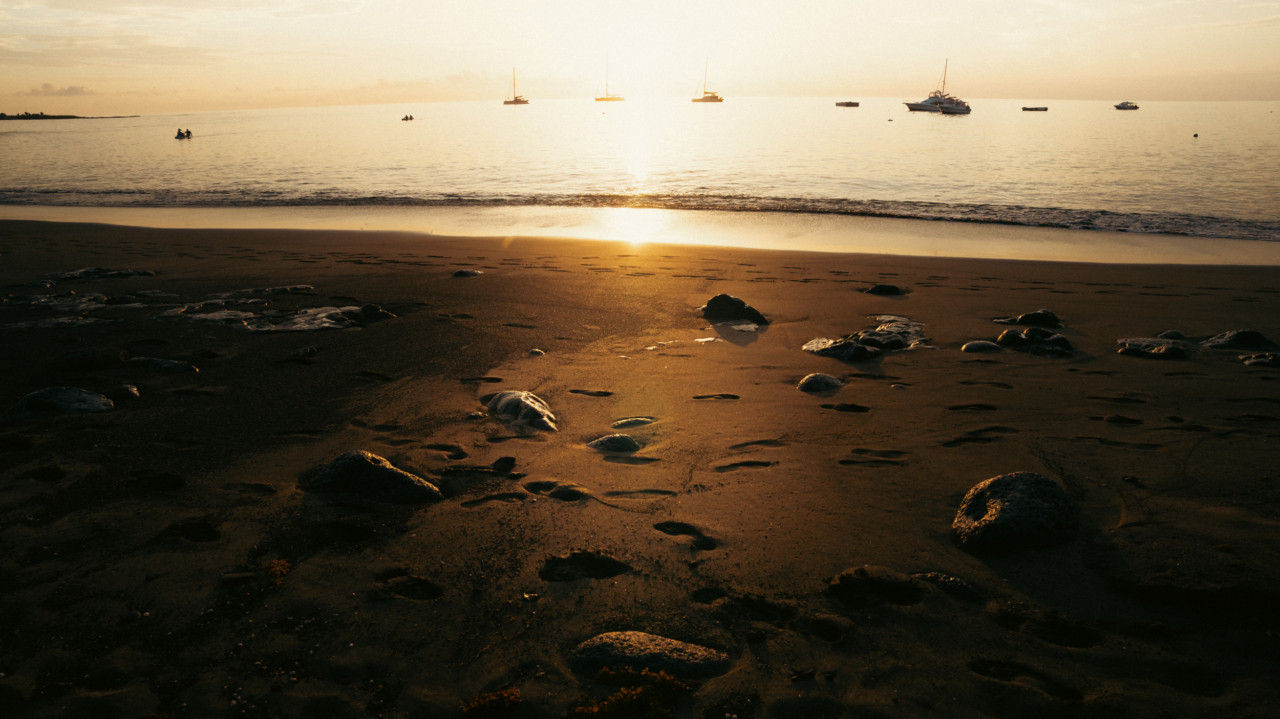
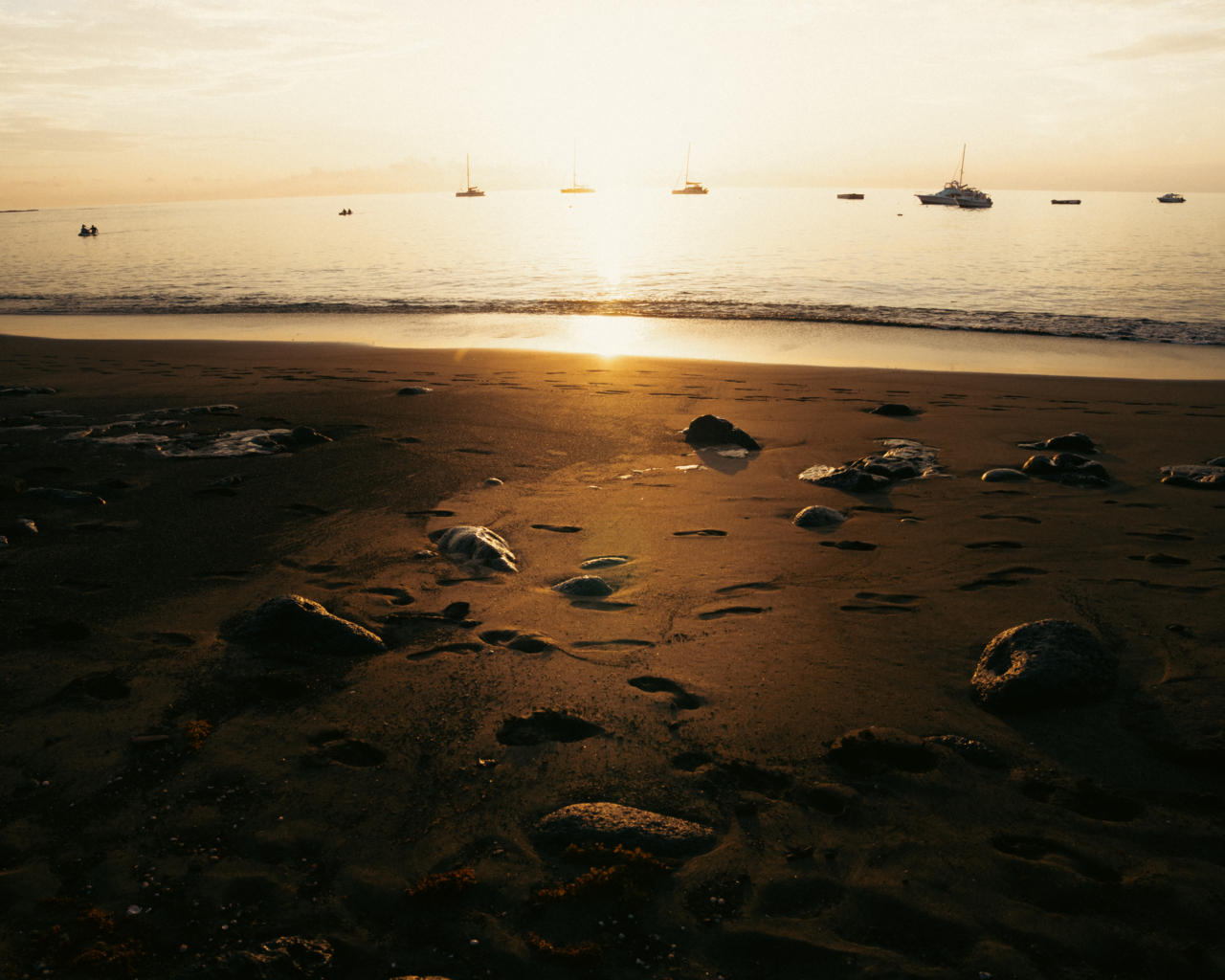
Playa Negra, one of the visitor sites located in Puerto Velasco Ibarra on Floreana Island.
words by adam popescu
photographs by carlos espinosa
There’s a legend in the Galápagos Islands that the old timers used to tell.
If you stare into the eyes of a giant tortoise—an animal that looks prehistoric and can live hundreds of years—it can see into your soul. The story goes that it knows your intentions at once. If you’re good, you’re deemed welcome and safe. If not, it marks you for death.
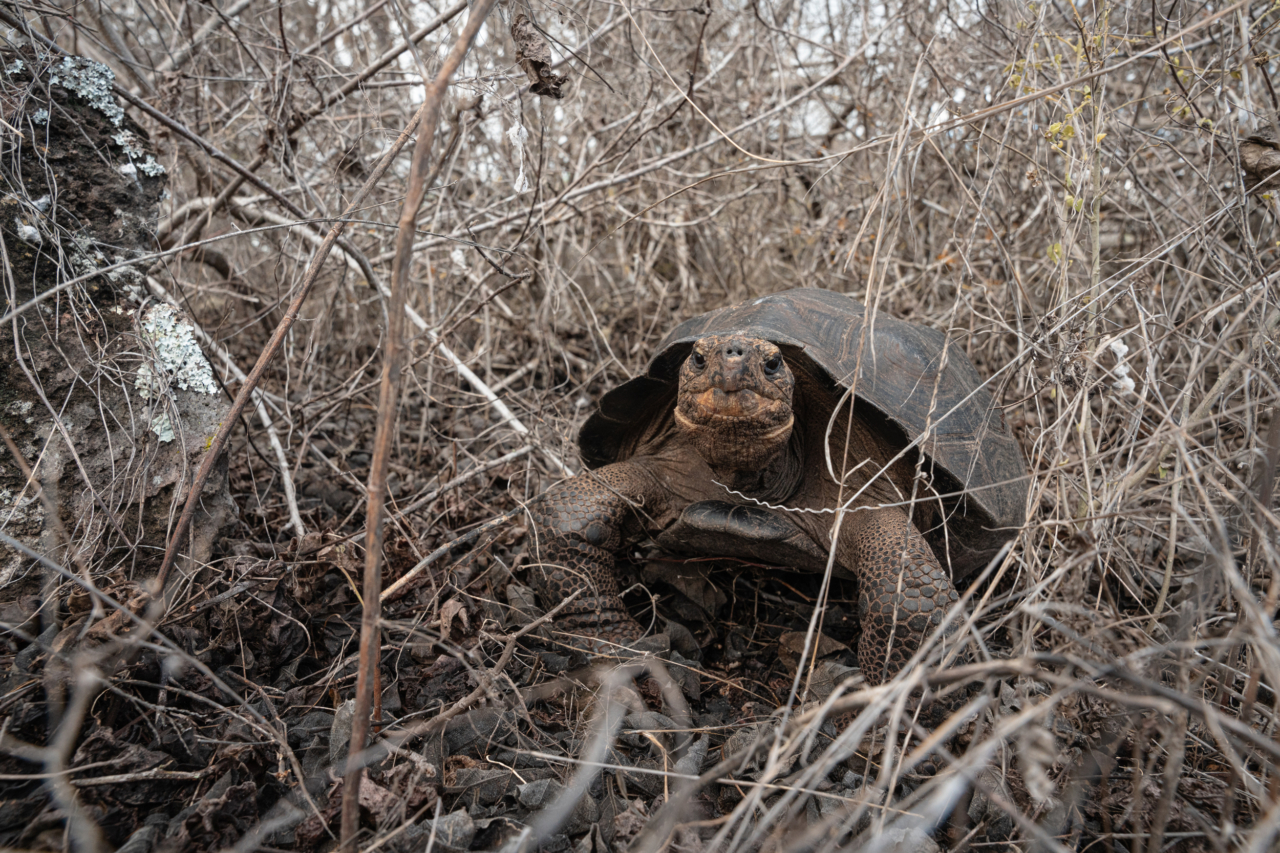
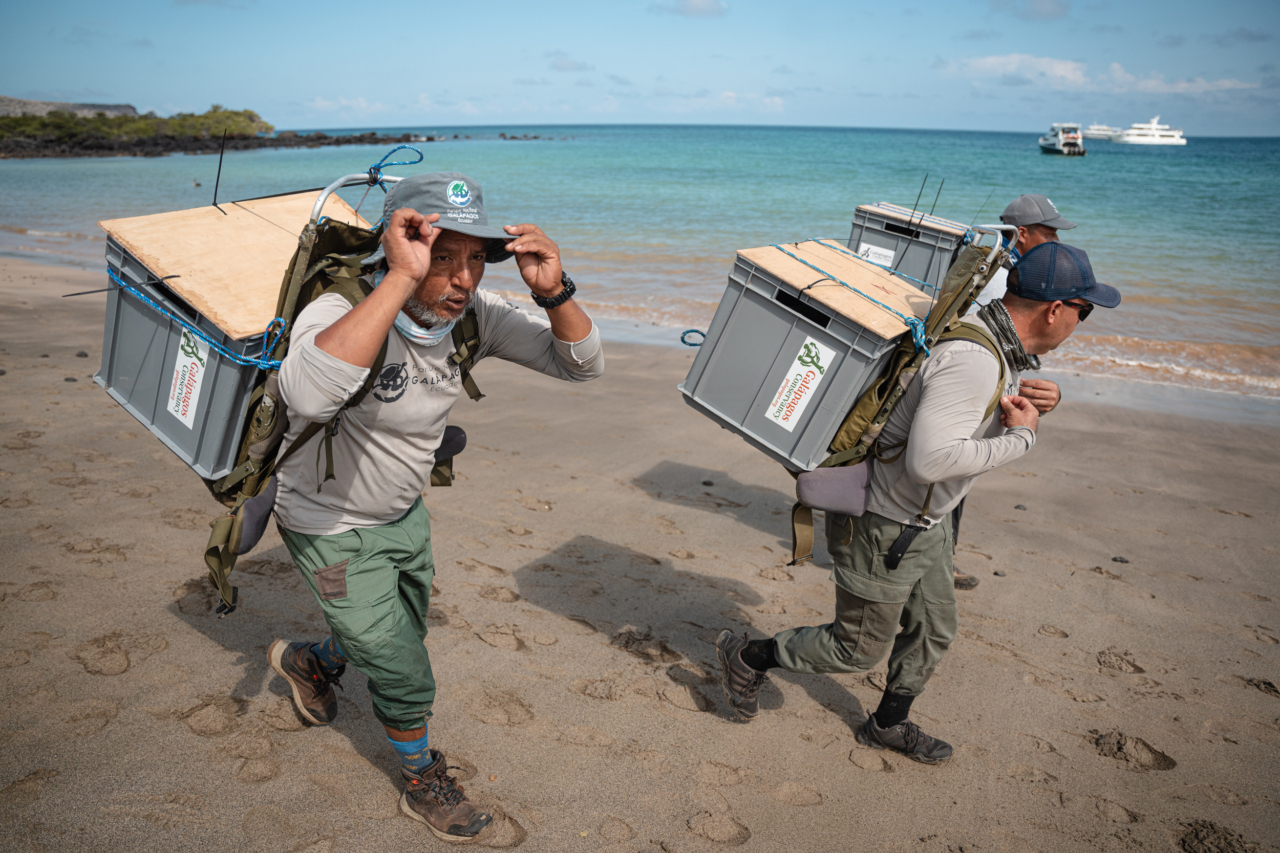
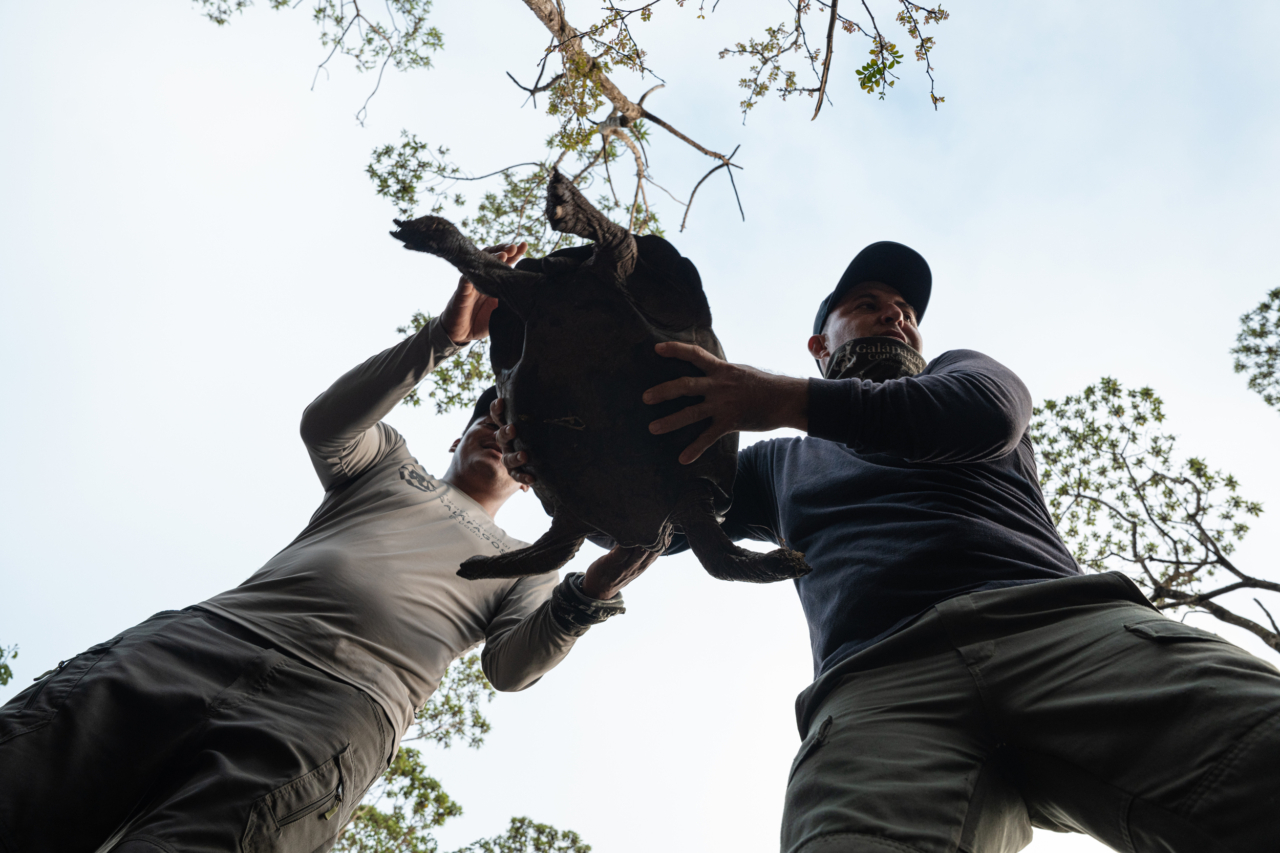
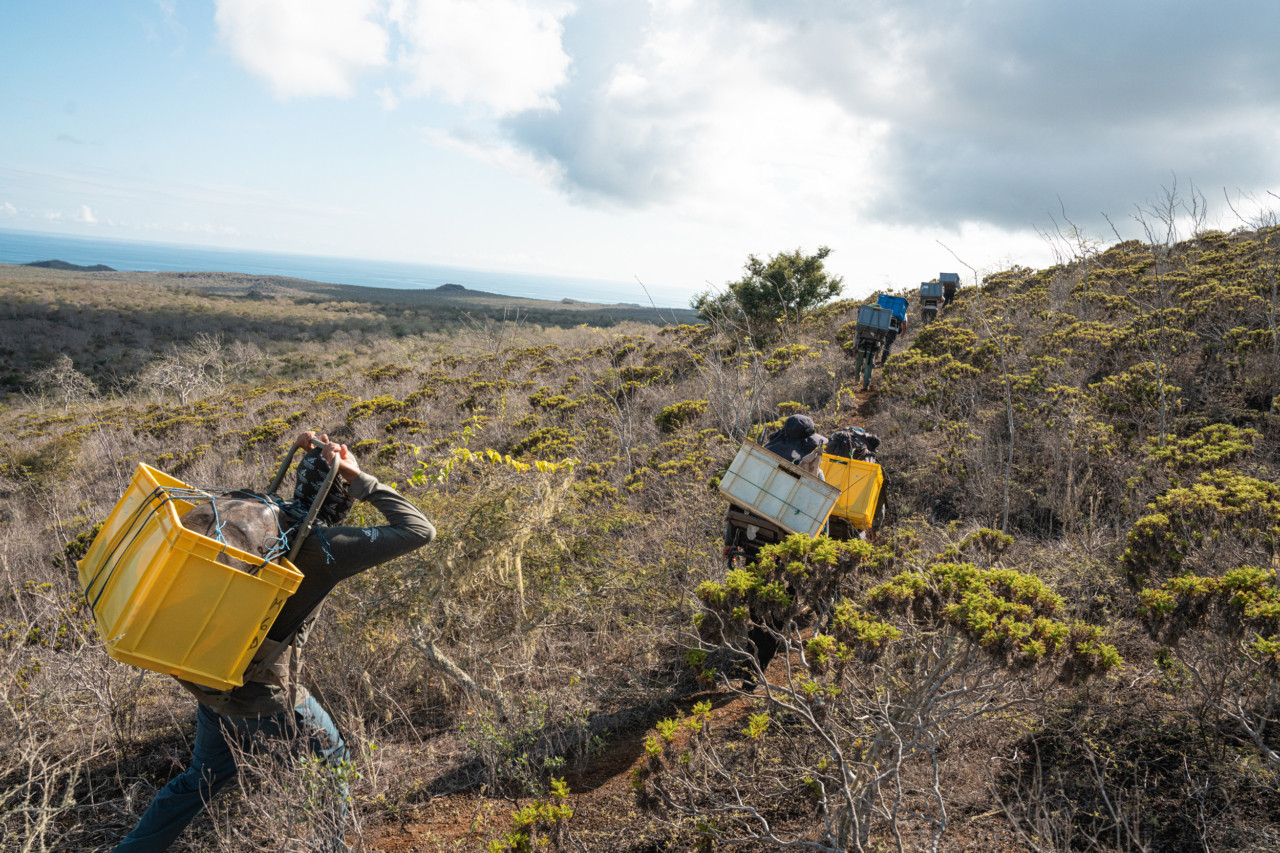
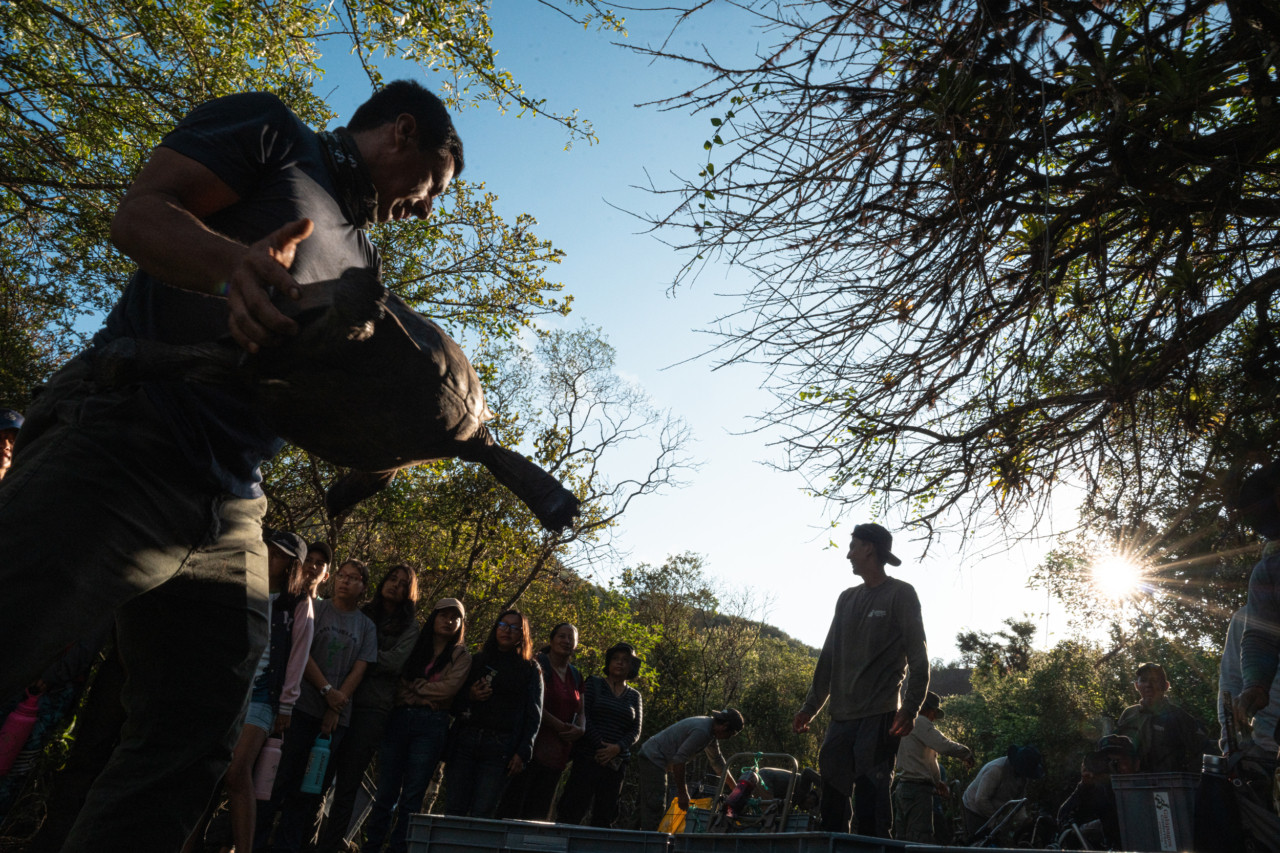
On a humid morning in late February, as a team of researchers and Galápagos National Park rangers trudged up a white sand beach, a winding lava field, and a grassy hilltop, it’s hard not to think about the past. Harder still when the rangers take off their packs and reveal what’s inside: 50 giant tortoises. Each one is between 7 and 15 years old and fitted with a GPS monitor. Their steps onto the island of Floreana are the first any tortoise has taken here in 175 years.
Thousands of Chelonoidis niger once roamed this volcanic island, but generations of whalers took them by the boatload for food. By the mid-1800s, Floreana’s giant tortoises were gone, considered extinct on the island, perhaps lending credence to the old-time curse. Murder and mystery have, after all, gone hand in hand here for both tortoises and people.
Now, conservationists are trying to reverse that history.
Floreana was the first of the Galápagos Islands to be settled. In the early 1800s, it drew whalers, pirates, and other castoffs, but waves of violence helped doom one fledgling settlement after another. In 1832, the Ecuadorian government turned the island into a penal colony. A handful of Germans landed a century later with the belief that they could mold the island into a tropical paradise, only to find it lacked ample water—and instead became ensnared in the infamous “Galápagos Affair,” a tangled episode of rivalries that ended in disappearances and unsolved deaths.
For the animals, the past 200 years have been just as violent. After the last Floreana giant was seen around 1850, according to experts, goats took over. Then donkeys, pigs, cats, rats: all creatures humans had brought with them. But without predators to check their advance, and with native animals ill-equipped to stop them, the invasive species rained down like a plague, eating and killing everything in sight. The onslaught completely reshaped the island’s ecosystem. It meant ruined crops for farmers—and less food for residents.
Populations of native and endemic plants, such as scalesia trees, and ground-nesting animal populations crashed. About half of the island’s bird species and multiple plant types were lost. Many more teetered on the brink, squeezed by invasives including blackberries and guavas that grew in dense thickets, blocked out the sun, and choked off native seedlings before they had a chance to take hold. On an island that evolved in isolation—where unique species depend on native plants for food and shelter—the losses were catastrophic.
Things came to a head in 1959, when the Galápagos National Park was established after UNESCO and the International Union for Conservation of Nature expressed concern that human activity was unsustainable and driving species extinctions across the 19 major islands. Floreana was among the most impacted by humans. Five decades later, the work of trying to reverse the damage began.
“Just as the community depends on the island, the island, in turn, depends on tortoises.”
“You can get quite philosophical that this generation is undoing what the former generation has done,” said Penny Becker, the chief executive of Island Conservation, which is among those spearheading change on the Galápagos. The nonprofit’s restoration projects on hundreds of islands around the world have a nearly 90% success rate.
Floreana’s fortunes shifted around 20 years ago when the park and a handful of partner organizations, including Island Conservation, hatched an ambitious plan: Restore Floreana. It began little by little, starting with the controversial work of removing invasive animals, clearing out the goats and donkeys that had stripped the landscape. But bringing back tortoises, whose eggs are easy prey, required beating back the rats, too. That has not been easy, said members of Fundación Jocotoco, an Ecuadorian organization helping lead the restoration. “Reaching this moment has taken more than 15 years,” said Eliécer Cruz, the director of Jocotoco’s Galápagos program.
The campaign has had starts and stops, in part because rats are among the toughest invaders to eliminate. As stowaways, they are adaptable and difficult to corner, especially on an island roughly the size of Washington, D.C. Still, thanks to camera traps that monitor the island and help target remaining hotspots, María Isabel Grijalva of Jocotoco believes they’re “getting very close to getting rid of them all.”
Now, organizations are increasingly focused on the slower work of rebuilding the island’s infrastructure through community workshops, native plant gardening, improvements in biosecurity, livestock management, and even pet care for the 125 farmers who call Floreana home. “Our livelihoods depend on the health of this island,” said Veronica Mora, a respected community leader.
Just as the community depends on the island, the island, in turn, depends on tortoises.
Tortoises engineer ecosystems by trampling pathways through thick brush, dispersing seeds via digestion, and even “shaping vegetation and creating micro-habitats,” said Rakan Zahawi, a tropical restoration ecologist and the executive director of the Galápagos-based Charles Darwin Foundation.
The islands themselves are a natural laboratory. “This is the ideal place to study the various stages of Earth’s formation,” said Pablo Guerrero, a marine biologist and former director of the park’s marine reserve unit who now serves as the marine conservation director of WWF Ecuador. “Being isolated, 600 miles from mainland Ecuador, makes it a place where diverse ocean currents converge and biodiversity is extremely high. You can find warm-water species such as hammerhead sharks, corals, tropical tunas, along with temperate water species like penguins and sea lions. It’s unique.”
But the Galápagos are also less intact than many outsiders imagine. That’s why, conservationists say, restoring islands like Floreana and bringing back its tortoises is key. If the effort succeeds, it could provide a template for other at-risk spots across the archipelago.
Today, harvests are up 80%, according to Claudio Cruz, whose father came to Floreana in 1939 when there were only 11 residents. After his parents gave birth to him—and his 11 brothers and sisters—the island’s population essentially doubled. Now, with the return of 50 juvenile tortoises and another 108 slated to follow in the coming days, Floreana will soon have more giants than people. “We’re very excited,” said Jennifer, who runs a kiosk by the dock selling ice cream and coffee to the occasional tourist.
But few visitors make it to Floreana. Accommodations are modest, and the island is so remote that staples like coffee and beer feel like luxuries. Puerto Velasco Ibarra, the island’s main settlement, is so small that calling it a town can feel like a stretch. The road is unpaved and lined by lava rock, and residents often double as farmers, cooks, and guides: whatever is needed on an island with no hospital or airport.
“Floreana has historically been neglected,” said Tom O’Hara, of the Galapagos Conservation Trust. Jennifer offered a different way of looking at it: “Maybe the tortoises will help the island develop more sustainably.”
It’s hard not to see the 50 juveniles stepping onto the island as something close to a miracle. The Floreana tortoise was considered extinct for nearly 200 years, and the animals being released are the product of a decades-long effort to recover what remains of its genetic lineage.
Rewilding can be contentious, and so can the popular idea of “de-extinction.” But James Gibbs, the conservation biologist and vice president of science and conservation at the Galápagos Conservancy, said that is not what is happening on Floreana. You cannot bring back an extinct animal, he added. But you can rebuild the conditions that allow species, and the people who live alongside them, to succeed.
Early signs are encouraging. Some bird species are already rebounding, and the plan envisions the eventual return of 12 other locally lost species, including finches, hawks, owls, and little vermilion flycatchers—all of which would benefit from the giants’ return. Though a full restoration will take decades, the trajectory is unmistakably upward.
By many accounts, Gibbs is a central reason this return is possible. In 2000, while surveying giant tortoises across the archipelago, he expected to only find domed-shaped tortoises on Isabela Island’s Wolf Volcano. Instead, he also stumbled upon what he called an unknown, “alien” tortoise with a distinctive saddleback shape. It turned out “they were hybrids,” he said.
“Floreana has historically been neglected. Maybe the tortoises will help the island develop more sustainably.”
The juveniles now being released are descendants of those animals. Genetic testing eventually revealed that the “aliens” on Wolf Volcano carried a mix of lineages, including Floreana and the local Wolf Volcano tortoise, with some individuals also showing ancestry from Santiago and Española islands. The young tortoises released on Floreana last week carry “between 30% and 70%” Floreana lineage, said Gibbs.
How did Floreana tortoises end up on the other side of the archipelago? By accident. Whalers were responsible for killing hundreds of thousands of tortoises across the islands, taking the animals aboard as living food for long voyages. In 1813, a clash between whaling ships ended with tortoises being tossed into a bay off Isabela. A few years later, another ship that had also collected Floreana tortoises was rammed by a whale and lost many of its tortoises in the same area. “Tortoises can float,” Gibbs noted, and DNA testing later traced the “aliens” back to those castaways.
Today, this new generation of young tortoises is back on Floreana, nosing through the grass for the first time since their predecessors were wiped out. As the group spread out from the release site, one hatchling seemed more interested in exploring Gibbs. “It might like to eat my boot,” he said, looking down with a smile. “They’re very interested in new things.”
“It’s a special moment,” he said. But the work, he added, is far from finished. In many ways, it’s only the beginning.
Join our membership community. Support our work, receive a complimentary subscription to Atmos Magazine, and more.
Humans Wiped Out Floreana’s Giant Galápagos Tortoises. Now They’re Bringing Them Back.