Photographs by Pietro Bucciarelli / Connected Archives; Jessica Barthel / Connected Archives; Tim Mosenfelder / Getty; Andrew Toth / Stringer; Santiago Balbuena / Pexels
words by Miranda Green and Emily Atkin
When I was a D.C. climate reporter, there were always a few journalists I considered friendly competition. They broke stories I wish I had, wrote articles in a way that made me race to the end of the page, and inspired me to be better at my job. Emily Atkin was one of them.
When Emily left traditional media to start her newsletter Heated a few years ago, I wasn’t surprised that it quickly became one of the top newsletters on Substack. If you care about climate change and are upset about what’s going on, do yourself a favor and check it out.
When I was digging into California Gov. Gavin Newsom for the newsletter last month, and came across something interesting regarding an environmental bill he had surprisingly vetoed, Emily immediately came to mind as the perfect partner to work on The Understory‘s first investigation.
Once we started pulling the thread on California’s near-ban on Teflon pans, it became clear that this story was much bigger than California: It was the blueprint for a national lobbying push, leaning hard on celebrity chefs and a conveniently narrow reading of PFAS health concerns.
—Miranda Green
California nearly triggered a seismic shift in American kitchens this fall.
A bill phasing out the sale of nonstick pans made with polytetrafluoroethylene—a type of PFAS “forever chemical”—cleared the state legislature in September with overwhelming support. Given the well-documented health risks associated with production of PTFE, commonly known as Teflon, advocates fully expected Gov. Gavin Newsom to sign SB 682 into law.
But then the celebrity chefs showed up.
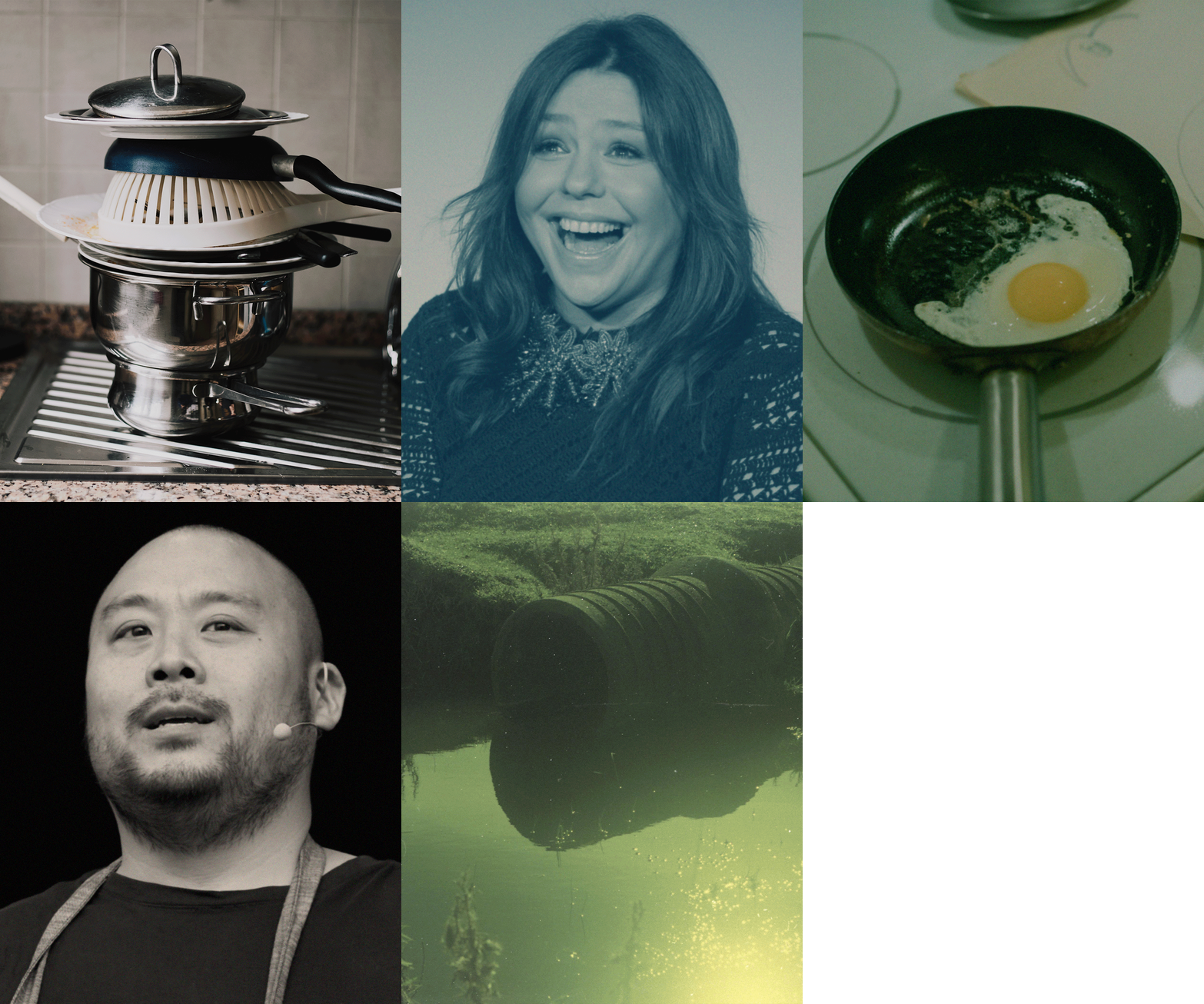
Days before Newsom was set to sign the bill, a wave of similarly worded letters to the California State Legislature appeared. Celebrity chefs Rachael Ray, David Chang, Thomas Keller, and Marcus Samuelsson all insisted that Teflon was safe when used correctly. Their letters warned that the bill was alarmist, unnecessary, and unfair to home cooks and professional chefs alike. Their message was polished, unified, and amplified across national media.
In the end, Newsom echoed their concerns. “I am deeply concerned about the impact this bill would have on the availability of affordable options in cooking products,” he wrote in his veto message.
But the chefs weren’t acting alone. They were working on behalf of the Cookware Sustainability Alliance, a newly created lobbying group representing some of the world’s largest pan manufacturers, which argued the bill would drive up consumer prices and needlessly restrict a “safe” product.
The reason the chefs’ letters aligned so cleanly with the CSA’s talking points is, in retrospect, unsurprising: They all have financial relationships with companies that produce and sell PTFE-coated pans—the same companies that fund the CSA, a joint investigation by Atmos and Heated found.
In her letter to Newsom, former Food Network talk show host Rachael Ray called PTFE-coated pans “a key component of durable, affordable nonstick cookware used by millions of home cooks across the country.”
She didn’t mention that she’s behind one of the bestselling nonstick lines in the country. Her “Cook + Create” collection, made with PTFE coatings, fills shelves at Walmart, Target, Macy’s, QVC, and Amazon.
Similarly, David Chang, chef and founder of the Momofuku restaurant group, told Newsom that banning PTFE-coated pans “risks placing unnecessary burdens on the very families we all want to support.” He left out that he sells his own PTFE-coated nonstick line, “io,” which carries a PFAS disclosure.
Thomas Keller, the Napa Valley chef behind the famed three Michelin star restaurant The French Laundry, also warned Newsom that eliminating PTFE-coated pans would eliminate “an important option for cooks who depend on them to prepare wholesome meals with confidence.” He omitted his commercial partnership with Hestan Culinary, whose high-end Insignia line includes a PTFE-coated skillet.
Marcus Samuelsson, a frequent television personality known for his Harlem restaurant Red Rooster, cautioned that California’s ban on PFAS would “have unintended and far-reaching consequences for both professional kitchens and everyday home cooks.” He left out that he’s an official chef ambassador for cookware company All-Clad, for which he appears in the company’s promotional materials, cooking videos, and retail campaigns. All-Clad’s nonstick lines rely on PTFE coatings.
While PFAS-free alternatives like ceramic nonstick pans are widely available at stores, the chefs’ letters largely dismiss them as “less effective” and “more costly,” intimating that PTFE is an essential tool for home and professional cooks.
In total, seven chefs wrote letters on behalf of CSA asking the California legislature to block the PFAS bill. They were posted to CSA’s website. Each chef had a financial stake—whether through sales, endorsements, or partnerships—in cookware made by companies that fund the CSA.
None of the chefs who wrote letters responded to requests for comment.
The Cookware Sustainability Alliance first emerged in 2024 and quickly became the most aggressive opponent of PFAS-in-cookware legislation in the United States.
Its members include five global cookware manufacturers, among them Meyer Corporation and the French conglomerate SEB. Together, Meyer and SEB dominate the nonstick market: Meyer produces more than 120,000 pans a day while SEB is the world’s largest cookware company, with brands ranging from All-Clad to Hestan.
The core of CSA’s argument is that PTFE is safe and different from the “bad” kind of PFAS.
Unlike some of the more well-known PFAS classes like PFOA and PFOS, Teflon isn’t deemed a hazardous substance by the EPA. It is a stable, inert subclass of the chemical that doesn’t dissolve in water and can’t accumulate in the human body. When it comes to cooking with it, the pans are safe when used properly—as in, not heated above 500 degrees Fahrenheit and not scratched.
“There’s between 12,000 and 15,000 chemicals that are considered part of the PFAS group,” said Steve Burns, CSA president. “The one that coats cookware is fluoropolymers, PTFE, Teflon. And we believe it to be safe, and almost every scientist and study I’ve ever seen agrees.”
On a technical level, researchers do tend to concur. But that safety has limits. Overheated PTFE can release fumes that cause “polymer fume fever,” also known as “Teflon Flu,” says PFAS researcher Rainer Lohmann. And scratched pans shed microparticles with unknown long-term health impacts.
But those issues pale in comparison to the biggest problem: the way PTFE is made.
“Making these fluoropolymers, or Teflon, is actually a very messy and dirty process,” said Lohmann, who leads the University of Rhode Island’s PFAS research program. “The communities that live next to where [Teflon] is made … some of them call themselves the ‘sacrifice zones.’”
That’s because making Teflon requires using fluorinated processing aids such as PFOA and, more recently, GenX—compounds that persist indefinitely once released into the environment. Oral exposure in animals has shown detrimental effects on certain organs including the liver and kidneys, compromised immune systems, cancer associations, and potential developmental problems in offspring.
Communities polluted by Teflon production include Parkersburg, West Virginia, where seven decades of PTFE production at DuPont’s Washington Works facility contaminated the Ohio River and local groundwater, leading to animal die-offs and exposing residents to some of the highest PFAS levels ever measured in human blood. This is the same contamination scandal depicted in the film Dark Waters.
And in North Carolina, Chemours’ Fayetteville Works facility shifted from PFOA production to GenX as a “safer” alternative. Then a 2017 study found GenX and other PFAS released by Chemours into the Cape Fear River contaminated the drinking water of more than 250,000 people, appearing in high levels in residents’ blood and even in homegrown produce.
Across the pond in Dordrecht, the Netherlands, a Chemours plant manufacturing Teflon contaminated surrounding air, soil, and drinking water, prompting Dutch health officials this spring to conduct a rare, targeted risk assessment for nearby neighborhoods.
“The problem with PFAS is not just the exposure that you get from the actual product itself, which is still problematic, but you have to look at the whole life cycle of PFAS,” said Gretchen Salter, policy director of Safer States. “This argument that says that PFAS polymers are safe is completely ignoring both the manufacturing and the disposal of that product.”
Burns doesn’t dispute the harms of PTFE manufacturing. But he argues that the cookware industry shouldn’t be punished for a problem originating with the chemical industry.
“We’re not the source. We’re two steps removed from the source,” he said. “I understand the concern, but you’re targeting a product in a kitchen when you should be talking about what’s happening in a factory.”
Burns also argues that PTFE is everywhere: in pacemakers, semiconductors, fuel lines, and medical devices. “My Apple Watch has fluoromers in it,” he said. “Nobody’s targeting Apple.”
And he’s correct that cookware is nowhere near the biggest consumer of PTFE chemicals; that title goes to industrial and electronics uses. So Burns begs the question: Why single out cookware?
Public health advocates have an answer. It’s because people don’t eat off Apple watches or semiconductors. They say cookware is one of the most direct, daily exposure routes to PTFE, and one of the easiest to replace with PFAS-free alternatives.
Advocates also say responsibility doesn’t end at the factory gate. Producers can’t turn a blind eye to the health impacts of the products they use and advocate for.
“You can think of it like a blood diamond,” Lohmann said. “The diamond is beautiful, but the production has a trail of misery.”
SEB, in particular, had already been through a political firestorm by the time California’s bill SB 682 reached Newsom’s desk. In early 2024, the French Parliament introduced a sweeping PFAS bill that initially included nonstick cookware. SEB, alongside several chemical companies, mounted an intense and ultimately successful pushback campaign that stripped cookware from the legislation.
The episode served as a warning shot: If France could attempt to ban PFAS pans, so could the United States. CSA was built to ensure that never happened.
In the past year, CSA has been active in 13 states where local lawmakers are considering regulating PFAS in consumer goods.
The group sued Minnesota in January, using the commerce clause to argue that a ban on PTFE was bad for interstate business. It also lobbied lawmakers in Rhode Island, Maine, and Connecticut to support amendments that would remove cookware from their existing bans. While those efforts were unsuccessful, CSA was integral in getting New Mexico and Illinois to remove fluoropolymers from their PFAS ban. It also convinced Vermont to delay implementing its ban on cookware by several years to 2028.
CSA spent thousands wining and dining lawmakers and paying their lobbyists this year, paying at least $15,000 in Vermont, $25,000 in Connecticut and $218,000 California, according to campaign finance records.
No PTFE bans in cookware have been passed in any states since CSA came on the scene in 2024, Burns said.
“I’m not going to claim complete credit, but I will claim partial credit that we are showing up and we’re talking about fluoropolymers,” he said. “We’re trying to de-wonkify it and make it just understandable.”
While CSA has netted many wins this past year, none were as important as the Golden State victory. As the world’s fourth-largest economy, any California ban on PTFE in cookware would have had trickle down effects to the way pans are made across the country. The bill in question would have ended sales of PTFE-coated pans in the state and limited the entrance of them to its ports—two of the largest in the country.
“I think it speaks to the gravity of California policy and our share on the market nationwide. You know, we have 40 million people here,” said Ben Cheever, press secretary for state Sen. Ben Allen, who introduced the bill.
Ultimately, CSA’s argument that the bill would be a knock on affordability, rather than a boost to health, is what netted them Newsom’s veto.
Cheever says it’s a false comparison and that health care and utility costs related to environmental exposure are still a major concern.
“We’ve been quite adamant about how environmental policy is getting used as a scapegoat for affordability issues right now, and we really think that if we take a stronger approach to protecting our environment, and in turn our public health and public infrastructure, it’s a strong point in favor of making things more affordable,” he said.
Join our membership community. Support our work, receive a complimentary subscription to Atmos Magazine, and more.
Why Are Famous Chefs Fighting to Keep ‘Forever Chemicals’ in Cookware?