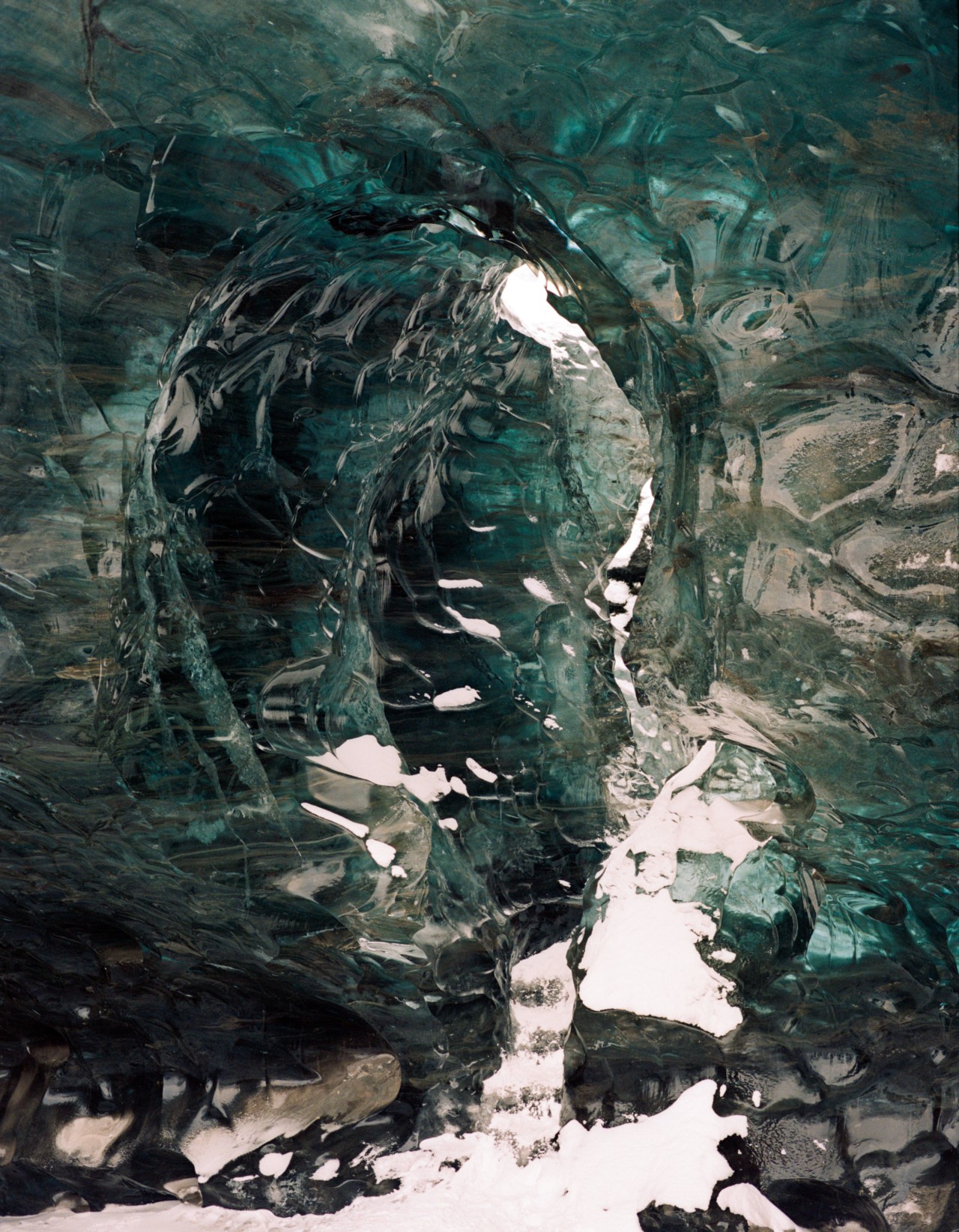
Photograph by Jess Gough for Atmos Volume 07: Prism
words by willow defebaugh
Photograph by jess gough
“We’re told we’re not connected to ice because that’s easy. But people are connected to ice.”
Once, on an island made of rock and fire and ice, there was a circle. A perfect circle cast in a glacier, a tunnel of ice carved by wind and rain and snow. I cannot convey its size in feet and yards and meters, I can only say that it might have been the eye of a god. Peering through it, miles of black terrain and mountains of moss arose, a glimpse into what may as well have been another world. In its presence, we were told this circle would only last a few more days before it melted and collapsed. By the time you read these words, it may have already become history.
Glaciers are timekeepers, records of life on Earth. They form over centuries as mounds of snow become compressed into large masses of perennial ice. They can be tens and even hundreds of thousands of years old; most of the glaciers we see today are what remains of the last ice age, which ended more than 10,000 years ago. The oldest glacier in Antarctica may be approaching one million years old. Glaciologists can study air bubbles trapped within the ice to learn about bygone climates, offering us clues about our planet’s past and future.
Glaciers take the form of ice sheets, continent-sized masses that extend out in all directions, and alpine glaciers, which originate at high altitudes and flow down into valleys. Frozen as they may appear, glaciers are always shifting. Under the pressure of their massive weight, internal ice deformation causes them to slide and flow outwards (in the case of ice sheets) or downwards (for alpine glaciers). Glaciers grow or advance when they accumulate more snow than the amount of ice lost from melting. When there is less snowfall or more melting, they retreat.
For as slowly as they have shaped, glaciers are melting faster. Climate change has caused the rate of glacial loss to double over the last two decades. Earlier this year, the most comprehensive study of future glacier trends was published in Science. The research found that 49% of glaciers could disappear completely by 2100, with half of those lost by 2050. And that scenario is presuming global heating is kept to 1.5C degrees. According to the World Meteorological Organization, we are on track to breach that critical threshold in the next five years, thanks in no small part to the fossil fuel industry’s unprecedented profits.
One day, our descendents may read with wonder about a world once covered in swaths of ice. As George Monbiot wrote for The Guardian this week, “Every hour is now an ‘if only’ moment: offering a better chance of avoiding collapse than the hour that follows. Grim as our time on Earth is, future generations will look back on it as a golden age. A golden age of wildlife, of mild weather, stability, prosperity, of opportunities to act. Our living world is a grey shadow of what it once was, but a vibrant paradise in comparison with what it will be. Unless, unless.”
I refuse to become numb to a melting planet, the erasure of entire ecologies and cultures. So much life has been lost, but so much remains—the treasured past of a future not yet sealed in ice. If we can learn anything from glaciers, it’s that time both melts and freezes, moves slow and fast. We humans think in scales too small; Earth is continuously changing between states, and we are part of that change whether we see ourselves reflected in it or not. We can wallow in despair, frozen in inaction, or we can do everything in our power to preserve that which has yet to vanish.
Once, in a universe of rock and fire and ice, there was a circle. A perfect circle cast in space, from elements scattered by stars that reconstituted themselves in more combinations than we can count, contoured by love and war and weather. I cannot convey the size of this circle in histories and kingdoms and cartographies, I can only say that it might be the eye of a god. In it, we can see the gaze of every lifeform, our own humanity staring back. Blink, and we might miss it.
Join our membership community. Support our work, receive a complimentary subscription to Atmos Magazine, and more.
A Perfect Circle