
Photograph by Simon Burstall / Trunk Archive
words by willow defebaugh
“Cultivate an understanding that life is long, that people both change and remain the same, that every last one of us will need to fuck up and be forgiven, that we’re all just walking and walking and walking and trying to find our way, that all roads lead eventually to the mountaintop.” —Cheryl Strayed
I’ve never been one to handle conflict well. Most often, I’m unsure whether it’s worth it to engage or if it’s more wise to rise above. At different points in my life, I’ve learned the value of taking the high ground, but I’ve also felt the ramifications of not standing up for myself or others in the name of avoiding discord. In many ways, I think our lives are shaped by our relationship with strife—and we aren’t the only animal whose evolutionary journey is intertwined with it.
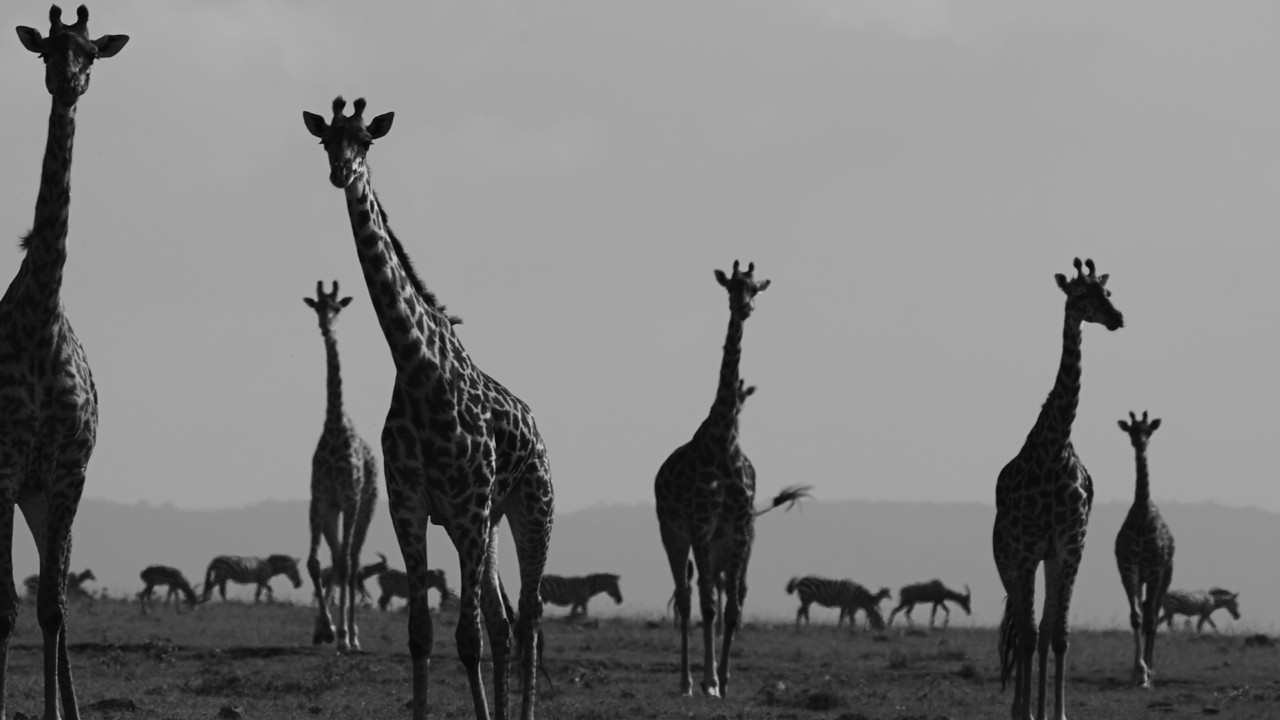
Out of all the creatures that roam the Earth, giraffes stand out as among the most unique. They are the tallest of all land-dwelling mammals, towering at heights of up to 19 feet. Their legs alone are taller than many people at about six feet, allowing them to run across the African savannahs they call home at impressive speeds of 35 miles per hour. Equally long are the necks they are renowned for, which have afforded them a number of advantages that we will get to shortly. More interesting, though, is how and why these animals became stretched by time.
Scientists trying to explain how nature evolved into what it is today have placed giraffes center stage in evolutionary theory over the years. In the early 1800s, Jean-Baptiste Lamarck used them as an example in his theory that evolution occurs by an individual’s adaptations being passed to their offspring. This was later disproved by Charles Darwin, who also used the giraffe to explain his theory of natural selection—that instead, inherited traits in a population are passed down due to the benefits they offer. This forms the basis of our understanding of evolution today.
Darwin pointed out that natural variation within a group meant that some giraffes would have had longer necks than others. He posited that competition for food meant that those with this trait were more likely to survive, mate, and therefore pass on this trait. As this continued to happen, the species would gradually reach new heights over time, so that it could rise above the conflict. While Darwin may have been right about the mechanics of evolution, his theory as to why giraffes specifically evolved this way would later be challenged.
In 1996, researchers Robert E. Simmons and Lue Scheepers argued that the main driver of this evolution was actually giraffes engaging in conflict rather than rising above it: specifically, the way males wield their necks to fight with each other over potential mates. This theory of sexual selection was later bolstered by the discovery of an ancient ancestor in China with a battle-ready neck and thick headgear, given a name in Mandarin that translates to strange beast.
So, did the giraffe take its shape by avoiding conflict or diving into it head-first? In the case of this creature and many others, a single truth can be hard to reach; evolution is driven by a mix of needs that take priority at different points due to varying environmental and social factors. One could have been the primary driver for a while, then transmuted into the other. Even evolution—as it molds and makes us—is subject to change over time.
We are strange beasts, all of us. We fight neck and neck and we avoid saying what matters most. I believe that there’s a third option: that we can show up in conflict with love. That we can use the gifts evolution has granted us not for violence or evasion, but to hold a higher view with clear vision. Conflict is a part of life; we will all hurt each other and get hurt. One way or another, it will stretch us, cause us to grow in new directions. What matters most is what we do next.
Join our membership community. Support our work, receive a complimentary subscription to Atmos Magazine, and more.
Strange Beasts