






















In the 18th century, Scottish economist Adam Smith wrote of an “invisible hand” in market economies. Others used the metaphor to express the idea that market-led economies are fundamentally benevolent or logical. This notion persists today. Mainstream economics tends to assume that current economic trends can be used to forecast future outcomes in an orderly, linear fashion.
But this understates the intensity of climate impacts. In 2018, for instance, William Nordhaus won the Nobel Prize in economics for his climate-modelling work. His model suggested that an optimal global temperature rise above pre-industrial levels, balancing the costs and benefits of climate mitigation, is over 3 degrees Celsius—far beyond the 1.5 degrees that global leaders aligned on at the Paris Agreement. In the era of climate breakdown, economic models like these are less appropriate, and potentially more dangerous, than ever before. Climate scientists recognize that a warmer world will be a fundamentally more unstable world, with complex interactions. Many effects will be exponential, not linear. This calls for climate action that is transformative, not just incremental.
John Fullerton is one of the people urging alternatives to the status-quo economic frameworks that are out of step with a rapidly warming world. He has built his second career from his disillusionment with mainstream economics: For two decades, Fullerton worked at the heart of the capitalist economy, in various managerial roles for JPMorgan. But he came to feel bored and unfulfilled there. In 2001, he left without a plan. He enjoyed some adventures during this time, such as sailing across the Atlantic. (In the middle of the ocean, as he was reading Herman Melville’s Moby-Dick, a humpback whale smashed into the sailboat’s rudder, making it necessary for the Canadian Coast Guard to rescue Fullerton and his friends.) But mainly, Fullerton immersed himself during this post-Wall Street period in reading and thinking about systems change. He concluded that exponential economic growth was going to break our finite planet.
In 2010, Fullerton founded a think tank called the Capital Institute, dedicated to sustainable economic principles, and he has since published multiple books and taught courses on the regenerative economy.
Regenerative economics, Fullerton’s preoccupation, is a radical reframing of economic principles inspired by diverse and resilient living systems. It is a hopeful vision. As Fullerton and coauthor Faye Cox write in Regenerative Economics: Creating Conditions for Health and Abundance on a Living Planet, “a regenerative economy is an integrated network of healthy local and regional economies, all creating and exchanging value with their integrity intact.” This “aims to circulate wealth through all levels of the economy, with all stakeholders able to contribute to its success and receive the benefits.”
Atmos called Fullerton up to discuss degrowth, capitalism, and the role that big banks could play in building a better world—if they were willing.
Christine Ro
What’s a simple definition of regenerative economics?
John Fullerton
Regenerative economics is the idea that an economy is a living system, and that we know a lot about how living systems are designed and work. That’s known in science as the regenerative process. The premise of regenerative economics is that we need to design our economies, our businesses, and in fact all organizations to be aligned with these patterns and principles that describe the regenerative process of how life works.
As simple as that sounds, it’s radically different than the discipline of economics, which was built on a foundation of Newtonian physics, which had no idea or understanding of living systems. So the simple idea is that the economy is a living organism, not a machine.
Christine
Why does it matter if we see the economy as a machine that can be broken down into its components or as a living system with complex relationships?
John
I think the evidence of the problem is what we now call the polycrisis: an interconnected series of individual crises, including ecological, environmental, political, and social inequality. All of these are actually interconnected symptoms of the failed economic system design.
In reductionist thinking, the whole is the sum of the parts; a machine is the sum of the parts of a machine. And we literally define the economy in conventional economics as the sum of all the parts. The promise of regenerative economics is that we can manifest a whole that’s far greater than the sum of the parts, just like your body is not simply the sum of the organs in your body. In the regenerative space we call this “regenerative potential.” There’s unseen potential that we’re not manifesting because we’re treating the economy and businesses as if they’re parts, as opposed to a bigger whole.
Christine
You alluded to the problem with metrics like gross domestic product (GDP), which define the economy as the sum of all the parts. Do you think that it’s useful to have some sort of metric from the language of economics that captures what you’re talking about in a regenerative economy? Or do we need to move on to different ways of measuring things?
John
I tend to think it’s a “both/and,” not an “either/or.” Measurements like GDP are not useless, but they certainly don’t do what we need them to do. There’s a whole movement literally going back to the guy who invented the GDP indicator, Simon Kuznets. He warned us not to use it as a measurement of the health of an economy. But even though lots of people ever since have been saying this is not a good measure of health, the politicians and the economists all point to GDP, and we freak out when it doesn’t go up as much as we hoped.
There’s a whole mini-industry now around this idea of wellbeing measures, and that’s a critical piece of solving this predicament. For now we have no way of measuring whether the transactions in the economy are extractive or are mutual in symbiotic relationships.
But while in the regenerative paradigm, we certainly agree we need better goals and better measures, we believe that we need to focus on how we create conditions for health to manifest. It’s more like a farmer than a mechanic. We need to figure out what’s the analogue to healthy soil for an economy.
Christine
Like GDP, something that a lot of people seem very attached to is economic growth. Why are people so attached to it, and how do you think about how we can live good lives without growth?
John
I don’t like the framing of shrink or grow. It’s more about the quality of what’s growing and about how life cycles. Our obsession with GDP is unintentionally causing us to obsess with this idea of degrowth, in my opinion. There’s a lot of things that need to shrink, like the amount of emissions we put in the atmosphere, but degrowth is actually not aligned with how life works. I mean, I’m 65, and I’m still growing. I’m just not growing physically.
That’s related to a concept in ecology called the adaptive cycle. The adaptive cycle shows that eventually, after something stops growing, it begins to break down and eventually releases that energy and matter into a new form—like compost. There’s nothing in the capitalist framework that sees the possibility of decay and death and rebirth. So if we’re going to have a regenerative economy that behaves the way life works, it needs to cycle the way life works. And that’s a huge challenge, way bigger than whether the economy should grow or what should be the growth rate.
Christine
So would you say that your vision of a regenerative economy has a complex relationship with capitalism?
John
It is a complex relationship, because I am not anti-capitalist. There’s a lot of good things about what I’ll call the free enterprise system, particularly the creative entrepreneurial side. Humans are innately creative, and life is innately creative. The creative aspect of our humanity, and of all life, is one of the features of capitalism, in contrast with a top-down, bureaucratic system. So that’s something we want to not only preserve but actually enhance. We’ve harmed the creative potential of capitalism by allowing there to be monopolies, corruption, and extraction. So you and I have a harder time going out and then manifesting our creativity because the system that we have to play in is fundamentally violent to young startups. But there’s also lots of things about capitalism that we need to change, so it’s tricky. That’s why I don’t use the term “regenerative capitalism” anymore.
There’s another way to think about capitalism. We need to think about multiple forms of capital: not just financial capital, but also relational capital, natural capital, social capital, and even spiritual capital, for instance. Like all of life, it’s about balancing these different parts into an integrated whole, as opposed to optimizing one of them. And the way we’ve designed capitalism is to optimize financial capital.
Christine
Concretely, what do you think a regenerative economy would look like for individuals?
John
The regenerative economy in the Bronx is going to look different than the regenerative economy in São Paulo. A lot of the regenerative economy emerges out of crisis in poor communities, because there’s pressure.
For example, the Mondragon cooperatives based in the Basque Country, in northern Spain, grew out of the post-Spanish Civil War economy, when the country was decimated and there was massive unemployment. It was built out of that stress. Today there are about 80 cooperatives, with billions of euros of annual turnover. Those aren’t 80 separate companies, but 80 companies managed as a single ecosystem, where the employees own these businesses. There I see an ecosystem being managed as a single whole. If you work at company A in the Mondragon network, and company A struggles and has to lay people off, you’re going to get an opportunity to work in company B, C, D, or E. You’re not going to get laid off. It’s not a written guarantee; it’s an implicit commitment.
Secondly, when company A does great in the year 2025, they put some of their profits into a central pool that gets allocated to company D, which struggled that year. So it’s built for the resilience of the whole. The CEOs of these individual companies don’t make as much money as they could elsewhere. And they don’t care, because they have a purpose beyond maximizing their personal success or net worth—and that actually facilitates the health of the whole.
In contrast, life in our economy feels like a fight. A regenerative economy would feel much more peaceful and beautiful than competitive and extractive. It would feel like there’s abundance. That abundance is actually in what people refer to as the commons, both the natural commons and cumulative human progress. We’ve allowed the billionaires metaphorically to extract from the commons and not pay for it, and that’s made life miserable for the rest of us.
Christine
JPMorgan, your former employer, is now the largest financier of the fossil-fuel industry. Do you think that large financial institutions can play a role in a regenerative economy?
John
My first job out of training was as an oil and gas banker. We need a JPMorgan, but JPMorgan needs to be in service of the health of the whole, not in service of the CEO’s bonus. I think large financial institutions could play a role in a regenerative economy if they chose to, and they could have a huge impact. But I also don’t think that they will, because they are at the heart of the finance algorithm. By that I mean that no matter what they say, when push comes to shove, they are ideologically programmed to prioritize profits.
But it’s more insidious than that. Every decision they make, in a very sophisticated way, is driven by this algorithm that seeks to optimize financial capital. The algorithm has no wisdom. The paradigm of a regenerative economy demands us seeing ourselves as part of something much bigger than the machine. It’s as if we’ve taken a forest that’s self-organizing and we’ve poured in poison, and we don’t even know we’re pouring poison, because we think of it as a machine to optimize money. The finance algorithm is the poison.
There’s a bigger challenge than I think people realize. This isn’t about bankers being bad or greedy, but is actually much deeper than that. It’s identity. Good luck convincing a devoutly religious person that they should change their religion, right? That’s what we’re dealing with. To change that, you’re dealing with someone’s worldview. And the reason why we’re in the polycrisis is because that’s very hard to change.
The environmental scientist Donella Meadows said that to change the system, the most important leverage point is our ability to let go of our paradigm—in other words, the ability to let go of our worldview, of our identity. She pointed out that what’s hardest for us to do is the most important leverage point. When I read that, it resonated instantly. My work for the last 15 years, since I started the Capital Institute, is about how we change the paradigm. We do that through storytelling and through undermining—with facts—the current paradigm.
“There’s nothing in the capitalist framework that sees the possibility of decay and death and rebirth. So if we’re going to have a regenerative economy that behaves the way life works, it needs to cycle the way life works.”
Christine
The current moment is very challenging for ESG (environmental, social, and governance), impact investing, and all of these approaches to contribute to a fairer economy. What do you think about trying to keep up the momentum in this politically challenging time?
John
I identify as an impact investor, but I know that impact investing is not some silver bullet. There are a lot of people that treated ESG or impact investing or B Corps [businesses certified as meeting certain social and environmental standards] as the silver bullet, and they didn’t acknowledge the importance of the paradigm. The paradigm has roared back. It just reinforces the argument that until we change the paradigm, we’re not changing anything. Of course it’s a good idea for companies to report their ESG metrics, but that doesn’t mean it’s going to change capitalism or solve climate change.
I view it over the long term. This is a pendulum swinging back that I hope will give us more momentum to swing further in the right direction next time. But it’s brutal in the short term.
Christine
When it comes to the role of democracy, on the one hand, your ideas seem to involve a lot of participation and relationships. On the other hand, do you think having a really strong centralized government could help to usher in these ideas of a regenerative economy more easily?
John
True democracy is absolutely aligned with living systems principles. One of them is what I call empowered participation. If we live in a system that is essentially a plutocracy, that’s bad for the people that don’t have political power, but it’s also bad for the health of the whole system. That’s exactly what we’re experiencing. So it would be nice if we had genuine democracy, and yet we have a short time to make big, radical changes.
One of the tenets of my theory of change is an idea that was proposed by Ilya Prigogine, a Nobel Prize-winning chemist. He said, “When a complex system is far from equilibrium, small islands of coherence in a sea of chaos have the capacity to shift the entire system to a higher order.” So as an alternative strategy to a genuine democracy that actually works the way we think it’s supposed to work, or a plutocracy or a king as ruler, we all are actually empowered more than we realize if we work and create these islands of coherence. It was an island of coherence that caused the Berlin Wall to fall down. That’s very empowering for people like you and me who feel powerless to change the system.
Talent Padani Kandagama Hair Gor Duryan Set Design Pierre-Alexandre Fillaire Producer Olivia Ghalioungui (Some Production)
This interview has been edited for length and clarity.
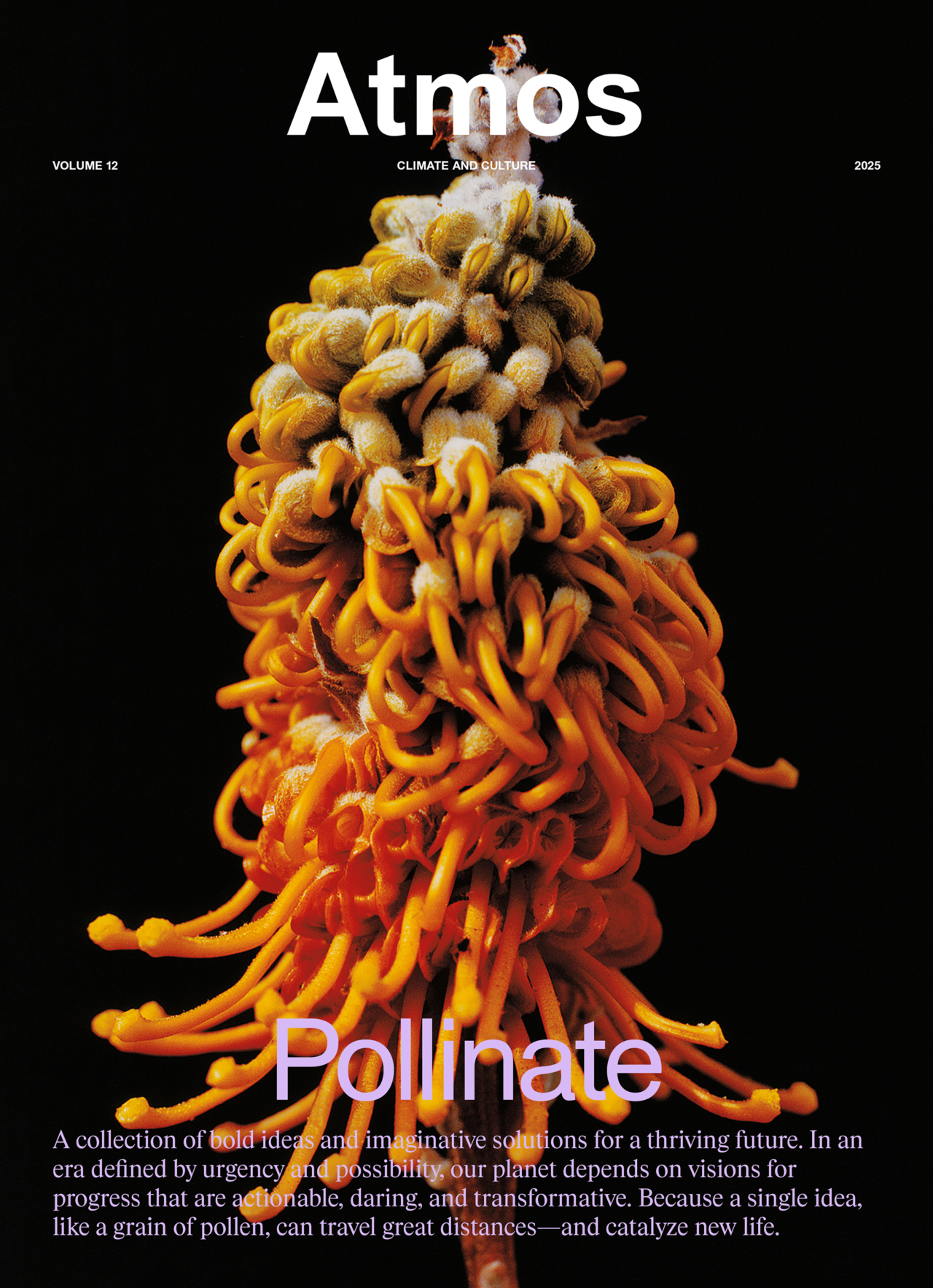
This story first appeared in Atmos Volume 12: Pollinate with the headline, “What If the Economy Was Modeled After Ecology?”
A collection of bold ideas and imaginative solutions for a thriving future. In an era defined by urgency and possibility, our planet depends on visions for progress that are actionable, daring, and transformative. Because a single idea, like a grain of pollen, can travel great distances—and catalyze new life.
What If the Economy Was Modeled After Ecology?