



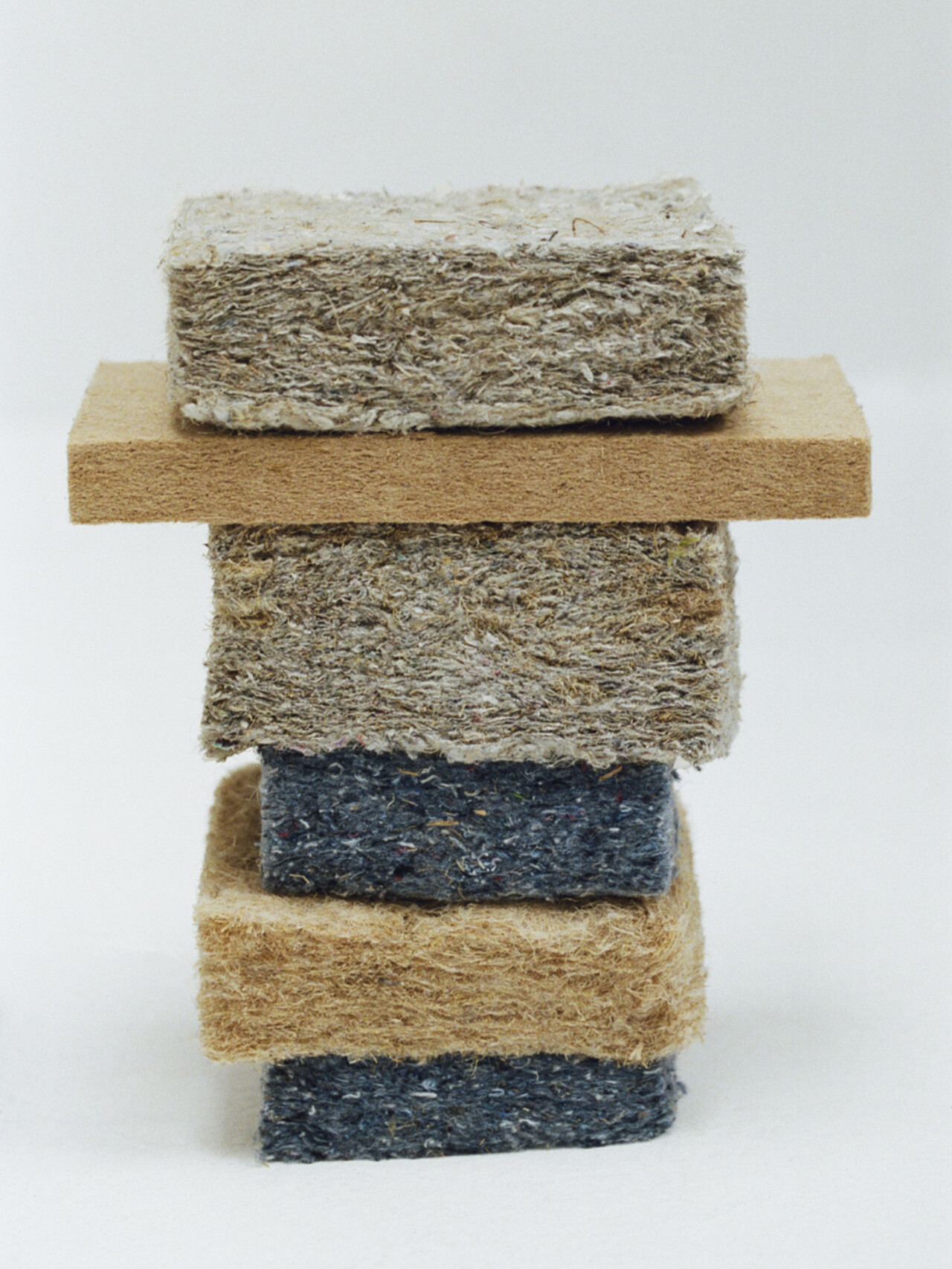

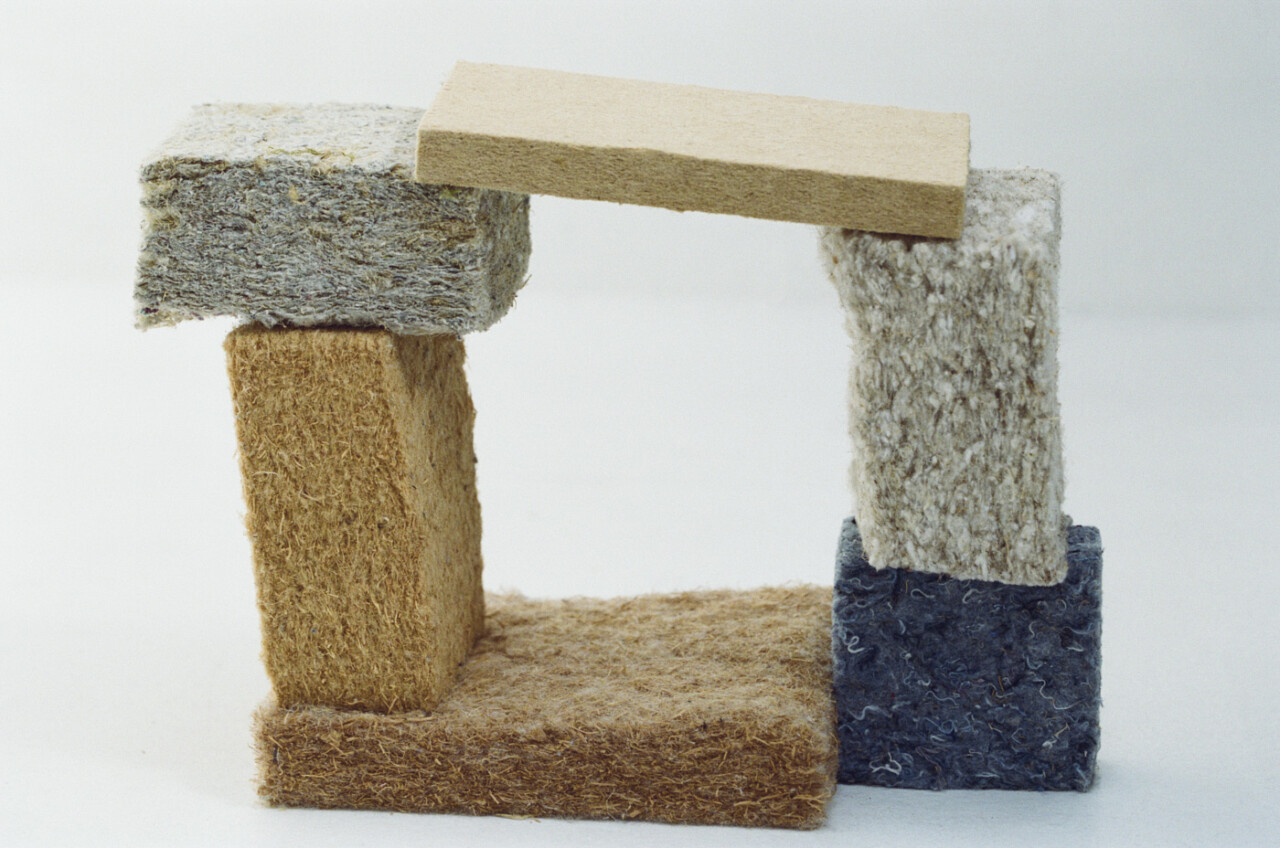
All visuals are conceptual interpretations of the topics discussed in this piece.
Words by Chris Baraniuk
photographs by ESTÉVEZ+BELLOSO
The winter rains were bad in Ireland this year; worse, even, than usual. But work can’t stop for that—there are houses to build and aging cottages to renovate. “The biggest problem we have here is it’s so damp,” said Ronan McDermott, director of Hempbuild, a building materials firm that supplies chunky construction blocks made mostly from hemp.
The blocks can’t support a lot of weight, but they’re strong insulators. Builders generally use them to form walls within a building’s frame or structure. “You avoid dampness, mold,” McDermott said, explaining that the hemp blocks help to regulate indoor humidity. “It’s my mission to bring this into Ireland.”
They’re easy to lay, like regular bricks or concrete blocks. “Once builders catch on to it,” he said, “there’s no great mystery.” Hempbuild is working on two houses in Dublin and recently built a large house in County Louth. Even so, McDermott acknowledged, construction blocks made from plant-based materials, such as hemp, are still uncommon in this part of the world.
Elsewhere in Europe, however, these blocks are starting to gain traction. They’re going into large commercial buildings, apartment complexes, and other big projects.
Hemp is just one example of a bio-based building material: products made partly from biomass, usually from plants, that can store carbon—taken up by those plants while they were alive—for long periods of time. That’s a striking contrast to many mainstream materials, especially aluminum, cement, and steel, whose production generates significant carbon emissions.
Wood is the most common bio-based material—practically everyone has some in their home. But it’s hardly the only option, and it might be wise to avoid overusing wood given the impacts of deforestation. In addition to hemp, straw and bamboo serve as versatile building materials, while seed husks can be ground up, bonded together, and pressed to form cladding panels. Some builders also now use blocks made from compressed earth.
In the West, these materials were for years mostly confined to a niche world of one-off “eco-homes,” the kind featured on TV or in magazines, which have little impact on the wider construction industry. That’s beginning to change. Proponents of bio-based building methods have become savvier, creating user-friendly products marketed for their versatility and ability to make homes more energy efficient.
If these materials go mainstream and adoption spreads, we might soon see entire cities built, in part, from plants and earth.
Hemp blocks are designed, above all, to facilitate faster construction with hemp and lime. When mixed, the materials form hempcrete, an insulating but breathable material that allows moisture to move through.
“The problem is, working with lime is an insanely long process,” said Gaëtan Dujardin, export sales manager at IsoHemp, the company supplying McDermott with the hemp blocks he uses in Ireland. After hemp and lime are mixed and molded, the blocks can take six to 10 weeks to dry. IsoHemp handles that slow-curing step, then ships the blocks once they’re ready to build with.
Despite its name, hempcrete has different applications from concrete and cannot support very heavy loads. Even so, Dujardin is quick to list hemp’s selling points. Beyond insulation and breathability—properties that have been evaluated in scientific studies—he said the blocks also significantly reduce outdoor noise, making interiors quieter. They are also resistant to fire.
IsoHemp’s blocks have already been used in large residential buildings, supermarkets, and even wine stores on vineyards. In southwestern France, a six-story apartment building is being erected with hemp-block walls.
Much of Dujardin’s job involves convincing people that hemp blocks are right for their project. He regularly fields questions about the benefits or durability of the blocks; and in some European countries, he encounters regulatory barriers that slow down adoption. But the resistance, he said, sometimes goes deeper. “People are afraid to change,” Dujardin said. “I have to accept it—but I’m really frustrated about it. There are ways to [build] better than we do now.”
“Building better” can mean a lot of things. From a decarbonization standpoint, bio-based materials have a clear appeal: The carbon that plants pull from the atmosphere as they grow can—if those plants are used to make buildings—remain stored for decades, even centuries. Ljubomir Jankovic, professor of energy and buildings at the University of Salford, cites data suggesting that concrete’s embodied emissions—those produced during manufacture—vary widely, but can range from roughly 8 to 87 pounds per cubic foot, depending on the mix and density. The United States average is around 18.5 pounds of CO2 emissions per cubic foot.
Hemp-lime materials, on the other hand, combine processing emissions with the carbon stored in the plant material, meaning they can lock away significant amounts of carbon. One cubic meter of hemp-lime in the form of hempcrete has negative embodied emissions, equivalent to about -108 kilograms of CO2 (-238 pounds), according to a 2008 book on the subject. Research suggests that straw bale materials can also be carbon negative.
Government policy is accelerating the shift to materials like these. Charlotte Taylor, a PhD candidate at the University of Bath researching the use of straw in buildings, noted that France since 2022 has required public buildings to be constructed using 50% bio-based materials.
The growing pressure to decarbonize buildings is already pushing designers and architects toward bio-based materials, said Lola Ben-Alon, an assistant professor at the Columbia University Graduate School of Architecture, Planning and Preservation. “I have no doubt that it will really grow exponentially in the next couple of years.”
But for bio-based products to gain widespread adoption, they must be easy to use.
Taylor once helped build a home out of straw bales on Scotland’s Isle of Skye. The process, she said, involved shaping the bales with a chainsaw. “To do that at scale—it would take ages,” she added. Still, she called straw a wonderfully “comfy” material, and, like hemp, it is valued for being both breathable and insulating. When tightly compressed, it is also surprisingly difficult to burn.
In Europe and the U.S., companies are now selling timber panels stuffed with chopped straw, made to order. They can be shipped to building sites and screwed together like a kit.
“If it’s not easy to put up, then people don’t care,” said Chandler Delinks, sales director at Modern Mill, a Mississippi-based building materials company that makes ACRE, a construction block made from ground-up rice husks and PVC. ACRE is used for cladding, window trim, porch floors, fencing, and outdoor showers, among other applications. Among the large projects currently installing ACRE is a 42-dwelling townhouse complex at Loon Mountain Ski Lodge in New Hampshire.
Separately, in Mexico, Anteros Regenerative Building Solutions makes compressed earth blocks, sold under the name EarthBlock. “Earth is unique in its thermal qualities,” said Andrew Tuck, the company’s founder. The blocks, he said, help keep interiors cool on hot, sunny days. Producing a cubic ton of them requires only about 19 gallons of water, and the material used can vary: soil excavated on-site, for example, or byproduct from a quarry. Projects now underway using EarthBlock include a 26-home development in California and a hotel complex in Mexico, Tuck said.
“If these materials go mainstream and adoption spreads, we might soon see entire cities built, in part, from plants and earth.”
Other bio-based materials are also drawing interest. One is Typha, a wetland plant with long, tough leaves that can be dried, ground, and compressed into cladding panels. The material can actually “bond itself,” becoming extremely durable, said Anthony Hudson, founder and creative director of Hudson Architects in England. “Under intense pressure, you can make fantastic boards,” he added.
In the United Arab Emirates, design studio Datecrete is using pulverized waste date seeds combined with a “natural binder system” to make a concrete-like material. Pavers made with datecrete appeared at the 2025 World Exposition show in Osaka, Japan, and were designed to cope with heavy footfall and a significant volume of rain. However, datecrete is not yet used for structural applications. “Any movement in that direction would require a separate program of mechanical characterisation, durability testing, certification, and engineering validation,” said co-founder Sara Farha.
Then there’s bamboo, which has been used as a traditional, bio-based building material for millennia. Architects and engineers are increasingly re-forming it into products suited to contemporary construction. In China, the world’s first seven-story building featuring engineered bamboo—the Ninghai Bamboo Tower—was recently completed.
One hurdle, experts say, is that engineered bamboo, like various bio-based building materials, isn’t well represented in building codes or regulations. But one of bamboo’s biggest advantages is how easily it can be produced, according to David Trujillo, an assistant professor in humanitarian engineering at the University of Warwick, who recently authored a structural engineering manual for bamboo. “This is something that grows extremely quickly,” he said. “You can harvest it in three years.”
Material choice isn’t only about performance. A key question when selecting specific materials is whether a local, reliable supply of hemp, straw, or bamboo is available. Prefabricated panels or blocks may need to travel long distances, which can add emissions that erode some of the climate benefits.
Tuck said mobile “micro plants” produce his compressed earth blocks, and that these facilities can even repurpose earth dug during foundation work. “We see ourselves scaling through these micro plants,” said Tuck. “We don’t see this as a centralized large plant that then ships product around a country.”
There’s also the issue of additives. Many products combine biomass with other materials that are not bio-based. ACRE, for example, is roughly 50% ground-up rice husks, said Delinks, but the rest is PVC, a type of plastic made from chlorine extracted from saltwater and polymers from natural gas. Delinks is quick to add that ACRE does not contain phenol, formaldehyde, adhesives, volatile organic compounds, or forever chemicals. When asked whether ACRE could one day include a bio-based alternative to PVC, he said: “There’s just not the availability and scalability of those [materials] yet.”
Even with trade-offs, proponents argue bio-based building products are still a climate upgrade over conventional materials, especially when they displace concrete-heavy assemblies. The biggest gains may come when materials are sourced close to where they’re used. In Ireland, for instance, hemp already has various industrial uses and is already grown by local farmers.
“I feel like the farmers hold the keys to a building boom—they are the quarry,” said McDermott. “They could be the backbone of the construction industry, while sequestering carbon and rejuvenating the soil. It’s such a win-win situation.”
Set Design Chloe Barriere
Join our membership community. Support our work, receive a complimentary subscription to Atmos Magazine, and more.
How to Build Cities Out of Plants and Earth