



Words by Jake Hall
Artwork by Enigmatriz
The environmental toll of today’s artificial intelligence boom is by now well-known. Energy-intensive data centers are proliferating at a quickening rate, spewing pollution and draining power grids. In communities already burdened by inequality, residents are fighting tech giants for their right to breathe clean air. Yet even as AI’s climate costs mount, so too does our reliance on it, which today spans everything from slop content to image generators trained on the work of non-consenting artists.
These technologies are, for better or worse, here to stay. But the future they’re shaping is still up for grabs. “The reality is that AI can also be leveraged as a tool to accelerate climate action in many ways,” said Roberta Pierfederici, a policy fellow at the Grantham Research Institute on Climate Change and the Environment.
Just last summer, a study in npj Climate Action, which was co-authored by Pierfederici, offered a rare counterpoint to the gloomy headlines by breaking down AI’s enormous potential to cut carbon emissions. Focusing on just three sectors—transport, meat and dairy, and light road vehicles—the researchers found that AI advancements could reduce global greenhouse gas emissions by 3.2 to 5.4 billion metric tons annually by 2035, enough to outweigh all projected global data-center emissions in the same timeframe. And that’s only one of the ways proponents argue AI could help curb the climate crisis.
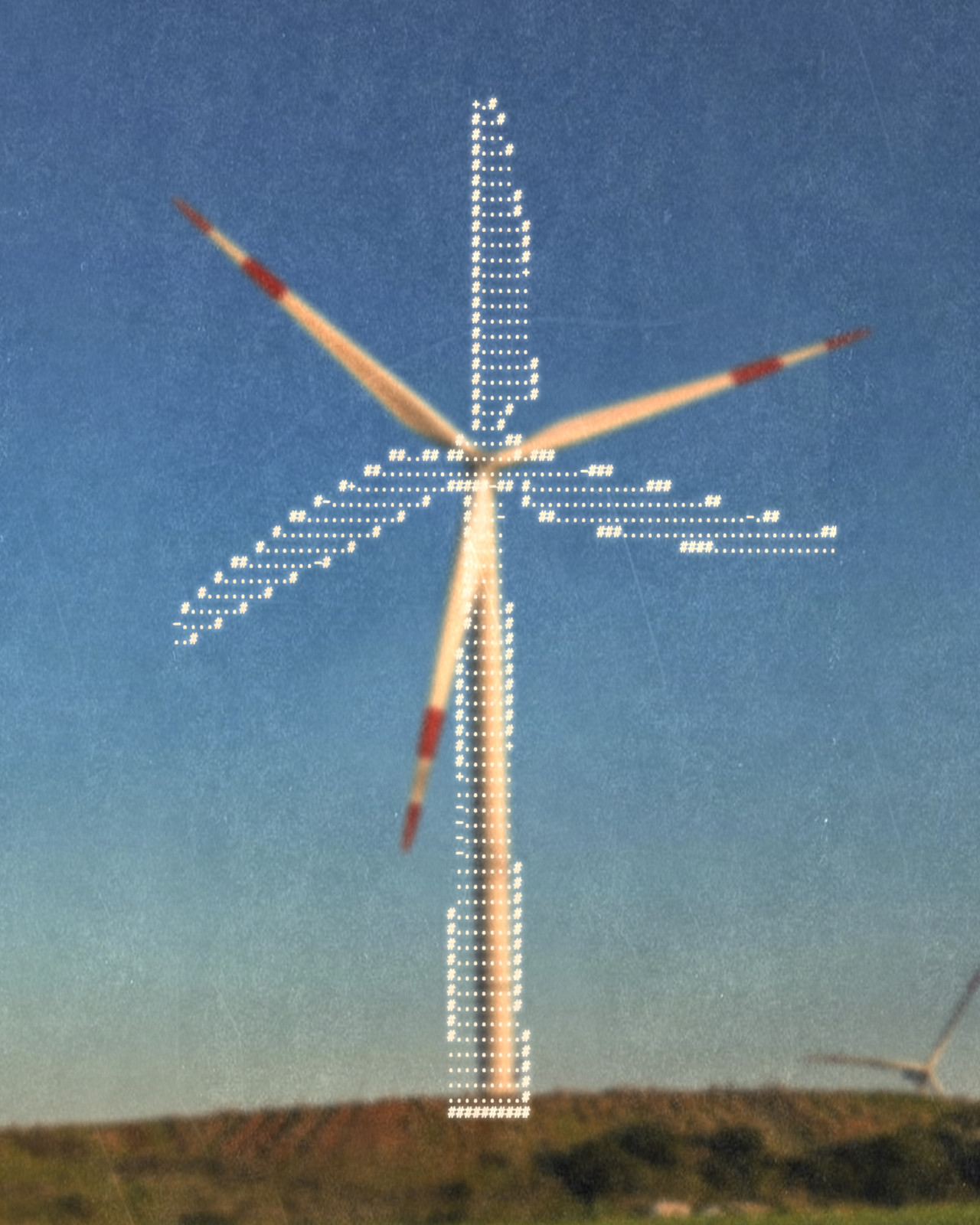
Pierfederici’s estimate comes with an asterisk. It assumes these technologies will eventually be deployed for public benefit, rather than for more extraction, as is currently the case. But AI is fast becoming a new layer of essential infrastructure, woven into how we govern, build, move, eat, and power our homes. What follows is a question of control and power—and possibility. Despite the prevailing narrative, AI is neither a climate villain nor a climate savior. It’s a catalyst. The question we’re left with is what, exactly, we’re choosing to amplify.
Some of the most consequential AI applications are already running in the background.
In a bid to mitigate short-term climate risks and cut back on waste, AI systems are being deployed, for instance, to more accurately predict extreme weather events, leading to earlier warnings that can prove life-saving. Across cities, AI models are retiming traffic signals by analyzing traffic in real time, cutting down idling emissions. In commercial kitchens, AI-powered trash cans are helping supermarkets and chefs reduce food waste. Meanwhile, scientists and conservation groups are pairing satellites with machine-learning models to generate ecological simulations that show how ecosystems might evolve across potential future climate scenarios and how they can become more resilient.
AI could also accelerate the transition to green energy. Renewable energy infrastructure, led by solar, blew open in the last decade and is on pace to grow nearly three times as quickly from 2024 to 2030 as it did between 2017 and 2023. But the transition from fossil fuels is rife with bureaucracy in places like the U.S., and connecting new energy projects to outdated power grids comes with a host of issues.
“One of the biggest challenges in integrating more renewables into the grid is their intermittency,” said Pierfederici. These energy sources are weather-dependent, too, which can present problems when it comes to forecasting. AI could overcome these obstacles by “improving electricity demand forecasting and managing supply from variable renewable sources,” she added, enabling a smoother transition to green power grids.
These examples are early steps. “There’s longer-term potential for even more transformative uses, like AI for material discovery and design,” Pierfederici said, citing Google DeepMind’s GNoME project as an example. The pioneering research tool predicted 2.2 million new crystal structures, including 380,000 materials stable enough to power next-generation superconductors and batteries. Such materials are crucial for scaling electric vehicles and renewable power, sectors currently constrained by high-emissions supply chains riddled with human rights violations.
“Despite the prevailing narrative, AI is neither a climate villain nor a climate savior. It’s a catalyst.”
The lack of long-duration batteries is another reason renewables still aren’t used to their full potential, making these material breakthroughs yet another way AI could speed up a sustainable energy transition.
A narrow, public imagination about AI adds to confusion around the technology’s climate role. “I do feel like public discourse around AI is focused solely on large language models and their consumer applications,” said Tara O’Shea, managing director of the Natural Climate Solutions Initiative at Stanford’s Woods Institute for the Environment, who has been working with AI since 2017. “The reality in my world is that machine learning is so much more than that. We can make datasets talk to each other in new ways, to find correlations and insights that we had previously been missing.”
O’Shea recently co-developed a system that maps forest structure and carbon stocks over time. The result is a far more accurate picture of how much carbon forests actually store, and how quickly they’re losing it. “We intuitively understand that healthy ecosystems provide all of these services, but we don’t really measure, let alone value, those things,” she said. “Now, we have this high-resolution, remotely-sensed data, as well as 3D data, and you can train a machine to correlate those data sets. Instead of having to do annual indirect estimates, which, for a long time, were all we could technologically do, we can now do a much more real-time direct estimation.”
That shift from inference to measurement has consequences beyond science. It’s long been known that forests are crucial carbon sinks, but reliable data showing their ecological value can now be used to drive global policy decisions. It could even earn payouts for developing nations preserving their forests, as part of the newly announced Tropical Forest Forever fund. This wealth redistribution is crucial, especially for Indigenous communities who have long stewarded Earth’s most efficient carbon sinks for no reward.
“As we get better at these models, they’re just telling us things that Indigenous science has been saying all along,” said O’Shea. “But there still needs to be more equity and access in how these models are trained and validated, which comes down to data governance issues. Indigenous communities must have a role in, and they must be compensated for, the collection and provision of training and validating data.”
Researchers are already using AI to generate better environmental data, guide climate policymakers, accelerate the much-needed green energy transition, and discover breakthrough materials across construction, agriculture, and energy systems. But many of those benefits will depend on how the technology is governed. AI is being deployed inside the same unequal society that helped produce the climate crisis in the first place, and without regulation the pattern risks becoming all too familiar.
Sergio Izquierdo, a photographer, filmmaker, and co-founder of Rescue the Planet, has spent years working with communities hit disproportionately hard by the climate crisis. Although AI isn’t “the largest direct driver” of the pollution, he told Atmos, his Plasticsphere documentary underlined how “algorithm-driven marketing, targeted advertising, and automated production chains accelerate resource extraction and waste.” And then, of course, there are data centers.
Izquierdo has heard many experts describe AI’s potential, but the technology is still far from delivering real-world impact. It’s “mostly a promise rather than a real driver on the ground,” he said. Scaling it responsibly, he emphasized, will require “strong guardrails.”
Even so, Izquierdo’s research into AI reveals high-impact opportunities. “During the making of Plasticsphere, we realized how little data exists on the quantity and pathways of plastic in rivers and coastal systems,” he said. Acquiring this data could improve cleanup strategies and, when “combined with policy pressure, this could help shift entire waste-management systems, especially in developing countries,” he added.
Though Pierfederici’s research shows just how game-changing AI could be in the climate fight, she’s also clear about the risks. Fossil fuel companies are already deploying AI to “optimize their exploration and extraction activities,” she said, underlining the importance of AI governance, which will inevitably come over the next few years. “It’s crucial that this be shaped by governments as leaving this solely to private companies does not ensure that AI applications are directed towards public goods,” she said.
That tension between promise and misuse is what defines the current moment.
Decarbonizing data centers is technically possible; companies like Meta have invested in matching their data center emissions with renewable energy. And at COP30, negotiations zeroed in on cutting the emissions of cooling technologies, an urgent priority given the global race to build more data rooms. The climate talks even saw the launch of an AI Climate Institute, billed as a tool to empower Global South countries to create their own AI-powered climate solutions. But these fixes take time. “What it really comes down to, is that we have to move capital toward ecosystem preservation or restoration,” said O’Shea, “and we have to stop capital from going in the wrong direction.”
Like anything, AI doesn’t exist in a vacuum. It could become one of the most powerful tools we have to confront climate breakdown if it’s governed, funded, and deployed with that purpose in mind. Instead, we’re watching power grids strained so companies can train ever-larger models in pursuit of profit. And so, the question remains: Will AI become another frontier of extraction? Or one of the most valuable resources we have to stabilize a warming world? There is a version of the future in which AI accelerates renewable energies, helps clean up oceans, and prevents deforestation. That world is still possible—if we choose it.
Join our membership community. Support our work, receive a complimentary subscription to Atmos Magazine, and more.
AI Is Making The Climate Crisis Worse. It Could Also Help Fix It.